Embodied Presence: 7 Ways to Be Truly Present in Your Body

We hope you enjoyed reading and learning more about the body and mind. If you would like to connect with our experts, click here
Author: Glenn Hall | Co-Founder of SomaFlow™ Institute
Embodied presence means staying connected to your body while experiencing the present moment. You notice your breathing, movement, balance, weight, tension, and physical sensations as they happen.
Yet daily life can pull your attention away. You may spend hours working without noticing your posture, move through tasks on autopilot, or carry tension without realizing it.
Embodied presence offers a simple way back. Instead of trying to stop your thoughts or immediately change your body, you begin by noticing. Feel your feet as you stand, your breath as you work, or your weight as you walk.
At SomaFlow™ Institute, we offer the Embodied Core Awareness Course, where you can explore embodied presence through guided movement and focused attention.
The course helps you develop greater awareness of your body, movement, and physical experience.
What Does “Embodied” Mean?
The word embodied points to the fact that you experience life through your body.
Your thoughts do not exist separately from your physical experience.
Nervousness may show up as a faster heartbeat or changes in your breathing. Concentration can make you hold your breath or tighten your shoulders. As you prepare to move, your body naturally gets ready for action.
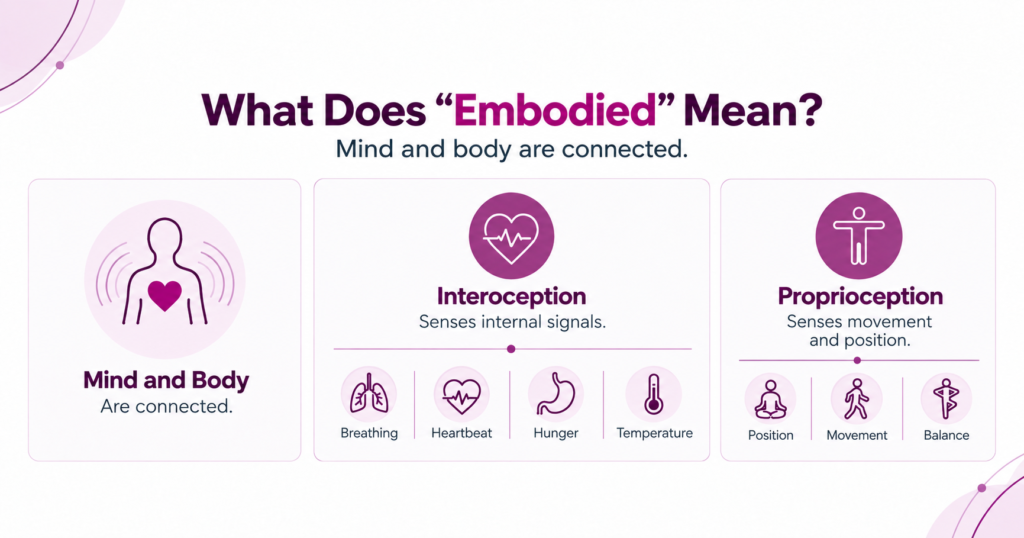
Research on interoception helps explain part of this connection.
Interoception refers to the way your nervous system senses, interprets, and integrates signals from inside your body.
These signals can include information connected with breathing, heartbeat, hunger, temperature, and other internal states.
Your body also gives you information about movement and position through proprioception. Proprioception helps you sense where your body is and how it moves.
Together, these systems give you information about your physical experience.
Embodied presence starts when you become more aware of that information.
It can become part of ordinary activities, helping you notice your breathing, movement, balance, and physical sensations as you move through everyday life.

A Different Way of Working With the Body
SomaFlow offers an approach centered on embodied practice and facilitation that many practitioners find more sustainable over time, prioritizing awareness, adaptability, and working with the body rather than against it.
How to Be Truly Present in Your Body?
Embodied presence does not require a long meditation session or a complicated routine.
You can practice it during ordinary moments by bringing your attention back to what you are physically experiencing.
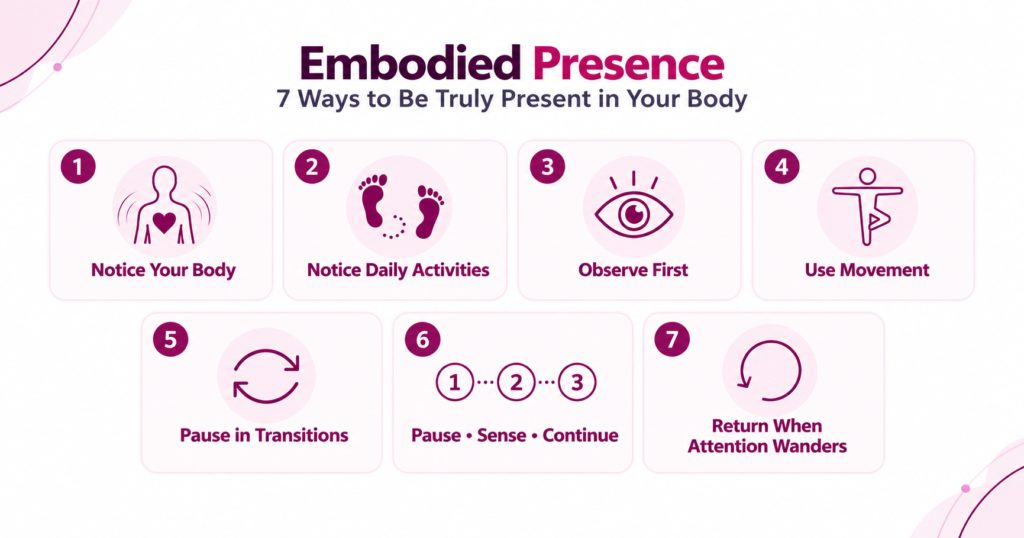
1. Notice Your Body Instead of Staying Only in Your Thoughts
Your attention can spend a lot of time in thoughts about the past or future. Embodied presence gives you a way to return to what is happening right now.
Start by noticing simple physical sensations.
Feel your feet against the floor. Notice your breathing. Sense your hands, shoulders, jaw, or the support beneath your body.
You do not need to change anything. Simply notice what you can feel.
For example, while sitting at your computer, you might realize that your shoulders have moved upward and your jaw feels tight. Instead of immediately trying to correct your posture, take a moment to notice these sensations.
That simple act of noticing brings your attention back to your body.
2. Notice Your Body During Everyday Activities
You do not need to stop what you are doing to practice embodied presence. Everyday activities already give you many opportunities to notice your body.
Notice how your feet connect with the ground as you walk.
Pay attention to your weight shifting as you reach for ingredients in the kitchen.
As you type, become aware of the movement in your hands and fingers.
Sitting at your desk, feel the support beneath your body.
These small observations can help you experience familiar activities in a new way.
For example, you may discover that you always lean toward one side when you stand at the kitchen counter. You do not have to change the habit immediately. First, notice it.
3. Observe Before You Try to Change
Many people notice something in their body and immediately think about how they should fix it.
Embodied presence starts somewhere else.
Observe first. Change later, if change feels appropriate.
If you notice tension in your shoulders, simply explore the sensation. Where do you feel it? Does it change when you breathe? Does it feel different when you move your arms?
If one side of your body feels different from the other, notice the difference without deciding that one side is wrong.
This approach creates space for curiosity. It reflects an important part of the relationship between mindfulness and awareness: noticing an experience without automatically trying to change it.
4. Use Movement to Return to the Present
Movement can give your attention a direct connection to the present moment.
You can notice how your body moves when you stand, sit, walk, reach, turn, or shift your weight.
Try standing still for a moment.
Feel where your weight rests on your feet. Then slowly move your weight from one foot to the other. Notice what changes.
You may feel more pressure under one foot. You may notice that one direction feels more familiar. You may notice changes in your balance or breathing.
You do not need to make the movement perfect.
The purpose is to experience the movement while it happens.
5. Pause During Transitions
Some of the easiest opportunities for embodied presence happen between activities.
A meeting ends, and your first instinct is to check your email. On the way home, your mind shifts to everything waiting for you. Before you have time to pause, one task gives way to the next.
Instead, use these transitions as small moments to return to your body. Before starting the next activity, pause for a few seconds.
Feel your feet. Notice your breathing. Sense your posture.
Notice how you feel as you move from one activity into another. You can do this before entering a meeting, after closing your laptop, before getting into your car, or when you arrive home.
You do not need to add another task to your day. Simply give yourself a moment to arrive in the next one.
6. Practice “Pause, Sense, Continue”
A simple way to bring embodied presence into your day is to follow three steps:
- Pause. Stop for a few seconds.
- Sense. Notice one or two physical sensations. Feel your feet, breathing, hands, shoulders, or the surface supporting you.
- Continue. Return to whatever you were doing.
For example, before answering a difficult message, pause. Feel your feet on the floor. Notice your breathing. Then read or answer the message.
You do not need to create a particular feeling. Give yourself a moment to notice your physical experience before continuing.
7. Return When Your Attention Wanders
You will not stay connected to your body every moment.
Your mind will wander. You will become absorbed in work. You will start thinking about something that happened yesterday or something that might happen tomorrow.
That does not mean you have failed at embodied presence. The practice is in the return.
Notice that your attention has moved away. Then bring it back to one simple physical sensation.
Feel your feet. Notice your breath. Sense your hands. Feel the movement of your body. Then continue with your day.
Embodied presence is not about maintaining perfect awareness. It is about developing the habit of returning to your physical experience, again and again.
Explore Embodied Presence With SomaFlow™
Embodied presence begins with a simple idea:
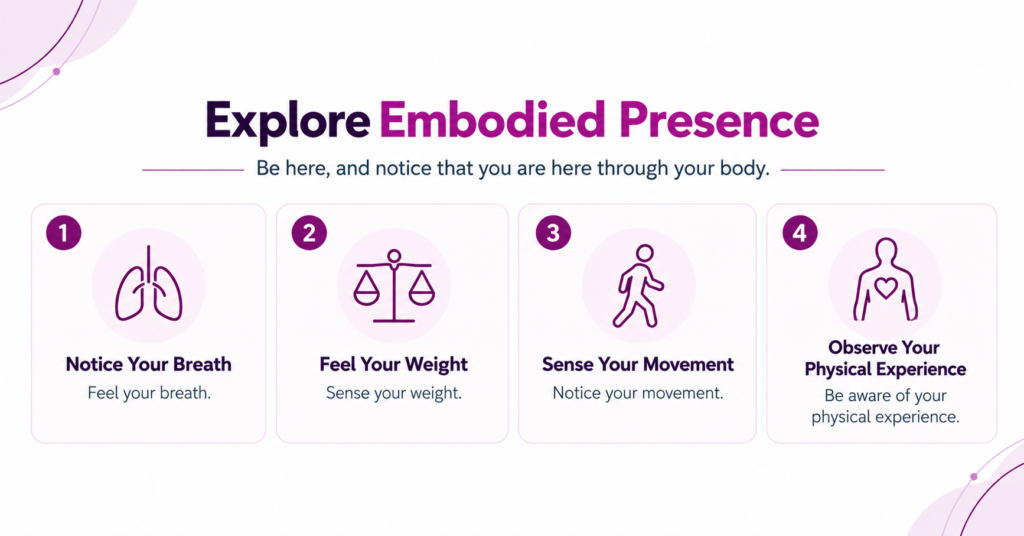
Be here, and notice that you are here through your body.
You do not need to force a change. You can begin with curiosity. Notice your breath. Feel your weight. Sense your movement. Observe your physical experience.
At SomaFlow™ Institute, somatic movement and embodied practice create opportunities to explore these experiences through gentle movement, attention, and guided learning.
If you want to develop a deeper understanding of embodied awareness and movement, explore the SomaFlow™ approach and learn how embodied practice can become part of the way you experience everyday life.
Frequently Asked Questions
Is embodied presence the same as mindfulness?
They overlap, but they are not exactly the same. Mindfulness can include awareness of thoughts, feelings, sounds, and surroundings. Embodied presence places special attention on physical experience and the body.
What is interoception?
Interoception describes how your nervous system senses and processes signals from inside your body. Researchers study interoception in relation to bodily regulation, emotion, self-awareness, and other aspects of human experience.
What is proprioception?
Proprioception helps you sense your body’s position and movement. It helps you know where your limbs are and how your body moves through space.
Can I practice embodied presence during work?
Yes. You can notice your feet, hands, breathing, posture, or physical sensations for a few seconds while you work. You do not need special equipment or a separate practice space.
Do I need to meditate to develop embodied presence?
No. You can practice through ordinary activities such as walking, sitting, working, cooking, or moving between tasks.
About the Author
Glenn Hall
Glenn Hall knows what it’s like to live with pain. Born with a serious back condition, he grew up dealing with stiffness, poor posture, and discomfort that never fully went away. Later in life, his challenges intensified: he suffered two complete biceps tears and two supraspinatus muscles retracted off the bone.