Posture Awareness Through Movement: Notice Your Body Better!

We hope you enjoyed reading and learning more about the body and mind. If you would like to connect with our experts, click here
Author: Glenn Hall | Co-Founder of SomaFlow™ Institute
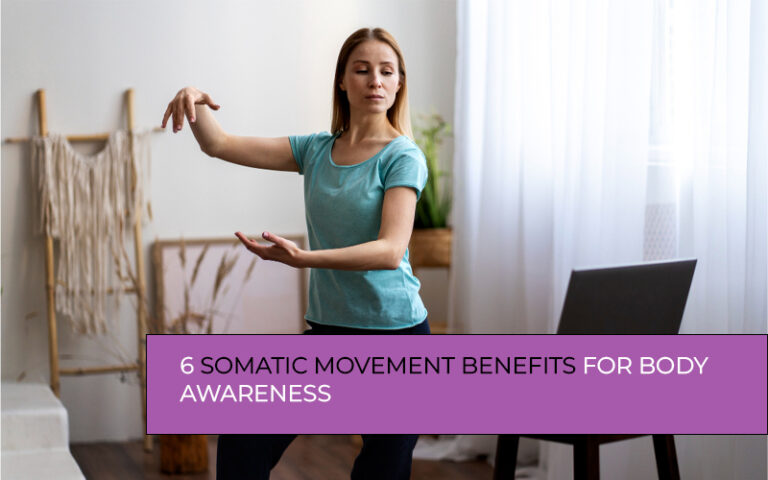
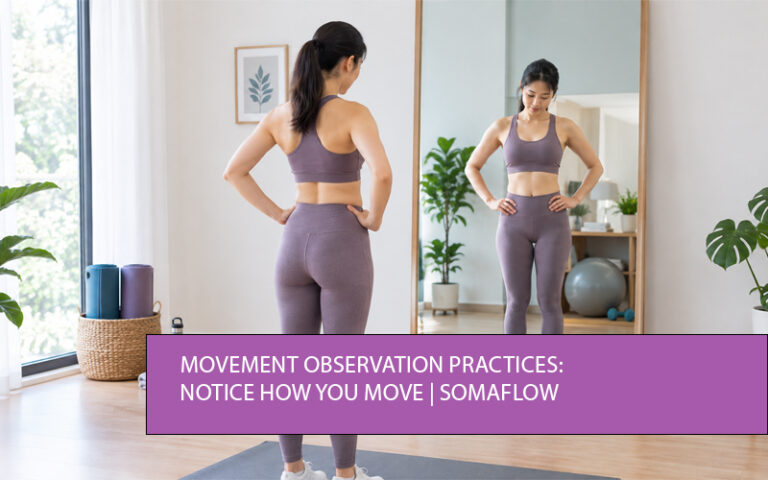
Posture awareness means noticing how your body sits, stands, balances, and moves. Gentle movement can help you notice your body position, weight, tension, and everyday movement patterns.
The problem is that most people move on autopilot. You may lean on one leg, lift one shoulder while typing, or move your head forwards when using a screen without noticing it.
Movement brings these habits into your awareness. By slowing down and paying attention, you can notice how your feet, pelvis, spine, and breathing respond as you move.
At SomaFlow™ Institute, we use gentle somatic movement to help people explore these patterns. Instead of forcing the body into a “correct” posture, you learn to notice what your body already does.
Enroll in our Embodied Core Awareness Course and learn how to build greater posture awareness through movement, understand your body’s patterns, and move with more ease.
What Is Posture Awareness?
Posture awareness means knowing how your body is positioned while you sit, stand, or move.
Researchers also use the term postural awareness. They describe it as your conscious awareness of your own body posture. Proprioception plays an important role because it helps your brain sense the position and movement of your body.
In simple words, posture awareness helps you answer questions such as:
- Where is my weight right now?
- Am I leaning to one side?
- What are my shoulders doing?
- How is my head positioned?
- Am I holding my breath?
- Where do I feel tension?
- Does one side move differently from the other?
You do not need to answer all these questions at once. You simply start noticing.
For example, imagine you are waiting for coffee. You look down and realise that almost all your weight sits on your right leg. You did not choose that position. Your body simply went there.
That moment is posture awareness. You noticed something your body was already doing.

A Different Way of Working With the Body
SomaFlow offers an approach centered on embodied practice and facilitation that many practitioners find more sustainable over time, prioritizing awareness, adaptability, and working with the body rather than against it.
Why Is Posture Awareness Important?
Most of us repeat the same movements every day. We use the same hand to hold our phone, sit in the same chair, carry a bag on the same shoulder, or cross the same leg when we sit.
Over time, these patterns can feel normal, so we stop noticing them. Posture awareness helps you notice these habits and understand how your body moves.
You may notice your shoulders rise when you feel stressed, your body lean forward while working, or your weight shift to one foot when standing.
Once you notice a pattern, you have more choices. You can change your position, move, take a breath, or simply decide that the position feels comfortable. Awareness comes before choice.
How Does Movement Improve Posture Awareness?
You can notice your posture while sitting still, but movement gives you more information.
For example, slowly turn your head to the right and notice what happens. You may feel your neck move, your eyes shift, your ribs respond, or one shoulder follow the movement.
Now turn to the left. Does it feel the same? Maybe one side feels easier, or you turn farther on one side.
Your breathing may also change. Slow movement gives you time to notice these small differences that you may miss when you move quickly.
A 2025 pilot study found that a 10-week somatic movement program improved spinal mobility in older adults and changed how some participants experienced movement in their spines. The study was small, with 15 participants completing the first assessment, so more research is needed.
The simple idea is this: movement gives you a way to learn about your posture instead of moving without noticing it.
What Does Posture Awareness Through Movement Feel Like?
Posture awareness does not always feel dramatic. Often, you notice very small things.
You may feel that:
- One foot carries more weight than the other.
- Your jaw tightens when you concentrate.
- Your shoulders move when you breathe.
- The pelvis shifts before you stand up.
- One arm swings more than the other while walking.
- You turn more easily in one direction.
- Your breathing becomes smaller when you tense your body.
For example, imagine you sit at your computer for an hour. You suddenly notice that your face has moved close to the screen and your shoulders feel lifted.
You could immediately tell yourself, “Sit straight.” But posture awareness gives you another option.
Move back slightly. Move forwards again. Notice the difference. Let your shoulders rise. Let them drop. Turn your head. Take a comfortable breath.
Now you know more about the position because you explored it. That is very different from simply correcting yourself.
Is Good Posture About Sitting Up Straight?
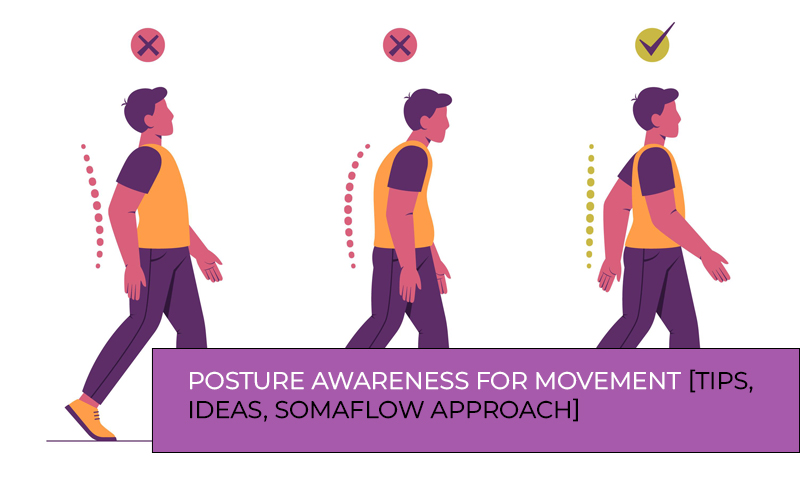
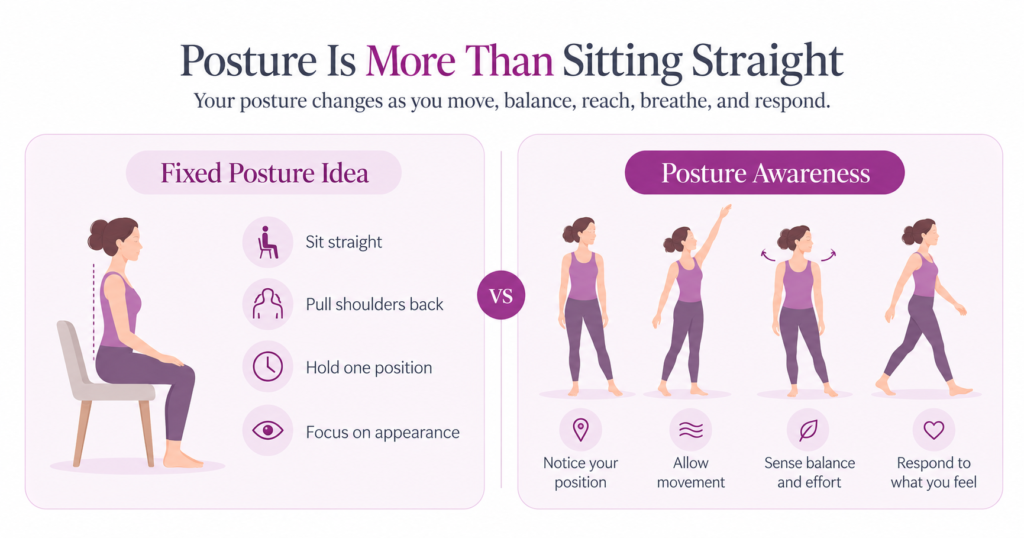
Not always. Many people think good posture means keeping the back straight, pulling the shoulders back, and holding the head upright. But your body needs to move, so you cannot stay in one position all day.
You bend forwards to read, turn to speak, lean back to rest, shift your weight while standing, and reach, twist, walk, and breathe throughout the day.
Your posture changes with what you do. Your nervous system also uses sensory information, including proprioception, to sense your body position and help you move and balance. This means posture is not just about how your body looks. It is also about how you sense and respond to movement.
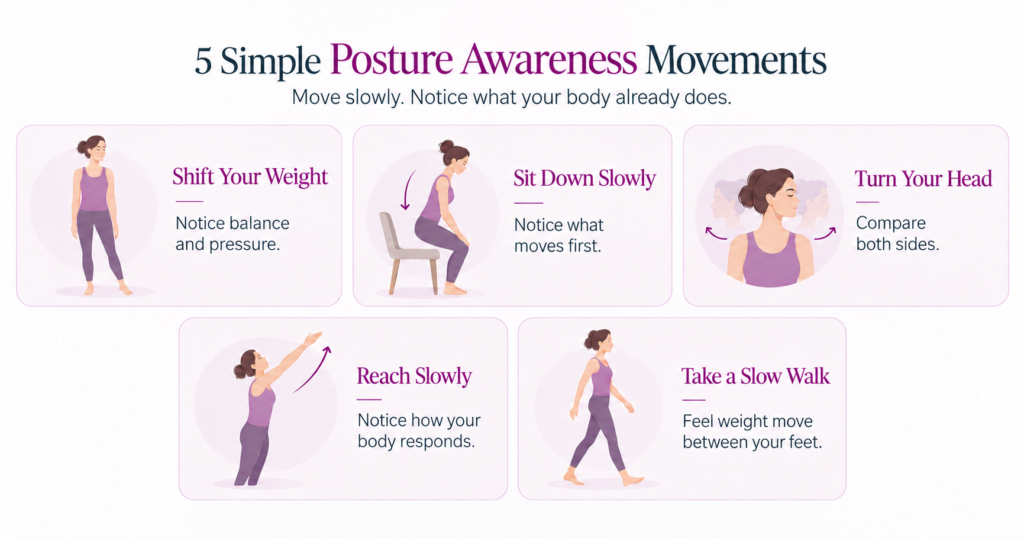
5 Simple Posture Awareness Exercises Through Movement
You do not need a mirror, special equipment, or a long workout. You can explore posture awareness through very small movements.
1. Shift Your Weight While Standing
Stand comfortably with both feet on the floor. Notice where you feel your weight.
Do you feel more pressure under your heels, toes, left foot, or right foot?
Slowly shift your weight towards one foot, return to the middle, and then shift towards the other foot.
Do not try to stand perfectly. Simply notice what happens.
Does your pelvis move? Does your spine change? Or does your head move? How does your balance feel?
This simple movement helps you notice how your body works together while standing.
SomaFlow also uses weight-shift exploration to bring awareness to balance, posture, standing habits, and weight distribution.
2. Notice How You Sit Down
Standing and sitting are everyday movements, which makes them useful for exploring posture awareness.
Stand in front of a chair and slowly sit down. Notice what moves first. Do you bend at your hips?
Does your head move forwards? Do your knees move? Does one foot push harder into the floor?
Now slowly stand up again. Paying attention to this simple movement can help you notice habits you may not have felt before.
3. Turn Your Head Slowly
Sit or stand comfortably and look forward. Slowly turn your head to one side, return to the middle, and then turn to the other side.
Notice more than your neck. What happens in your eyes, shoulders, chest, ribs, and breathing? You may notice that a simple head movement involves more of your body than you expected.
4. Reach for Something
Place an object in front of you and slowly reach towards it. Notice how the movement begins.
Does your arm move first? Does your shoulder move? Or does your chest move forwards? Do you shift your weight?
Now place the object slightly farther away and reach again. Changing the distance can help you notice how your body changes its posture to complete the movement.
5. Take a Slow Walk
Walk across the room at a comfortable pace.
Feel each foot meet the floor and notice how your weight moves from one leg to the other. Pay attention to your arms, pelvis, and breathing.
You do not need to change the way you walk. Simply observe it. Walking helps you experience posture as movement because your body keeps adjusting its position as you move through space.
How Are Posture Awareness and Proprioception Connected?
Proprioception is your sense of where your body is and how it is moving. It helps you know where your arms, legs, and joints are without having to look at them.
For example, you can touch your nose with your eyes closed or walk without watching your feet. Your muscles, joints, connective tissues, nervous system, and brain all provide information about your body position and movement.
Posture awareness uses this information along with your attention. Your body may know that you have shifted your weight onto your left foot, but you may not notice it until you pay attention.
This is why slow, focused movement can help. It gives you time to notice what your body is doing.
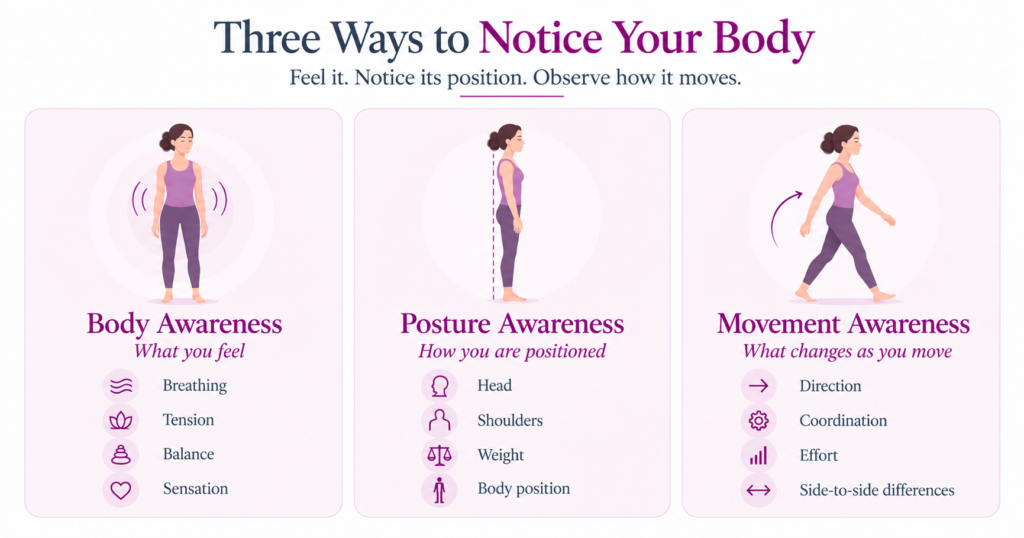
Posture Awareness and Body Awareness: What Is the Difference?
Posture awareness is part of body awareness. Body awareness includes many physical experiences, such as:
- Breathing
- Balance
- Muscle tension
- Physical sensation
- Movement
- Effort
- Body position
- Posture
Posture awareness focuses more closely on how your body positions and organises itself.
For example, body awareness may help you notice that your neck feels tense. Posture awareness may help you notice that your head has moved forwards and slightly to the right.
Movement awareness may help you notice what happens when you slowly bring your head back towards the middle.
The three ideas work together.
Can Posture Awareness Help You Notice Tension?
Yes. Posture awareness can help you notice tension before it becomes a habit. You might grip the steering wheel while driving, raise your shoulders while answering an email, or tighten your stomach before speaking in a meeting.
When you pay attention, you may notice these patterns sooner.
For example, while working on a difficult task, you may realise that your shoulders have slowly moved towards your ears. Instead of forcing them down, gently move them higher and then let them come down.
Notice the difference. This simple movement can help you feel how much effort you were using and become more aware of tension in your body.
The SomaFlow™ Approach to Posture Awareness
At SomaFlow™ Institute, we start with awareness, not perfect posture.
Through slow somatic movement, you explore how you sit, stand, shift your weight, breathe, balance, and move.
You may notice how your pelvis and spine work together, how your breathing changes as you move, or where you use more effort than you need.
You may also discover movement patterns that have felt normal for years. Through guided movement, observation, sensation, pacing, and direct experience,
SomaFlow™ approach helps you build greater embodied awareness of your posture, coordination, and movement.
You learn to feel what your body is doing, and that awareness gives you a place to begin.
Start With One Movement Today!
You do not need to change your posture all day. Start with one simple movement. Notice how you stand, sit, breathe, shift your weight, and move. At SomaFlow™ Institute, our somatic movement approach helps you build posture awareness through gentle movement and direct experience.
Browse through our courses to enroll and start understanding your body, movement patterns, balance, and posture with greater awareness.
People Also Ask
How can I improve posture awareness?
You can improve posture awareness by slowing down and noticing how your body moves. Try simple movements like walking, sitting, standing, reaching, or shifting your weight. Pay attention to your balance, breathing, and body position.
What is posture awareness training?
Posture awareness training helps you notice how your body sits, stands, balances, and moves. It may include slow walking, weight shifts, breathing exercises, and simple movements.
Can somatic movement improve posture awareness?
Somatic movement can help you notice your body and movement patterns through slow movement and attention. A small 2025 study found improved spinal mobility after a 10-week somatic movement program. More research is needed to understand its effects on posture awareness.
Is posture awareness the same as good posture?
No. Good posture describes how your body is positioned. Posture awareness means noticing how your body is positioned and how it changes as you move.
Why is movement important for posture?
Movement helps you notice how your body works while you walk, sit, stand, bend, reach, and breathe. It can help you notice changes in your balance, weight, breathing, and muscle effort.
About the Author
Glenn Hall
Glenn Hall knows what it’s like to live with pain. Born with a serious back condition, he grew up dealing with stiffness, poor posture, and discomfort that never fully went away. Later in life, his challenges intensified: he suffered two complete biceps tears and two supraspinatus muscles retracted off the bone.