5 Simple Movement Observation Practices for Body Awareness

We hope you enjoyed reading and learning more about the body and mind. If you would like to connect with our experts, click here
Author: Glenn Hall | Co-Founder of SomaFlow™ Institute
Movement observation means paying attention to how your body moves instead of moving through the day without noticing. You may notice how your feet meet the floor when you walk, how your shoulders move when you reach, or how your weight shifts when you stand up.
Most of the time, these movements happen automatically. You walk to another room, reach for a cup, sit in a chair, or turn your head without thinking about every part of the movement.
Movement observation gives you a chance to slow down and notice what is already happening.
At SomaFlow™ Institute, we use gentle somatic movement to help people explore movement through attention, sensation, and direct experience. Instead of asking you to perform a movement perfectly, you learn to observe what your body does and how the movement feels.
Explore the SomaFlow™ approach and learn how movement observation can help you become more aware of your body’s patterns, effort, balance, and coordination.
What Is Movement Observation?
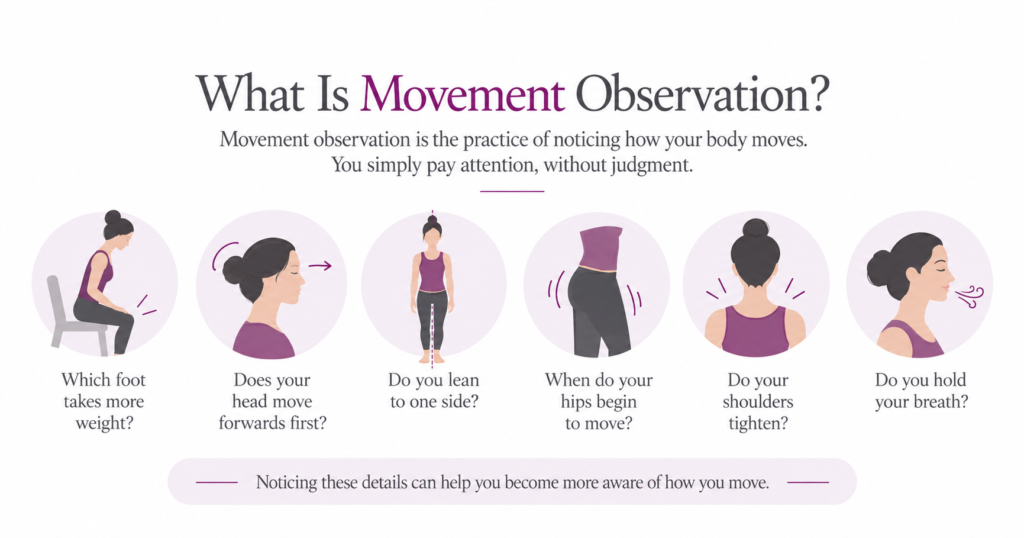
Movement observation is the practice of noticing how your body moves. You do not need to judge the movement or immediately change it. You simply pay attention.
For example, when you stand up from a chair, you could notice:
- Which foot takes more weight?
- Does your head move forwards first?
- Do you lean to one side?
- When do your hips begin to move?
- Do your shoulders tighten?
- Do you hold your breath?
- Does standing up feel easier on one side?
These questions can help you notice parts of movement that usually happen outside your attention.
Movement also gives your brain information about body position and motion. Proprioception helps you sense where your body and its parts are and how they are moving. Researchers describe proprioception as an important part of how we sense body position and movement.
In simple words, your body is constantly receiving information about movement. Movement observation helps you pay attention to some of that information.
Why Is Movement Observation Important?
Many of the movements we make every day are familiar.
Sitting at the same desk, picking up a phone with the same hand, climbing stairs, carrying a bag on one shoulder, or turning in the same direction when getting out of bed can all become automatic.
Because these movements feel normal, it is easy to stop noticing them. Movement observation brings attention back to these everyday patterns.
Learning more about posture awareness can help you notice these patterns with much better attention.
For example, imagine walking while talking on the phone. At some point, the right arm may swing freely while the left arm stays closer to the body.
There is no need to decide that one side is wrong.
Simply noticing the difference can reveal something about the way the body moves. Walking again while paying attention to both arms may show that the difference changes, stays the same, or feels different altogether.
Awareness does not mean that every movement needs correction. It simply gives you more information about what your body is doing.
How Does Movement Observation Work?
Movement observation often starts with a simple movement performed slowly.
Slowing down gives you more time to notice small changes in position, balance, breathing, muscle effort, and direction.
For example, slowly turn your head to the right.
Notice what happens in your neck. Then notice your eyes, shoulders, chest, ribs, and breathing. Now return to the middle and turn your head to the left.
Does the movement feel exactly the same?
Maybe one side feels easier. Maybe one side feels smaller. Or you notice your shoulder moving with your head.
You do not have to fix anything.
You are observing.
Our sense of movement involves information from several parts of the body, including muscles, joints, and skin. This information helps the nervous system understand body position and movement.
This is one reason small movements can provide useful information about how you move.
What Does Movement Observation Feel Like?
Movement observation does not have to feel unusual or dramatic. Sometimes you notice something very small.
You may notice that:
- One foot feels heavier than the other.
- Your jaw tightens when you concentrate.
- Your shoulders move when you breathe.
- The pelvis shifts before you stand.
- One arm swings more while walking.
- You use more effort than you expected.
- You turn more easily in one direction.
- Your breathing changes during a simple movement.
- A movement feels different when you slow it down.
For example, imagine you are reaching for something on a high shelf.
You could simply grab the object and move on. Or you could slow the movement down.
Notice your feet. Notice your weight. Feel your arm begin to move. Notice whether your shoulder, ribs, or spine also participate. Then reach again.
The second time, you may notice something you missed the first time. That is movement observation.
Movement Observation vs. Movement Correction
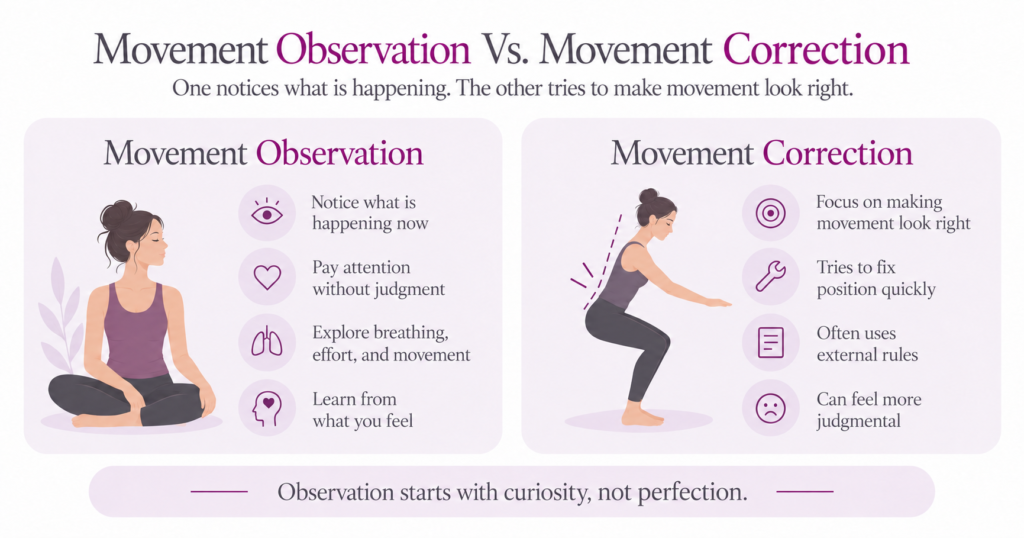
Movement observation is different from trying to make every movement look “right.”
When people hear the word posture or movement, they sometimes think about correction. They may think:
“Keep your back straight.”
“Pull your shoulders back.”
“Stand evenly.”
“Walk properly.”
Movement observation starts somewhere else. It asks:
“What is happening right now?”
Suppose you notice that your shoulders rise while you type. Instead of immediately forcing them down, notice what happens when you let them rise. Then let them soften.
Notice your breathing, your neck, and how much effort you use. You are not trying to create a perfect position. You are learning about the movement itself. This approach can make movement exploration more curious and less judgmental.
This kind of attention can also support a greater sense of embodied presence, where awareness comes from noticing and experiencing what is happening in your body.
5 Simple Movement Observation Practices for Body Awareness
Movement observation does not require special equipment, a mirror, or a long exercise session.
Everyday movements can become simple opportunities to notice balance, weight, breathing, effort, and coordination.
The aim is not to make every movement look the same. Instead, slow down enough to notice what happens before, during, and after each movement.
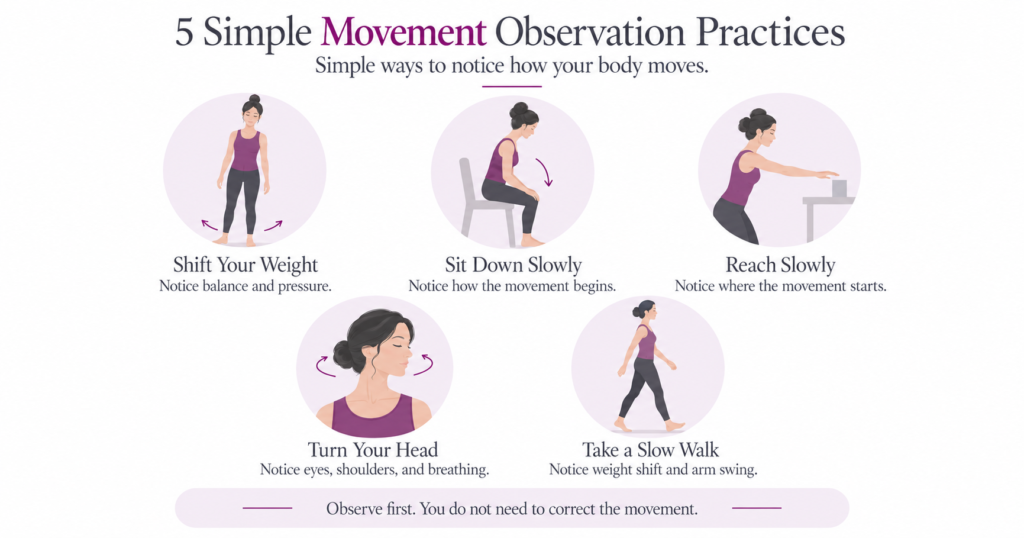
1. Shift Your Weight While Standing
Stand comfortably with both feet on the floor. Take a moment to notice where your weight rests.
Perhaps more weight sits under one foot. Maybe the pressure feels stronger through your heels, toes, or the outside edges of your feet.
Slowly shift your weight towards your right foot. Come back to the middle, then shift towards your left foot.
Notice what happens as your weight moves.
Does your pelvis shift or your spine respond? Does your head move? And what about your breathing change?
There is no need to make both sides feel identical. The difference itself can be useful information.
SomaFlow™ movement exploration uses weight shifts to help bring attention to balance, standing habits, weight distribution, and the way different parts of the body work together.
2. Observe the Movement of Sitting Down
Sitting down happens so often that most people barely notice it.
Stand in front of a chair and slowly lower yourself towards the seat. Pay attention to how the movement begins.
Do your hips move first? Do your knees bend together? Does your head move forwards? Does one foot press into the floor more than the other?
Then slowly stand up again. Notice whether the same sequence happens in reverse.
A familiar movement can reveal familiar habits when you give it more attention. You may discover that your body shifts, bends, or transfers weight in a particular way without any conscious decision.
The goal is not to correct the movement. First, notice it.
3. Explore a Slow Reach
Place a small object in front of you.
Slowly reach towards it and notice where the movement begins. The hand may move first, or the shoulder may join the movement. Your chest, spine, or pelvis may also respond as the arm reaches forwards.
Now place the object a little farther away. Reach for it again and notice what changes.
The extra distance may cause your weight to shift or your spine to move differently. A simple reach can therefore show how the arm works together with the rest of the body.
This type of observation can make everyday coordination easier to notice.
4. Turn Your Head and Notice More Than Your Neck
Sit or stand comfortably and look straight ahead.
Slowly turn your head towards the right. Return to the middle, then repeat the movement towards the left.
Instead of focusing only on how far your head turns, notice what happens around the movement.
Do your eyes move first? Does one shoulder follow your head? Does your chest or ribcage respond? What happens to your breathing?
One side may feel easier than the other. The movement may also feel different when you slow it down.
This kind of exploration shows why movement observation involves more than watching one body part. A small movement can involve several areas working together.
A 2025 pilot study also explored a 10-week somatic movement program and found improved spinal mobility in older adults. The study was small, so the findings need further research. But it offers an example of how structured somatic movement can be studied in relation to movement and body experience.
5. Take a Slow Walk
Walking gives you a chance to observe movement as your whole body works together. Walk across the room at a comfortable pace. Start by noticing your feet as they meet the floor.
Feel the shift of weight from one leg to the other. Then bring your attention to your arms. Notice how they swing as you walk.
Next, notice your pelvis and breathing.
Does your breathing change when you slow down? Does one foot feel different from the other? Does one arm move more freely?
There is no need to change your walking style. Simply observe it.
Walking is useful for movement observation because the body does not hold one fixed position. The feet, legs, pelvis, spine, arms, and head keep adjusting as the body moves through space.
Movement Observation and Body Awareness: What Is the Difference?
Movement observation is one part of broader body awareness, which includes noticing your breathing, balance, physical sensations, muscle tension, and body position. It can also include awareness of movement, effort, posture, and how your body carries its weight.
Movement observation focuses more closely on what happens while your body moves.
For example, body awareness may help you notice that your shoulder feels tense.
Movement observation may help you notice that your shoulder rises every time you reach forwards.
You can then explore the movement slowly and notice what changes.
The ideas work together.
Is Movement Observation the Same as Watching Someone Move?
No.
Watching another person move is visual observation.
Movement observation in a somatic context focuses on your own experience of movement. You notice what you feel as you move.
For example, you might watch yourself walking in a mirror and see that one shoulder sits higher. That gives you visual information. But when you walk slowly and notice how your weight shifts, how your feet meet the floor, and how your shoulders move, you are exploring the movement from your own experience.
Both types of observation can provide information, but they are not the same.
Start With One Movement Today!
You do not need a 30-minute practice to begin observing your movement.
Choose one familiar action. Stand up from a chair. Reach for a cup. Turn your head. Walk across the room. Then slow it down.
Notice what moves first, where you feel your weight, your breathing, and how much effort you use.
You do not have to judge what you find. You simply pay attention.
At SomaFlow™ Institute, gentle somatic movement gives you a structured way to explore these experiences and develop greater awareness of how you move.
Explore SomaFlow™ courses and begin discovering your movement through observation, sensation, and direct experience.
People Also Ask
How often should I practice movement observation?
A few minutes a day can be enough to start. Choose one simple movement and pay attention to how it feels.
Can I practice movement observation while doing everyday tasks?
Yes. Walking, brushing your teeth, getting dressed, reaching for an object, and getting in and out of a chair can all become opportunities to observe movement.
Can movement observation help with movement habits?
Movement observation can help you become more aware of repeated movement patterns. Once a pattern becomes noticeable, you can explore it with more attention.
Should movement observation feel slow?
Not always. Slow movement can make small changes easier to notice, especially when you are beginning. Over time, you can bring the same awareness to your normal pace.
Can I practice movement observation without a teacher?
Yes. Simple practices such as walking, shifting your weight, reaching, and sitting down can be explored on your own. Guided practice can provide additional structure and support.
What should I focus on during movement observation?
Start with one thing. Notice your weight, breathing, balance, direction, effort, or the way different parts of your body move together. There is no need to observe everything at once.
Can movement observation be done while sitting?
Yes. Sitting can be a useful way to notice weight distribution, breathing, muscle tension, and how your spine, pelvis, head, and shoulders respond to small movements.
What is the difference between movement observation and mindfulness?
Mindfulness involves paying attention to present-moment experience. Movement observation applies that attention specifically to physical movement, sensation, body position, and effort.
About the Author

Glenn Hall
Glenn Hall knows what it’s like to live with pain. Born with a serious back condition, he grew up dealing with stiffness, poor posture, and discomfort that never fully went away. Later in life, his challenges intensified: he suffered two complete biceps tears and two supraspinatus muscles retracted off the bone.