Embodiment: How Can You Feel More at Home in Your Body?

We hope you enjoyed reading and learning more about the body and mind. If you would like to connect with our experts, click here
Author: Glenn Hall | Co-Founder of SomaFlow™ Institute
Most of us live in our heads. We think, plan, worry, and scroll while our bodies quietly carry us through the day. Embodiment is the practice of paying attention to your body again. It means noticing how you move, how you breathe, and where you hold tension.
Many people feel stiff, tired, or disconnected from their body without knowing why. They sit for hours, rush through tasks, and only notice their body when something hurts.
At SomaFlow™ Institute in Las Vegas, we teach embodiment through slow, guided somatic movement.
Our classes help you build body awareness step by step, so you can understand how your body moves and where it holds tension.
What Is Embodiment?
Embodiment is the experience of being fully present in your body. Instead of only thinking about your body, you feel it from the inside.
You notice your breath, your posture, your weight on the ground, and the subtle sensations that accompany every movement.
Think about the difference between reading about swimming and actually feeling the water on your skin.
One is an idea. The other is a lived experience.
Embodiment turns your body from an idea back into a lived experience.
You practice embodiment by slowing down and paying attention. You might notice how your feet press into the floor when you stand and your shoulders creeping up toward your ears while you work.
Modern neuroscience links embodiment to interoception, the ability to notice internal bodily signals such as breathing, heartbeat, and muscle tension.
Paying attention to these signals can improve emotional awareness.
That simple noticing is the first step.

A Different Way of Working With the Body
SomaFlow offers an approach centered on embodied practice and facilitation that many practitioners find more sustainable over time, prioritizing awareness, adaptability, and working with the body rather than against it.
Why Is Embodiment Important?
Your body is with you every moment of your life. When you lose touch with it, small problems can grow quietly.
When you stay connected to it, you catch those problems early and move through your day with more ease.
These are the reasons why embodiment deserves your attention:
1- You Notice Tension Before It Builds Up
Tension rarely appears out of nowhere. It builds slowly, hour by hour, while you sit at a desk or grip your steering wheel in traffic.
When you practice embodiment, you learn to catch tension early. You feel your jaw tightening or your shoulders rising, and you can soften them before the end of the day.
2- You Understand How You Actually Move
Most people move on autopilot. They walk, sit, and reach the same way every day without ever noticing their habits.
Embodied practice shines a light on those habits. You start to feel how you shift your weight, how you hold your posture, and which movements feel easy or hard.
That awareness gives you real information about your own body.
3- You Feel Calmer and More Grounded
Your body and your mind talk to each other all day long. When your attention rests in your body, your racing thoughts often slow down.
Simple practices like feeling your breath or sensing your feet on the floor can help you feel steadier. Many people describe this as feeling “grounded” or “at home” in themselves.
4- You Build a Kinder Relationship With Your Body
Many people think only about their bodies when they judge them. They focus on how it looks or what it cannot do.
Embodiment shifts that focus. Instead of judging your body from the outside, you listen to it from the inside.
Over time, this builds trust, patience, and respect for the body you live in.
5- You Stay Present in Daily Life
Embodiment does not stop when a class ends. The awareness you build carries into everything you do.
You taste your food more fully, notice the sun on your skin during a walk, and you catch yourself slouching and gently adjust.
Life feels less like a blur and more like something you actually experience.
What Is the Difference Between Embodiment and Somatic Movement?
Embodiment is the goal, and somatic movement is one of the clearest paths to reach it.
Somatic movement is slow, gentle movement done with full attention.
The word “somatic” comes from “soma,” which means the living body as you feel it from within. In somatic practice, how a movement feels matters more than how it looks.
In a regular workout, you might count reps and push for results. In somatic movement, you move slowly and ask questions instead.
How does this stretch feel on the left side compared to the right?
Where do I brace when I lift my arm?
What happens to my breath when I turn my head?
At SomaFlow™ Institute, our somatic training focuses on awareness, not correction. We do not try to fix your body or force it into a “perfect” posture.
We guide you in exploring your own movement, so your awareness can grow naturally.
What Does Embodied Practice Look Like?
Embodied practice can be much simpler than most people expect. You do not need special skills, a flexible body, or years of experience. You only need attention and a willingness to slow down.
A typical embodied practice includes three parts:
1- Slowing Down
Speed hides sensation. When you move fast, you miss the small signals your body sends.
Embodied practice begins by slowing everything down. A slow reach of the arm or a slow roll of the shoulders gives your brain time to notice what is actually happening.
2- Focusing Attention
Once you slow down, you turn your attention inward. You might follow your breath, sense the weight of your head, or track the feeling of your spine as you bend.
This focused attention is like turning up the volume on your body’s signals. Sensations you never noticed before become clear.
3- Exploring Without Judging
Embodied practice is exploration, not performance. There is no score, no perfect form, and no finish line.
If a movement feels tight, you simply notice that it feels tight. You stay curious instead of critical. This gentle attitude makes the practice safe and welcoming for every body.
What Happens in a Somatic Movement Session at SomaFlow™ Institute?
A somatic movement session at SomaFlow™ Institute is slow, guided, and gentle.
Your instructor leads you through simple movements while you pay close attention to how each one feels.
There is no pressure to perform, stretch deeply, or keep up with anyone else.
1- A Calm Start
Each session begins with a few quiet moments. You settle in, notice your breath, and let your attention arrive in your body. This helps you shift out of the day’s busy pace.
2- Guided Movement Exploration
Your instructor guides you through slow movements, often lying down, seated, or standing. The movements are small and simple on purpose. Small movements make it easier to feel what is happening inside.
As you move, the instructor asks gentle questions.
Where do you feel this movement?
Does one side feel different from the other?
These questions train your attention like a muscle.
3- Rest and Noticing
Rest is part of the practice, not a break from it. Between movements, you pause and notice how your body feels. Many people are surprised by how different they feel after just a few minutes of aware movement.
4- Carrying It Into Daily Life
Before the session ends, your instructor helps you connect what you noticed to your everyday life.
You leave with something simple to try at home, like sensing your feet while you wait in line or checking your shoulders while you drive.
Signs You May Be Disconnected From Your Body
Disconnection from the body is very common in modern life. It often develops gradually, so many people don’t realize it’s happening.
You may be disconnected from your body if you:
- Finish the day with pain or stiffness that built up without you noticing.
- Sit for long periods without being aware of your posture.
- Hold your breath when you’re concentrating.
- Feel like you spend most of your time “living from the neck up.”
- Rush through meals without noticing the taste or texture of your food.
- Feel restless or uncomfortable when you try to sit still.
- Struggle to describe how your body feels beyond words like “fine” or “tired.”
These signs don’t mean something is wrong with you. They simply suggest that your attention has drifted away from your body.
Embodiment practices help you reconnect by bringing your awareness back to your physical experience.
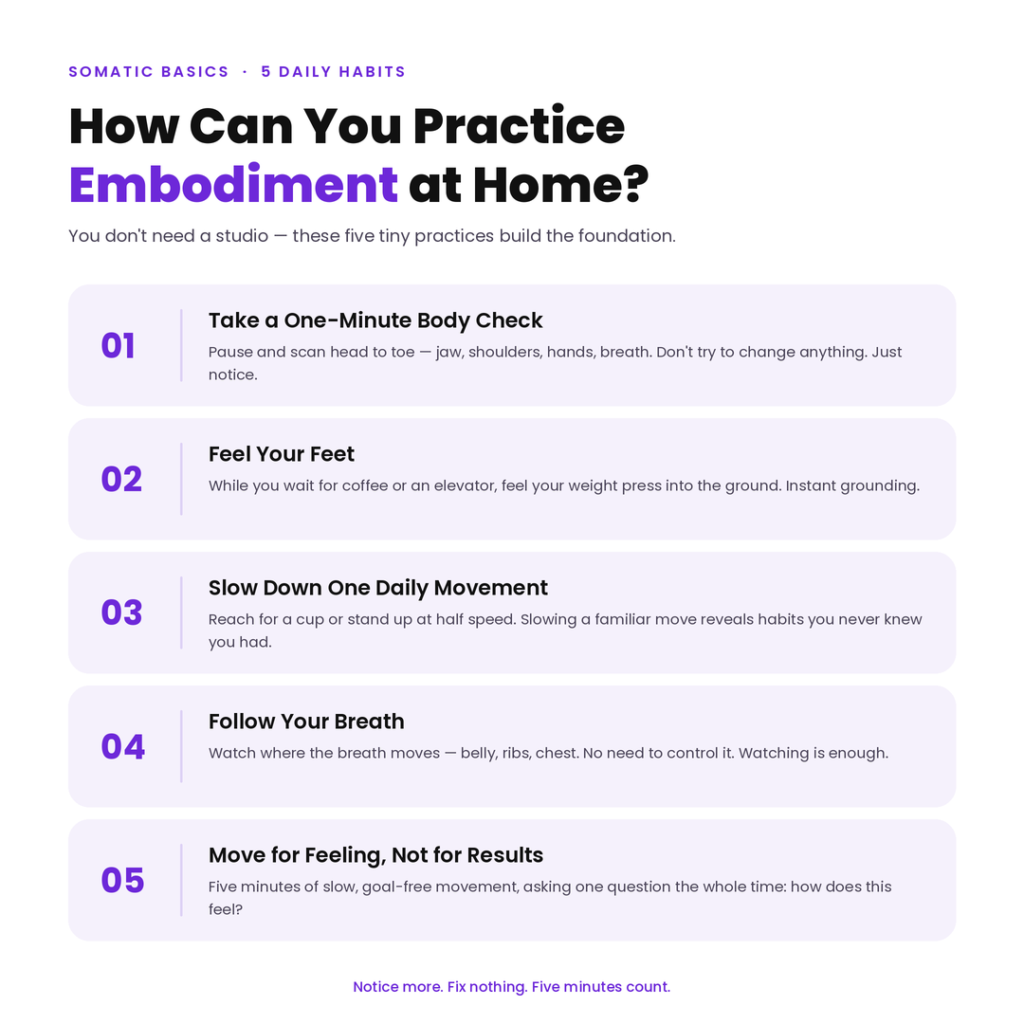
How Can You Practice Embodiment at Home?
You do not need a studio to begin. Guided classes help you go deeper, but simple daily habits build the foundation. These are five easy ways to start:
1- Take a One-Minute Body Check
Pause once or twice a day and scan your body from head to toe. Notice your jaw, shoulders, hands, and breath. Do not try to change anything. Just notice.
This tiny habit trains your attention and takes less than a minute.
2- Feel Your Feet
Whenever you stand, waiting for coffee or an elevator, bring your attention to your feet. Feel the weight pressing into the ground. Notice if you lean more on one side.
Feeling your feet is one of the fastest ways to feel grounded.
3- Slow Down One Daily Movement
Pick one movement you do every day, like reaching for a cup or standing up from a chair. Do it at half speed and pay attention to how it feels.
Slowing down a familiar movement often reveals habits you never knew you had.
4- Follow Your Breath
Sit or lie down for a few minutes and simply feel your breath. Notice where it moves in your body. Does your belly rise? Do your ribs widen? Does your chest lift?
You do not need to control the breath. Watching it is enough.
5- Move for Feeling, Not for Results
Set aside five minutes to move slowly with no goal in mind. Roll your shoulders, sway side to side, or stretch gently. Ask yourself one question the whole time: how does this feel?
This is somatic movement in its simplest form, and five minutes count.
Who Can Benefit From Embodied Practice?
Embodied practice welcomes every body, every age, and every fitness level. Because the movements are slow and gentle, you never need strength, flexibility, or experience to begin.
Desk workers often come to release the stiffness that builds from long hours of sitting. Busy professionals come to slow down and quiet a racing mind.
Older adults come to stay aware of their balance and movement as their bodies change.
Athletes and dancers also practice embodiment.
Deeper body awareness helps them notice their habits and move with more care and control.
And many people come simply because they feel distant from their own body and want that connection back. If you have a body and you can pay attention, you can practice embodiment.
4 Common Myths About Embodiment
A few myths stop people from trying embodied practice. Let’s clear them up.
Myth 1: “I need to be flexible or fit.”
Embodiment is about awareness, not ability. You can practice it sitting in a chair or lying on the floor. There are no poses to achieve and no fitness bar to clear.
Myth 2: “It’s just stretching or slow yoga.”
Somatic movement may look gentle from the outside, but the work happens on the inside. The goal is not to stretch further. The goal is to feel more. That focus on inner sensation sets it apart from most exercise classes.
Myth 3: “It’s too ‘out there’ for me.”
Embodiment is practical, not mystical. It is simply the skill of paying attention to your own body. Noticing your posture or your breath is as down-to-earth as it gets.
Myth 4: “I don’t have time.”
You can practice embodiment in the moments you already have. Standing in line, sitting at a red light, or walking to your car can all become part of the practice. A guided class helps you go deeper, but daily life offers endless opportunities to practice for free.
Choosing the Right Place to Learn Embodiment
If you want to build embodiment with support, the right teacher and setting make a real difference. These are some of the things you should look for:
A Focus on Awareness, Not Correction
Some classes try to fix your posture or force your body into set shapes. Embodied practice works differently.
Look for a teacher who guides you to explore and notice, rather than one who tells you everything you do is wrong.
Slow, Guided Movement
The practice should feel unhurried. A good somatic class gives you time to sense each movement instead of rushing from one exercise to the next.
A Welcoming Space for Beginners
You should never feel judged for being new or stiff. A good studio meets you exactly where you are and lets you move at your own pace.
Clear, Simple Guidance
A good teacher explains things in plain words. You should always understand what you are being asked to do and why. If you leave a class feeling confused, the guidance was not clear enough.
Why Do People in Las Vegas Choose SomaFlow™ Institute?
People come to SomaFlow™ Institute because we keep the practice simple, gentle, and honest.
We are the Institute for Somatic Movement and Embodied Practice in Las Vegas, and everything we teach centers on one goal: helping you build real body awareness.
The SomaFlow™ approach focuses on awareness, not correction. We never treat your body as a problem to fix.
Instead, we guide you through slow, focused movement so you can discover how your body moves and where it holds tension.
Every class uses guided somatic exploration. Your instructor leads you step by step, so you always know where to place your attention.
Beginners feel at home from the first session because there is nothing to perform and no way to fall behind.
Over time, our students describe the same shift. They notice tension earlier. They move with more ease. They feel more present in their daily lives, both inside and outside the studio.
Start Feeling at Home in Your Body!
Embodiment is a skill, and like any skill, it grows with practice. You can start today with one minute of noticing your breath or feeling your feet on the ground.
When you are ready to go deeper, guided somatic movement gives your practice structure and support.
If you are looking for somatic movement and embodied practice in Las Vegas, SomaFlow™ Institute is here to guide you.
Join us for an Embodied Core Awareness Course and begin building the body awareness that helps you move, rest, and live with more ease.
Contact SomaFlow™ Institute today to book your first session, or call us at 702-234-5610.
Full-Body SomaFlow Course
An immersive introduction to embodied awareness, self-practice, and whole-body integration through the SomaFlow method.
People Also Ask
What does embodiment mean in simple words?
Embodiment means being fully present in your body. Instead of only thinking, you also feel. You notice your breath, your posture, and the sensations that come with movement. It is the difference between having a body and actually living in it.
Is somatic movement the same as exercise?
No. Exercise usually aims for results like strength or endurance. Somatic movement aims for awareness. The movements are slow and gentle, and the focus stays on how each movement feels rather than how many you complete.
Do I need experience to start embodied practice?
No experience is needed. Somatic movement is slow, simple, and guided, so complete beginners can join comfortably. You do not need to be flexible, fit, or familiar with any movement practice.
How long does it take to build body awareness?
Many people notice small changes after their first session, such as feeling calmer or noticing tension they had ignored. Deeper awareness builds over weeks and months of regular practice. Like any skill, consistency matters more than intensity.
Can I practice embodiment at home?
Yes. You can practice with simple habits like a one-minute body scan, feeling your feet while standing, or slowing down a daily movement. Guided classes help you go deeper, but home practice builds a strong foundation.
Is embodied practice relaxing?
Most people find it deeply calming. The slow pace and focused attention often quiet the mind and release tension. That said, the main goal is awareness. Relaxation is a welcome result, not the finish line.
Disclaimer: This article is for general information only. Somatic movement and embodied practice at SomaFlow™ Institute focus on building body awareness and are not medical treatment, physical therapy, or mental health care. If you have an injury, pain, or a health condition, please speak with a qualified healthcare provider before starting any new movement practice.
About the Author
Glenn Hall
Glenn Hall knows what it’s like to live with pain. Born with a serious back condition, he grew up dealing with stiffness, poor posture, and discomfort that never fully went away. Later in life, his challenges intensified: he suffered two complete biceps tears and two supraspinatus muscles retracted off the bone.