5 Benefits of Embodied Presence in Everyday Life [+ 3 Exercises]

We hope you enjoyed reading and learning more about the body and mind. If you would like to connect with our experts, click here
Author: Glenn Hall | Co-Founder of SomaFlow™ Institute
Embodied presence means paying attention to your body as you move through everyday life. Instead of spending most of your time in your thoughts, you notice your breathing, posture, balance, tension, movement, and physical sensations as they happen.
Embodied presence gives you a simple way to pause and notice these signals. You can begin by bringing your attention to one movement or physical sensation at a time.
At SomaFlow™ Institute, we explore this kind of awareness through gentle somatic movement and guided learning.
The SomaFlow™ approach encourages people to notice their own movement patterns and explore breathing, balance, weight shifts, and physical sensations.
What Is Embodied Presence?
Embodied presence means staying aware of your physical experience while you take part in an activity. It involves noticing what happens in your body as you move, breathe, sit, stand, or interact with your surroundings.
This idea connects closely with body awareness, which researchers describe as awareness of bodily sensations, processes, and actions.
Body awareness can involve proprioception, which helps you sense your body’s position and movement, and interoception, which helps you notice signals from within your body.
Imagine sitting at your computer and answering emails. You might notice your shoulders rising, your feet pressing into the floor, or your breathing changing as you concentrate.
Instead of automatically ignoring these signals, you pause and observe them.
You do not need to change your posture immediately. You simply notice what your body is doing.

A Different Way of Working With the Body
SomaFlow offers an approach centered on embodied practice and facilitation that many practitioners find more sustainable over time, prioritizing awareness, adaptability, and working with the body rather than against it.
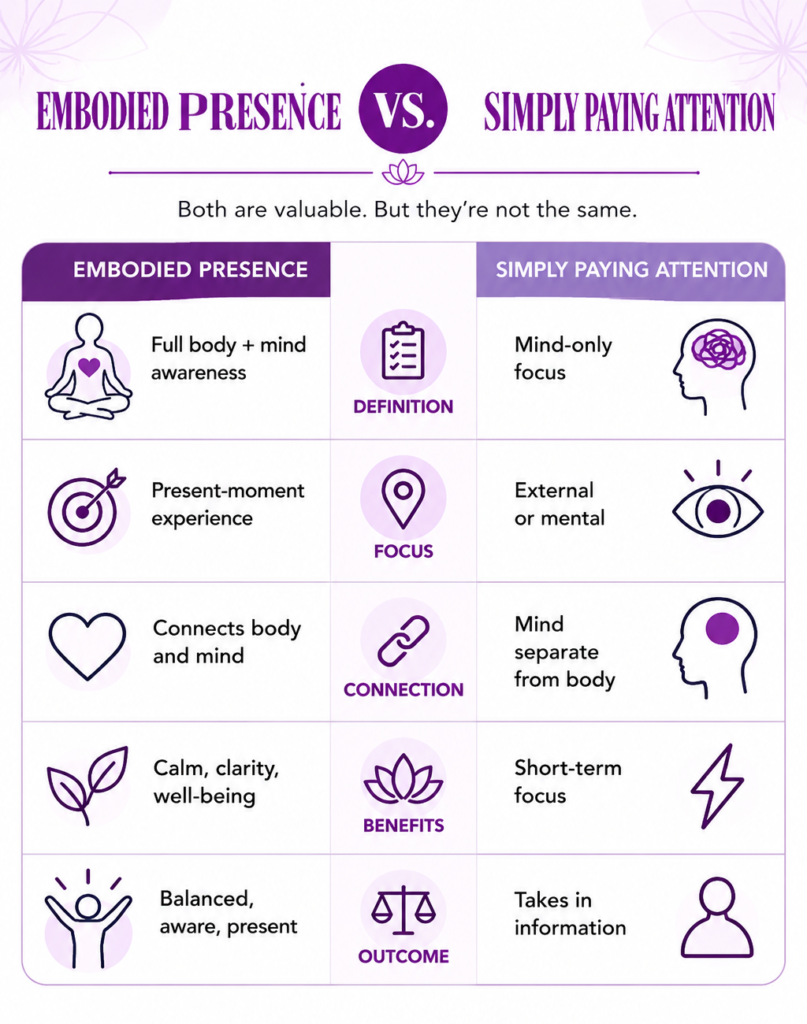
Embodied Presence vs. Simply Paying Attention
General mindfulness often involves paying attention to thoughts, emotions, sounds, or surroundings. Embodied presence brings your physical experience into that attention.
You might notice:
- How your feet contact the floor
- How your shoulders move while you breathe
- Where you hold tension
- How your weight shifts when you stand
- How your body responds to movement
- Whether one side feels different from the other
You do not need to analyze every sensation. You can simply notice what you experience.
5 Benefits of Practicing Embodied Presence
Practicing embodied presence gives you a chance to slow down, notice what your body is telling you, and become more familiar with the way you move through everyday life.
1. It Builds Body Awareness
Embodied presence helps you notice what happens inside and around your body as you move.
You may notice your breathing while walking, your shoulders’ position while working, or the pressure under your feet as you stand. These small details often fade into the background when you focus on a task.
When you regularly bring your attention back to these sensations, you become more familiar with your body’s responses during everyday activities.
2. It Helps You Recognize Movement Habits
Your body develops familiar ways of doing things.
You may cross the same leg every time you sit, carry your bag on the same shoulder, or turn your head more easily toward one side.
You might not notice these patterns until you deliberately pay attention to them.
Embodied presence gives you an opportunity to observe these habits without immediately labeling them as good or bad.
Once you recognize a familiar pattern, you can explore other ways of moving when they feel comfortable.
3. It Encourages More Mindful Movement
Think about how often you move without really noticing the movement itself.
You stand up, sit down, walk across a room, reach for something, or bend down while your attention stays somewhere else.
Embodied presence invites you to give some of that attention back to the movement.
For example, when you stand from a chair, notice your feet, knees, hips, and breathing.
Feel how your weight shifts forward and upward as you stand. You do not need to make the movement perfect. Simply paying more attention can help you understand how your body organizes an ordinary action.
4. It Helps You Notice Tension
Tension can become part of your routine so gradually that you stop noticing it.
You might tighten your jaw while concentrating, lift your shoulders during a busy workday, or grip your phone while reading a stressful message. Your body can develop these responses without you consciously choosing them.
Embodied presence helps you notice these changes.
When you notice tension, you can pause instead of automatically pushing through it. Take a comfortable breath and give yourself a moment to explore whether you can continue the activity with less effort.
5. It Creates Space for Self-Observation
Modern life often rewards constant action. You finish one task and immediately move to the next. Before long, you may spend an entire day responding to what needs your attention without checking in with yourself.
Embodied presence creates small pauses within that routine.
You might notice your feet before walking into a meeting, your breathing before answering a difficult message, or your shoulders before returning to your computer.
These moments take only a few seconds, but they give you a chance to notice your physical experience.
How to Practice Embodied Presence During Everyday Activities?
You do not need to set aside an hour for embodied presence. Everyday activities offer plenty of opportunities to practice.
While Working
You do not need to fix anything. Start with observation. Sit comfortably and notice your feet, hands, shoulders, and breathing. Ask yourself:
- Are my feet touching the floor?
- What do my shoulders feel like?
- Am I holding my breath?
- How much effort do I use while typing?
While Walking
Notice each step as you walk.
Pay attention to how your feet meet the floor and how your weight moves from one side to the other. Notice your arms, shoulders, and breathing, too.
Try not to change your walking pattern immediately. First, learn how you naturally move.
While Eating
Take a moment to notice your posture before you start eating.
Feel your feet or the support beneath you. Notice how you reach for your food and how your body moves during the meal.
You can also slow down for a few bites and notice the physical experience of eating.
While Cooking
Cooking involves standing, reaching, turning, lifting, and carrying.
Notice how you distribute your weight while standing at the counter. Pay attention to your shoulders when you reach for something. Notice whether you repeatedly lean toward one side.
These observations can reveal movement habits that you rarely notice during a busy day.
During Household Tasks
Cleaning, folding clothes, washing dishes, and carrying objects all involve repeated movements.
Notice how you bend, reach, twist, and lift. You might discover that you always use one side of your body for a particular task.
You can explore a different movement when it feels safe and comfortable, rather than forcing yourself to change the habit.
3 Simple Embodied Presence Exercises
You do not need a long practice session to become more aware of your body.
These simple exercises can fit into a quiet moment at home, during a work break, or between everyday activities.
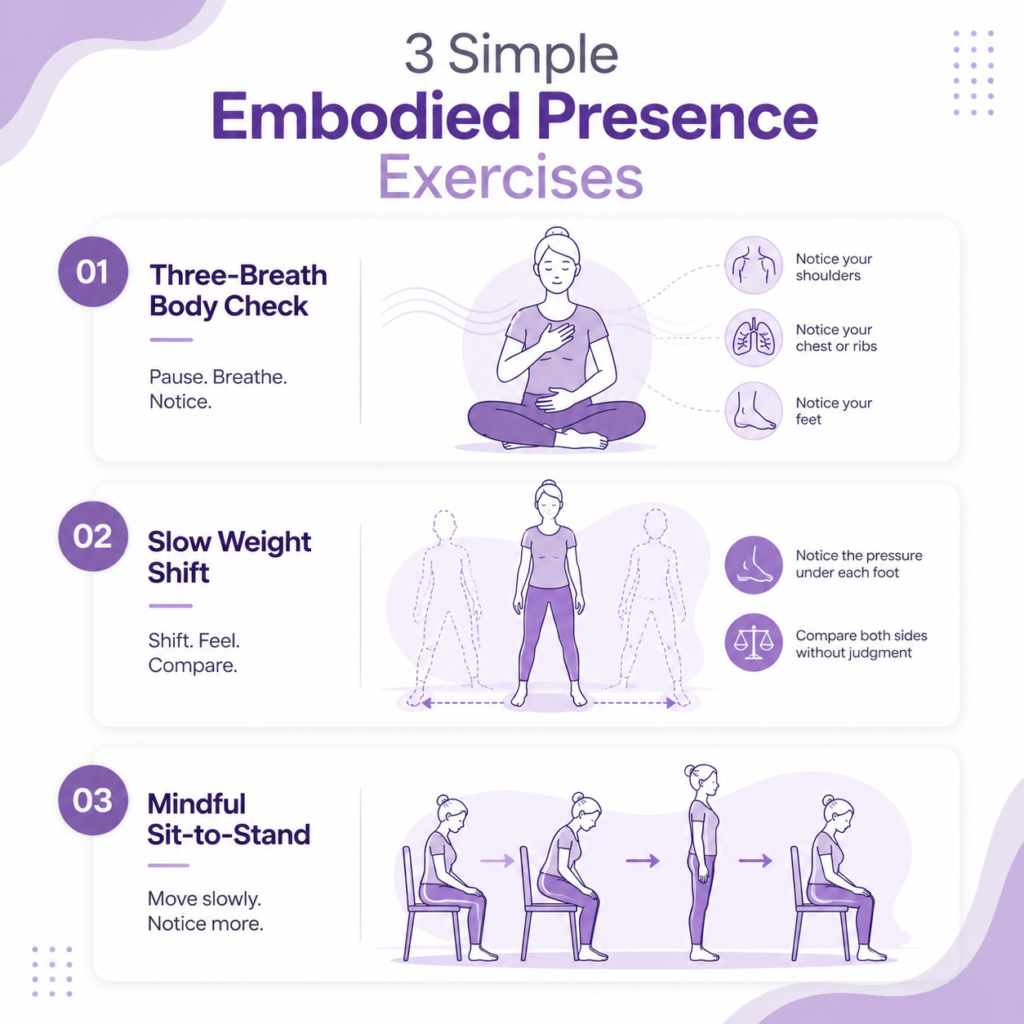
1. Three-Breath Body Check
Sit or stand comfortably.
Take three natural breaths without forcing them to become deeper. During each breath, notice one part of your body.
You might notice your shoulders during the first breath, your chest or ribs during the second, and your feet during the third.
Then return to your activity.
This exercise takes less than a minute and can fit easily into your daily routine.
2. Slow Weight Shift
Stand with your feet comfortably apart.
Slowly move your weight toward your right foot. Notice the pressure under that foot. Then slowly move your weight toward your left foot.
Compare both sides without judging them.
Notice whether one direction feels easier or more familiar. Keep the movement small and comfortable.
3. Mindful Sit-to-Stand
Sit in a comfortable chair.
Before standing, notice your feet and breathing. Then slowly lean forward and allow your weight to move toward your feet.
Stand at a comfortable pace and notice how your legs and hips contribute to the movement.
Sit down again slowly and observe the movement from the opposite direction.
Start Practicing Embodied Presence Today!
Embodied presence does not require you to change your entire routine. Start with one ordinary activity.
Notice your feet while standing. Pay attention to your breathing while working. Observe your shoulders while walking. Feel how your weight shifts when you sit down or stand up.
Give yourself time to observe before you try to change anything.
With regular practice, these short moments can become part of your everyday awareness. You can use them to learn more about your movement habits, physical sensations, and responses to daily activities.
If you want to explore embodied awareness through guided somatic movement, enroll in our Embodied Core Awareness Course and learn how SomaFlow™ can support your learning.
Full-Body SomaFlow Course
An immersive introduction to embodied awareness, self-practice, and whole-body integration through the SomaFlow method.
People Also Ask
How can I practice embodied presence?
Start with a simple activity such as walking, sitting, working, or cooking. Slow down for a moment and notice your breathing, posture, movement, and physical sensations.
Is embodied presence the same as mindfulness?
Embodied presence shares principles with mindfulness, but it focuses particularly on physical experience and movement. You focus on what you notice in your body as you take part in an activity.
Can I practice embodied presence at work?
Yes. You can take short awareness pauses while working. Notice your feet, shoulders, breathing, hands, and sitting position before returning to your task.
Do I need special equipment?
No. You can practice embodied presence during many everyday activities without special equipment.
How long should I practice?
You can start with a few minutes or even a few seconds at a time. Consistent attention matters more than creating a long or complicated routine.
About the Author
Glenn Hall
Glenn Hall knows what it’s like to live with pain. Born with a serious back condition, he grew up dealing with stiffness, poor posture, and discomfort that never fully went away. Later in life, his challenges intensified: he suffered two complete biceps tears and two supraspinatus muscles retracted off the bone.