What Is Qigong Breathing? Techniques, Benefits & Beginner Exercises

We hope you enjoyed reading and learning more about the body and mind. If you would like to connect with our experts, click here
Author: Glenn Hall | Co-Founder of SomaFlow™ Institute
Qigong roughly means “cultivating energy,” from qi (life energy) and gong (skill gained through practice). Qigong breathing is one of the simplest ways to calm your body, and you can learn it in a few minutes, with no equipment and no experience.
Most of us breathe fast and shallow without noticing, especially on busy or stressful days. Our shoulders creep up, our chest gets tight, and we feel more rushed than we need to.
Qigong breathing helps you slow down and notice what your body is doing.
At SomaFlow Institute, breath awareness is part of everything we teach, from movement to responsive touch. Want to experience it in person? Explore our SomaFlow workshops and courses.
What Is Qigong Breathing?
Qigong breathing is a gentle practice from traditional Chinese movement arts that uses slow, relaxed breaths into the lower belly. People pair it with soft movement and focused attention. Its aim is to bring the body, breath and mind into a calm, steady rhythm.
Qigong (said “chee-gong”) has roots in China that go back many centuries. According to the National Center for Complementary and Integrative Health (NCCIH), qigong brings together three things: posture and movement, slow and deep breathing, and focused attention.
Tai chi, which many people already know, is actually one form of qigong. Your breath can stay natural, or you can match it to your movements, breathing in as you rise and breathing out as you settle.
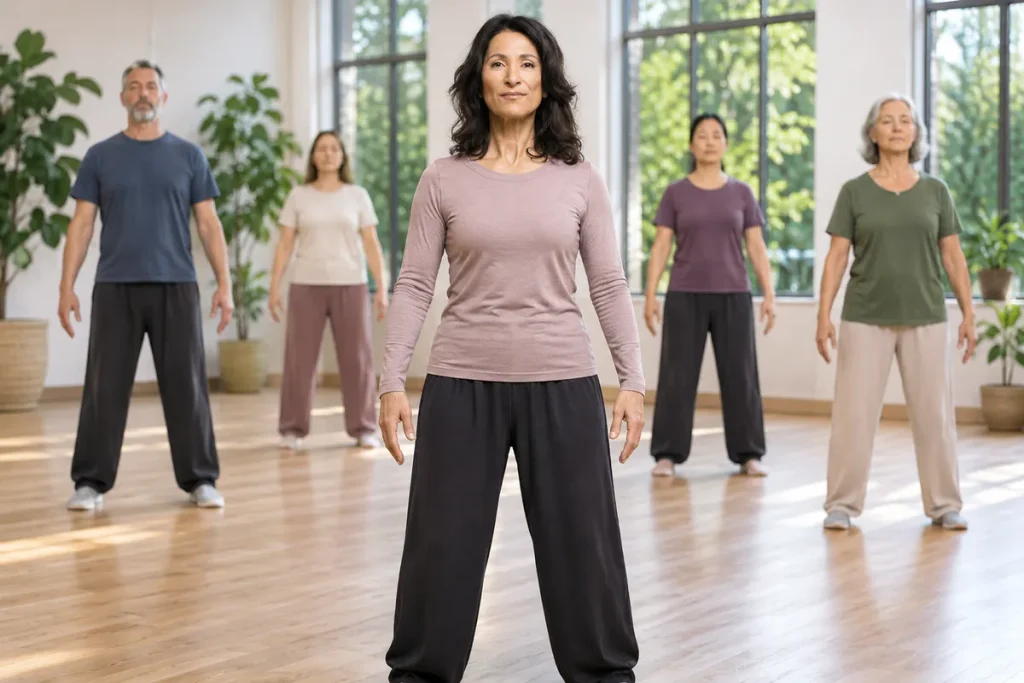
How Does Qigong Breathing Work?
Qigong breathing works by slowing your breath down and letting it move lower in your body, so your belly and ribs do more of the work.
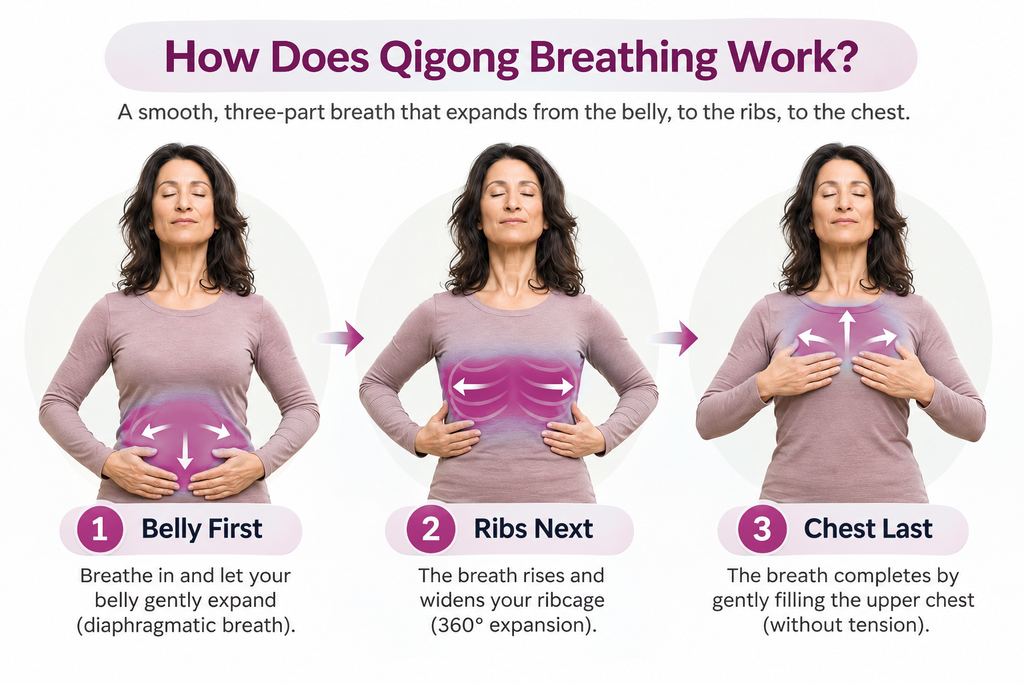
Diaphragmatic Breathing and Rib Expansion
When you breathe in, your diaphragm (the dome-shaped muscle under your lungs) moves down.
Your belly softens outward and your lower ribs widen a little. When you breathe out slowly, everything gently returns.
Long, easy exhales are linked with the body’s rest response, partly through the vagus nerve. That’s one reason many people feel calmer after just a few minutes.
Breath and Mindful Movement
In qigong, breath and movement work together. As you lift your arms, you may feel your chest open and your back gently stretch.
Over time, many people start to feel breathing as something the whole body takes part in, not just the lungs. It’s simply a way of paying closer attention to yourself.

A Different Way of Working With the Body
SomaFlow offers an approach centered on embodied practice and facilitation that many practitioners find more sustainable over time, prioritizing awareness, adaptability, and working with the body rather than against it.
5 Main Types of Qigong Breathing
There are a few main styles of qigong breathing, and beginners usually start with the simplest one.
| Technique | How it feels | Best for | Level |
| Natural abdominal breathing | Belly softly rises and falls | Relaxing, getting started | Beginner |
| Reverse (Daoist) breathing | Belly draws in on the inhale | Building focus | Intermediate |
| Nose in, mouth out | Slow, smooth, quiet | Calming down | Beginner |
| Sound breathing (Liu Zi Jue) | Soft sounds on the exhale | Longer exhales, relaxation | Beginner to intermediate |
| Microcosmic Orbit | Breath guided along the spine and front of the body | Deep practice | Advanced, learn with a teacher |
If you are new, stay with natural abdominal breathing for a few weeks. The other styles will feel easier once that one feels normal.
4 Qigong Breathing Exercises for Beginners
These four exercises are gentle, need no equipment, and take only a few minutes each.
1. Natural Abdominal Breathing
Sit or stand comfortably and rest one hand on your lower belly, an area qigong calls the Dan Tian.
Breathe in through your nose and let your belly soften out under your hand.
Then breathe out slowly and feel it fall. Keep going for 1 to 2 minutes. Never force the breath.
If it feels like effort, make it smaller. Our Embodied Core Awareness Course explores this area in more depth.
2. Standing Breath Awareness
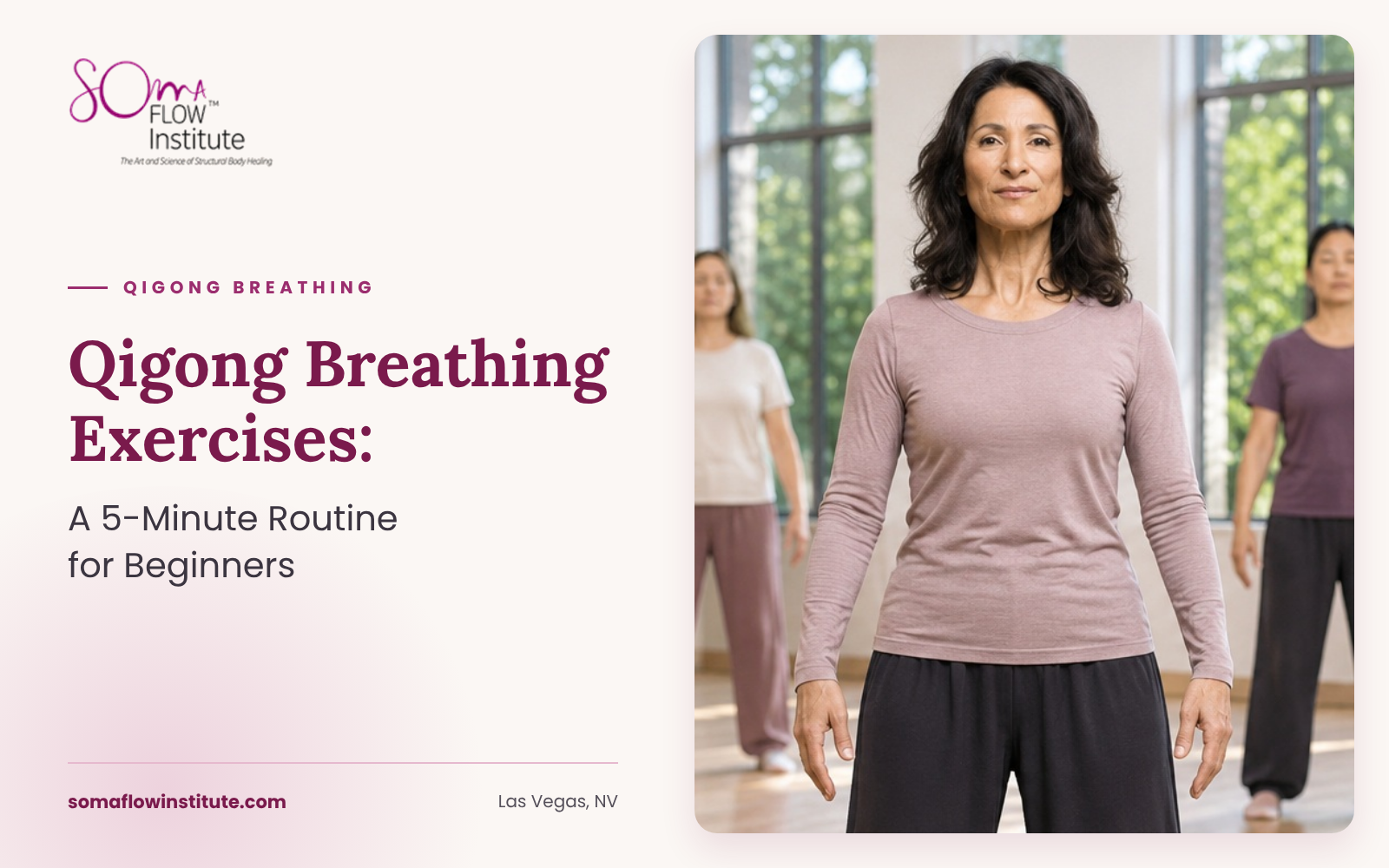
Stand with your feet hip-width apart, knees soft and arms relaxed. This simple resting stance is called Wu Ji. Close your eyes if that feels okay and just notice your breath without changing it.
Then notice your feet, your balance and any small sways. Stay here for 1 to 2 minutes. If you feel unsteady, keep your eyes open.
3. Raising and Lowering the Arms With the Breath
Start in Wu Ji. As you breathe in, slowly float your arms up in front of you to shoulder height, palms facing down.
As you breathe out, let them sink back down. Repeat 6 to 8 times. Let your breath set the pace, not the other way around, and keep your shoulders soft the whole time.
4. Opening and Closing the Hands
Bring your hands in front of your chest as if you’re holding a large, light ball. Breathe in and let your hands drift apart, as if the ball is growing. Breathe out and let them come closer again.
Repeat for about a minute. Some people notice warmth or tingling in their hands. If you don’t, that’s completely fine.
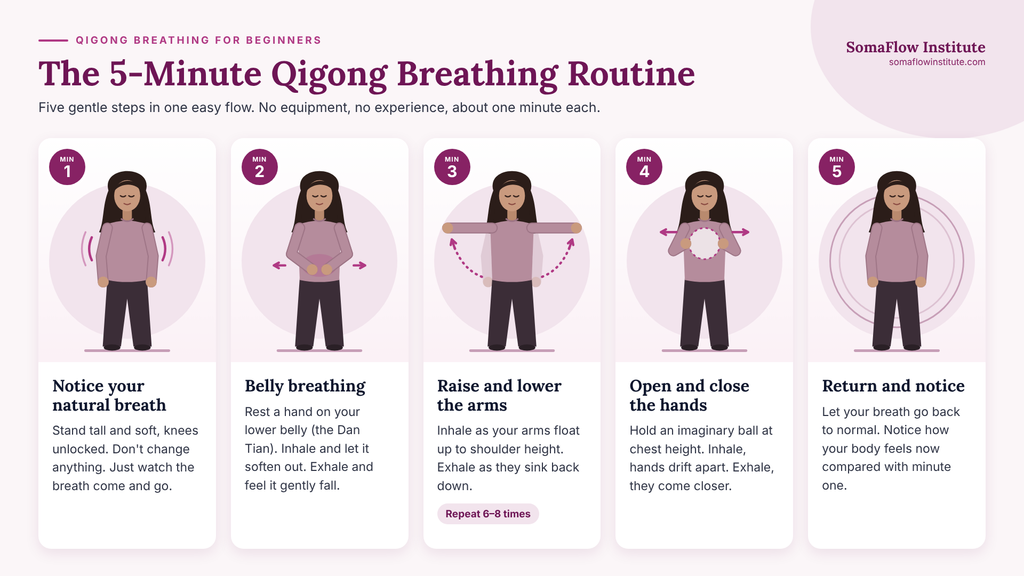
A Simple 5-Minute Qigong Breathing Routine
This short routine links the four exercises so you can practice in about five minutes.
| Minute | What to do |
| 1 | Observe your natural breath |
| 2 | Natural abdominal breathing |
| 3 | Raising and lowering the arms |
| 4 | Opening and closing the hands |
| 5 | Return to natural breath and notice how you feel |
No room to stand? You can do every step seated in a sturdy chair. If you feel dizzy or lightheaded at any point, stop and let your breathing go back to normal.
Benefits of Qigong Breathing: What Does Research Say?
Research suggests that qigong can contribute to relaxation, body awareness, and balance.
Keep in mind that most studies test qigong as a whole practice, not breathing alone, and many of them are small.
Relaxation and Stress Awareness
Many people feel calmer after practice and notice more easily where they hold tension.
Some small studies link qigong with lower anxiety. In people with COPD, for example, a 2019 review of 6 studies found it reduced self-rated anxiety and depression when added to usual care. NCCIH notes that the evidence is still limited.
Posture and Body Awareness
Slow movement with your breath can help you observe how you stand, sit, and hold yourself. Over time, that awareness may help you build better posture habits.
Balance, Lung Function and Older Adults
A 2019 survey of reviews cited by NCCIH found sufficient evidence to support qigong for balance training and fall prevention.
For people with COPD, a 2020 review of 31 studies (3,045 participants) found that adding qigong to usual treatment improved lung function, quality of life and exercise ability.
Safety Tips and Common Mistakes
NCCIH reports that qigong appears to be safe, and many studies found no negative side effects. Keep these tips in mind:
- Talk to your healthcare provider before starting if you are pregnant or have a heart or lung condition. Some movements may need to be adjusted during pregnancy.
- Avoid forcing your breath. Breathe slowly and comfortably. Deep or rapid breathing can make you feel dizzy.
- Don’t hold your breath. Keep your breathing smooth and steady throughout the exercises.
- Relax your muscles: Keep your shoulders loose and your abdomen relaxed.
- Don’t think about perfection. Focus on comfortable, natural movements rather than getting every movement right.
How Breath Awareness Fits SomaFlow Practice
Breath is often the first thing our practitioners learn to watch, in themselves and in the people they work with. In our workshops, the first thing most beginners notice is how high in their chest they’ve been breathing.
In a SomaFlow practice session, practitioners learn to notice their own breathing as well as their client’s, because breath often shows how settled someone feels.
This attention to breath sits at the heart of the SomaFlow Method, where a slow, easy breath helps fascial movement and responsive touch feel more natural for both people.
The same awareness carries into embodied coaching, where noticing the breath becomes a simple way to stay present with what the body is saying.
Start With a Few Easy Breaths
Qigong breathing is simple: slow breath, gentle movement and kind attention. You don’t need to get it perfect. Try a few comfortable minutes today.
When you are ready to go deeper, explore our SomaFlow workshops or book a free consultation call.
Full-Body SomaFlow Course
An immersive introduction to embodied awareness, self-practice, and whole-body integration through the SomaFlow method.
People Also Ask
Should you breathe through your nose or mouth during qigong?
Most beginners breathe in and out through the nose. Some styles breathe out through the mouth. Choose whichever feels slow, quiet and comfortable for you.
How long should beginners practice qigong breathing?
Five to ten minutes a day is plenty to start. Practicing a little every day usually helps more than one long session each week.
Can you practice qigong breathing while sitting?
Yes. Sit on a sturdy chair near the front with your feet flat and your spine tall but relaxed. Rest your hands on your thighs between movements, and keep the arm raises at a height that feels easy.
Is qigong breathing the same as yoga pranayama?
No. Both use focused breathing, but qigong comes from Chinese traditions and usually pairs breath with gentle movement. Pranayama comes from yoga and often uses specific breath patterns.
This article is for educational purposes only and is not medical advice. If you have a health condition, please speak with a qualified healthcare provider before starting any new practice.
About the Author
Glenn Hall
Glenn Hall knows what it’s like to live with pain. Born with a serious back condition, he grew up dealing with stiffness, poor posture, and discomfort that never fully went away. Later in life, his challenges intensified: he suffered two complete biceps tears and two supraspinatus muscles retracted off the bone.