10 Somatic Workout Benefits for Movement & Body Awareness

We hope you enjoyed reading and learning more about the body and mind. If you would like to connect with our experts, click here
Author: Shoshi Hall | Co-Founder of SomaFlow™ Institute
Somatic workout benefits include greater body awareness, smoother coordination, better posture observation, and more sustainable movement habits in daily life.
If you are a therapist or bodyworker, these benefits are important. The way your clients move every day shapes how they feel in their bodies, and somatic workouts give them a simple way to notice that movement.
Most exercise asks the body to perform. Somatic movement asks the body to pay attention. That small shift changes everything about how a workout feels, and it opens the door to skills you can share with the people you work with.
At SomaFlow™ Institute in Las Vegas, we teach this through experiential somatic workouts built around slow movement, focused attention, and real-world movement habits.
What Are Somatic Workouts?
A somatic workout is a slow, awareness-based movement practice. Instead of counting reps or chasing intensity, you move gently and observe what your body is doing.
You notice your posture, pacing, and which parts of you move easily and which parts feel stiff or held.
The word “somatic” comes from “soma,” meaning the body as experienced from the inside.
Research on proprioception, our internal sense of body position and movement, shows that this inner sense plays a central role in balance, coordination, and motor control.
Somatic workouts are a practical way to train that sense.
Traditional Workouts vs Somatic Workouts
| Traditional Workouts | Somatic Workouts |
| Performance-focused | Awareness-focused |
| Repetitions and sets | Movement observation |
| High intensity | Gentle pacing |
| Calorie burning | Coordination and posture awareness |
| Push through fatigue | Slow down and notice |

A Different Way of Working With the Body
SomaFlow offers an approach centered on embodied practice and facilitation that many practitioners find more sustainable over time, prioritizing awareness, adaptability, and working with the body rather than against it.
10 Somatic Workout Benefits for Movement
The benefits of somatic workouts go beyond burning calories or building strength.
They teach you how to move with greater awareness, making everyday activities feel easier, smoother, and more comfortable.
1. Develops Greater Body Awareness
The biggest benefit of somatic workouts is learning to pay attention to your body.
Most of us move through the day on autopilot without noticing how we sit, stand, or carry tension. Once you become aware of these habits, you can start changing them.
You may realize that you always hunch your shoulders while working on your laptop. Simply noticing this habit helps you relax them throughout the day.
2. Improves Movement Coordination
Somatic workouts slow movements down, giving your brain and muscles time to communicate better. Instead of relying on automatic patterns, your body learns to move more smoothly and efficiently.
Reviews of awareness-based movement methods, such as the Feldenkrais Method, have found improvements in balance and movement function.
Climbing stairs or getting out of a chair may feel steadier because your movements become more controlled rather than rushed.
3. Helps You Understand Your Posture
Rather than teaching a “perfect” posture, somatic exercise helps you observe how you naturally hold your body. You begin to notice where you lean, collapse, or stiffen, allowing you to make comfortable adjustments.
You might discover that you put most of your weight on one leg while standing in line and start distributing it more evenly.
4. Creates More Efficient Movement Habits
Many people put extra effort into simple tasks without realizing it.
Somatic practice teaches your body to use only the amount of force needed, making movement feel easier and reducing unnecessary strain.
Instead of tightening your neck while carrying grocery bags, you learn to engage your whole body and move more comfortably.
5. Increases Flexibility Naturally
Somatic workouts don’t rely on forcing deep stretches. As your body releases excess tension, your joints and muscles can move more freely, making everyday movements feel smoother and less restricted.
Bending down to tie your shoes may feel easier because your hips and back move more freely instead of feeling stiff.
6. Strengthens Your Ability to Focus
The benefits of somatic movement require you to stay present and notice how your body feels during each exercise.
This mindful attention strengthens your ability to stay focused during exercise and everyday activities. According to NCCIH, mind-body practices combine movement with mental focus and controlled breathing.
Instead of rushing through a task while distracted, you may find it easier to stay focused on one activity at a time.
7. Improves Balance and Stability
Balance starts with knowing where your body is in space.
Somatic exercises help you notice how your weight shifts and teach small adjustments that make you feel steadier and more stable.
Standing on one foot while putting on your shoes may feel easier because you’re more aware of your body’s position.
8. Teaches Better Breathing Patterns
Many people unknowingly hold their breath when concentrating or moving. Somatic workouts encourage breathing that flows naturally with movement, helping your body stay relaxed.
When lifting a heavy box, you may breathe steadily instead of holding your breath and creating extra tension.
9. Makes Everyday Activities Feel Easier
The goal of somatic movement is to improve how you move in everyday life. Better awareness and coordination can make routine tasks feel more comfortable and less tiring.
Simple tasks like reaching for a high shelf or getting in and out of a car can feel easier when your body learns to move with better coordination and less unnecessary effort.
10. Encourages Slow, Intentional Movement
In a fast world, slowing down is a valuable skill.
Somatic workouts teach you to move deliberately, helping you notice what your body needs and improving the quality of every movement.
Instead of rushing through a morning stretch, you pay attention to how each movement feels, allowing your body to relax and move more comfortably throughout the day.
How Does SomaFlow™ Approach Somatic Movement?
SomaFlow™ Institute teaches somatic movement through small-group, hands-on workshops in Las Vegas.
The SomaFlow™ approach is experiential learning.
You move, observe, and explore with guidance, rather than just listening to theory. We focus on posture observation, coordination awareness, pacing, and sustainable movement practices that you can use yourself and share with your clients.
How to Start Somatic Workouts as a Beginner
Move slowly. Pay attention to posture and pacing. Avoid force. Start with one or two simple movements, practice them consistently, and let guided instruction sharpen your observation skills as you go.
Are Somatic Workouts the Same as Therapy?
SomaFlow™ workshops are educational and experiential.
They focus on movement exploration and awareness. They are not psychotherapy, clinical care, or medical treatment.
If you work in a clinical field, somatic workouts are best understood as movement education you can study and practice, not as a treatment method.
Ready to experience it for yourself?
Book a SomaFlow™ course or workshop and learn guided somatic movement hands-on in Las Vegas.
Full-Body SomaFlow Course
An immersive introduction to embodied awareness, self-practice, and whole-body integration through the SomaFlow method.
People Also Ask
How are somatic workouts different from regular workouts?
Regular workouts focus on performance, reps, and intensity. Somatic workouts focus on awareness, pacing, and observing how you move. Both are useful, but they train different skills.
How often should you do somatic workouts?
Short, consistent practice works best. Even five to ten minutes a few times a week builds noticeable awareness. Many people fold small somatic moments into daily activities like walking or sitting.
What are examples of somatic workouts?
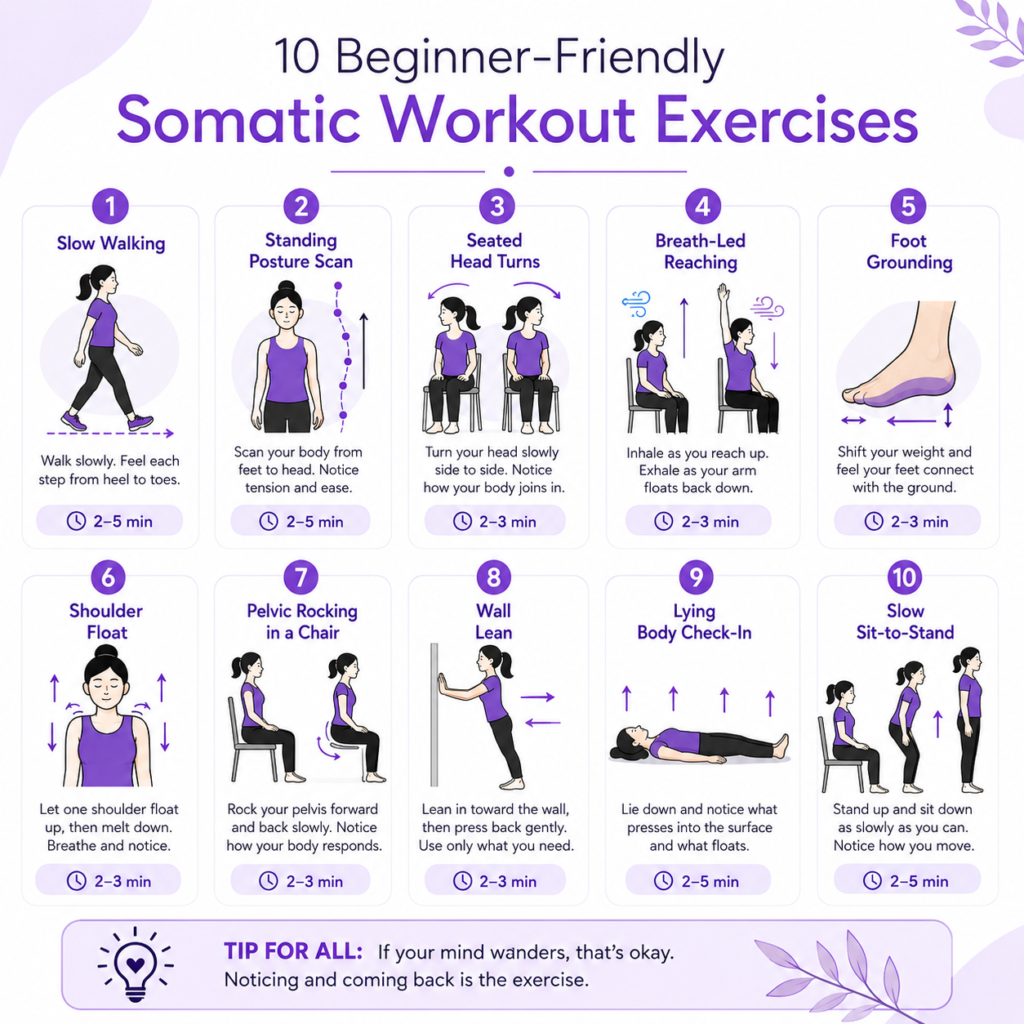
Slow walking, standing posture scans, seated head turns, breath-led reaching, foot grounding, shoulder floats, pelvic rocking, and slow sit-to-stand transitions are all somatic workouts. Each one is simple, gentle, and beginner-friendly.
Why are somatic workouts good for beginners?
They require no equipment, no fitness level, and no force. The only skill needed is attention, which everyone can practice. That makes them one of the most accessible ways to start moving with awareness.
How can somatic workouts support daily movement?
They train you to notice posture, pacing, and effort during ordinary tasks. Over time, walking, lifting, and sitting feel smoother and less strained because you catch unhelpful habits as they happen.
About the Author
Shoshi Hall
Shoshi Hall’s journey into healing began on the stage. As a professional dancer, she experienced both the beauty and the vulnerability of the human body. Years of rigorous training left her with persistent neck and lower back pain, discomfort that touched not only her body but her spirit as well.