
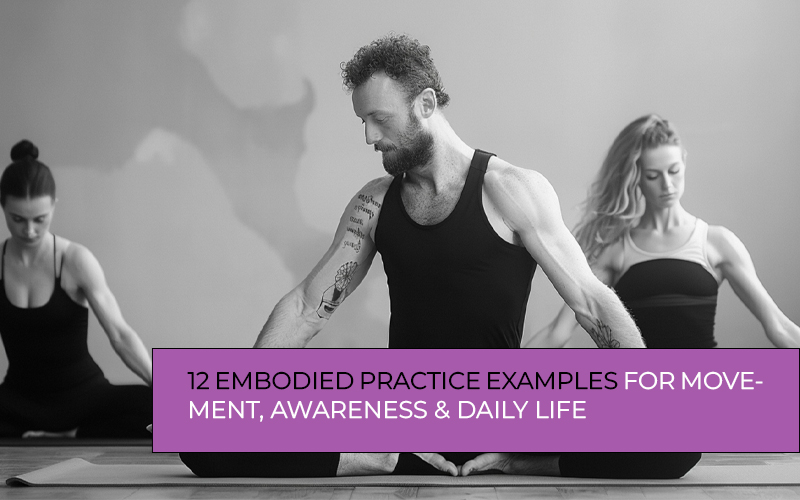
12 Embodied Practice Examples for Movement, Awareness & Daily Life
We hope you enjoyed reading and learning more about the body and mind. If you would like to connect with our experts, click here
Author: Shoshi Hall | Co-Founder of SomaFlow™ Institute
Embodied practice means learning through direct experience of your body instead of only thinking about it. It uses movement, posture, breath, and observation to build body awareness.
Many people study anatomy and movement through books, but struggle to understand how these ideas feel in real life. They focus on correcting the body instead of noticing how it naturally moves.
Embodied movement practices solve this by encouraging slow exploration and attention during everyday movement.
For therapists and body workers, this creates practical learning that goes beyond theory.
The SomaFlow™ Institute uses a movement-based experiential learning approach that encourages slow exploration, attention, and body awareness rather than performance.
What Is an Embodied Practice?
An embodied practice is any activity that helps you experience your body through direct attention and movement.
Many people think about movement without actually feeling it. For example, someone may know that they should “stand straight,” yet never notice how their feet press into the floor or how their shoulders respond while standing.
Embodied awareness activities encourage observation instead of assumption. Rather than asking, “Am I doing this correctly?” you begin asking:
- What do I notice?
- How does this movement feel?
- Where does my weight shift?
- How does my breathing change?
These questions help develop body awareness exercises that create practical learning through experience.
This is also different from simply analyzing movement.
Thinking about movement happens in the mind. Medical News Today describes it as “mind-body-connection.”
Embodied practice happens while you are moving and paying attention.
For body workers and therapists, this skill becomes valuable because observation often reveals patterns that cannot be understood through theory alone.
A Different Way of Working With the Body
SomaFlow offers an approach centered on embodied practice and facilitation that many practitioners find more sustainable over time, prioritizing awareness, adaptability, and working with the body rather than against it.
Why Do People Explore Embodied Practices?
People explore embodied movement practices for many different reasons. Many professionals use these practices to improve observation skills and movement education.
1- Developing Movement Awareness
Every movement tells a story about coordination and habits. Watching how you walk, turn, or reach can reveal patterns you never noticed before.
Movement awareness examples help you understand these patterns without judging them as good or bad.
2- Improving Posture Observation
Posture changes throughout the day. Sitting at a computer looks different from standing in a kitchen or carrying groceries.
Posture awareness practices encourage observation rather than constant correction. The goal is to notice variation instead of chasing one “perfect” position.
3- Building Attention and Coordination
Coordinated movement depends on attention. When people slow down and observe transitions between movements, they often notice details they previously missed.
This makes guided embodiment exercises useful learning experiences for students and professionals alike.
4- Exploring Movement Habits
Everyone develops habits through daily life. Crossing one leg, leaning onto one hip, or turning the head more to one side may become automatic.
Embodied practice examples help bring these habits into awareness so they can be explored rather than ignored.
5- Supporting Mindful Daily Movement
Embodiment does not only happen in a classroom or workshop. Daily activities provide endless learning opportunities.
Walking through a hallway, climbing stairs, reaching for a cup, or getting out of a chair can all become moments of observation.
Mindfulness encourages paying attention to the present moment. That is why many embodied practices begin with simple observation rather than immediate action.
6- Learning Through Direct Experience
Reading about movement is helpful, but experiencing movement creates another level of understanding.
Experiential movement learning combines action with observation. Instead of collecting information, you collect experience.
12 Embodied Practice Examples Therapists Should Know
These embodied practice examples help therapists and body workers develop stronger observation skills through direct movement experience.
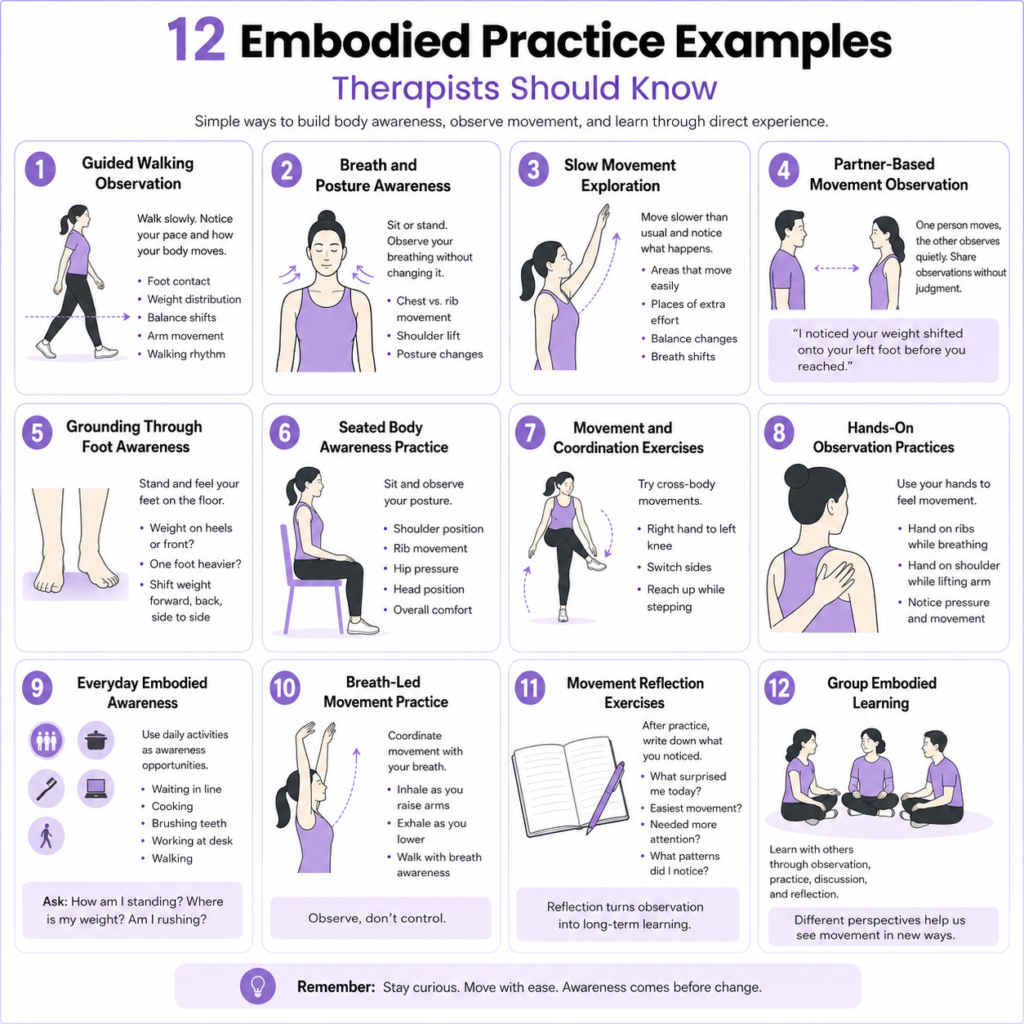
1. Guided Walking Observation
Walking is something most people do every day, yet few people truly observe it.
Begin by walking slowly across a room. Notice your pace without trying to change it. Feel which part of your foot contacts the ground first and how your weight shifts from one leg to the other. Pay attention to:
- Foot contact
- Weight distribution
- Balance shifts
- Arm movement
- Walking rhythm
This simple activity is one of the easiest embodied practice examples because it turns an everyday action into a learning experience.
2. Breath and Posture Awareness
Sit or stand comfortably and simply notice your breathing.
Does your chest move more than your ribs?
Do your shoulders lift during inhalation?
Does your posture change when you breathe more slowly?
There is no need to control the breath. The goal is observation.
Over time, these body awareness exercises can improve your ability to recognize how breathing and posture interact during everyday movement.
3. Slow Movement Exploration
One of the simplest somatic workouts is moving more slowly than usual. Slow movement gives you time to notice details that are easy to miss during normal speed.
Raise one arm slowly and then lower it. Turn your head gently from side to side. Stand up from a chair without rushing.
As you move, notice where the movement starts and how the rest of your body responds. You may observe:
- Areas that move easily
- Places where you feel extra effort
- Changes in balance
- Small shifts in breathing
The goal is not to perform perfectly. The goal is to become more aware.
4. Partner-Based Movement Observation
Working with another person can help you notice movement patterns that you may overlook on your own.
One person performs a simple movement, such as reaching forward or stepping sideways, while the other quietly observes. Afterward, the observer shares what they noticed without judging or correcting.
For example, they might say:
“I noticed your weight shifted onto your left foot before you reached.”
This creates a learning experience based on observation instead of criticism.
For therapists and body workers, developing this skill is valuable because careful observation often comes before effective guidance.
5. Grounding Through Foot Awareness
Your feet are constantly providing information about balance and movement. Yet many people rarely pay attention to them.
Stand comfortably and notice how your feet meet the floor. Is more weight on the heels or the front of the feet? Does one foot carry more weight than the other?
Then gently shift your weight forward, backward, and side to side. Observe how your body adjusts without forcing any changes.
This is one of the easiest embodied awareness activities because it can be practiced almost anywhere.
6. Seated Body Awareness Practice
Many people spend hours sitting each day without noticing how they are positioned.
Sit in a chair and take a moment to observe your posture. Notice where your back contacts the chair and whether both feet rest equally on the floor.
Pay attention to:
- Shoulder position
- Rib movement during breathing
- Pressure through the hips
- Head position
- Overall comfort
Instead of trying to sit “perfectly,” simply observe what you experience. Awareness comes before change.
7. Movement and Coordination Exercises
Cross-body movements are excellent examples of movement awareness because they require attention and coordination.
Try touching your right hand to your left knee while walking slowly. Then switch sides. You can also reach one arm upward while stepping with the opposite foot.
Move at a comfortable pace and notice how your body organizes itself.
Experiential movement learning happens when you stay curious about the process instead of focusing on the outcome.
8. Hands-On Observation Practices
Hands can become tools for awareness rather than correction.
Place one hand on your ribs while breathing naturally. Then place a hand on your shoulder or upper arm while slowly lifting your arm. Notice the movement under your hand.
The purpose is not to push or force movement. Gentle contact simply provides another way to observe pressure, pacing, and coordination.
For students preparing to become body workers, this practice can improve attention to subtle movement qualities.
9. Everyday Embodied Awareness
Embodiment does not have to happen during a formal practice session. Daily life offers many opportunities for observation. You can practice while:
- Waiting in line
- Cooking dinner
- Brushing your teeth
- Working at a desk
- Walking through a parking lot
Ask simple questions:
How am I standing? Where is my weight? Am I rushing or moving steadily?
These small moments help build consistent body awareness over time.
10. Breath-Led Movement Practice
Breath and movement naturally work together. Instead of treating them as separate actions, observe how they interact.
Try slowly raising your arms while inhaling and lowering them while exhaling. Walk slowly while noticing the rhythm of your breathing.
Do not try to create a perfect breathing pattern. Instead, explore how movement changes when you pay attention to your breath.
This simple exercise combines guided embodiment exercises with movement observation in a practical way.
11. Movement Reflection Exercises
Learning continues even after movement stops.
After practicing, take a few minutes to write down what you noticed. You might discover that you consistently lean to one side, rush certain movements, or hold unnecessary tension during simple tasks. Questions for reflection include:
- What surprised me today?
- Which movement felt easiest?
- Which movement required more attention?
- What patterns did I notice?
Keeping a movement journal helps transform observation into long-term learning.
12. Group Embodied Learning
Learning with others creates opportunities to see movement from different perspectives.
In a guided group session, participants observe, practice, discuss, and reflect together. One person’s observation may help another notice something new about their own movement.
For therapists and body workers, this shared learning environment builds communication skills as well as movement awareness. It also encourages curiosity rather than competition.
How Does SomaFlow™ Approach Embodied Practice?
SomaFlow™ teaches embodied practice by helping people learn through movement and direct experience. Instead of trying to perform movements perfectly, the focus is on paying attention to how the body naturally moves.
During guided sessions, participants observe their posture, coordination, pacing, and movement patterns. They learn by exploring and noticing rather than memorizing instructions.
The SomaFlow™ approach includes guided movement, body awareness, posture observation, hands-on exploration, and small-group learning.
Rather than asking, “How do I fix this?” SomaFlow™ encourages a different question: “What do I notice while I move?”
This simple shift helps therapists, body workers, and students build better observation skills and develop a deeper understanding of movement through experience.
Full-Body SomaFlow Course
An immersive introduction to embodied awareness, self-practice, and whole-body integration through the SomaFlow method.
5 Tips for Starting Embodied Practices
You do not need special equipment or advanced training to start embodied movement practices. The most important step is simply paying attention to how your body moves.
- Move slowly. Slower movement makes it easier to notice small details and changes.
- Observe without judging. There is no perfect way to stand, walk, or reach. Focus on awareness instead of correction.
- Pay attention to pacing. Notice how your movement begins, changes, and ends instead of trying to improve it.
- Avoid forcing movement. If something feels uncomfortable, make the movement smaller and continue observing.
- Stay curious and practice regularly. Even five minutes of body awareness exercises each day can strengthen your observation skills over time.
Final Note!
Embodied practice is about learning through movement, observation, and experience. The more you pay attention to your body, the more you understand how it moves and works.
If you are ready to build these skills in a supportive environment, book a SomaFlow™ workshop and explore embodied practice through guided, hands-on learning.
People Also Ask
Can embodied practices be part of daily life?
Yes. Everyday activities such as sitting at a desk, climbing stairs, cooking, or standing in line can become opportunities for movement observation and body awareness.
What is the difference between mindfulness and embodiment?
Mindfulness generally involves paying attention to present experiences, thoughts, or sensations. Embodiment specifically emphasizes learning through direct physical experience and movement while observing how the body functions.
How do beginners start embodied movement practices?
Beginners can start with simple body awareness exercises such as slow walking, observing posture while sitting, or coordinating gentle movement with natural breathing. The key is to stay curious and avoid judging the experience.
Are embodied practices physical exercises?
They can include movement, but their primary purpose is awareness rather than fitness or performance. The emphasis is on exploring movement patterns and developing attention.
What is movement observation?
Movement observation is the practice of carefully noticing how the body moves during everyday actions or guided exercises. It helps people recognize patterns, coordination, pacing, and posture through direct experience.
About the Author
Shoshi Hall
Shoshi Hall’s journey into healing began on the stage. As a professional dancer, she experienced both the beauty and the vulnerability of the human body. Years of rigorous training left her with persistent neck and lower back pain, discomfort that touched not only her body but her spirit as well.