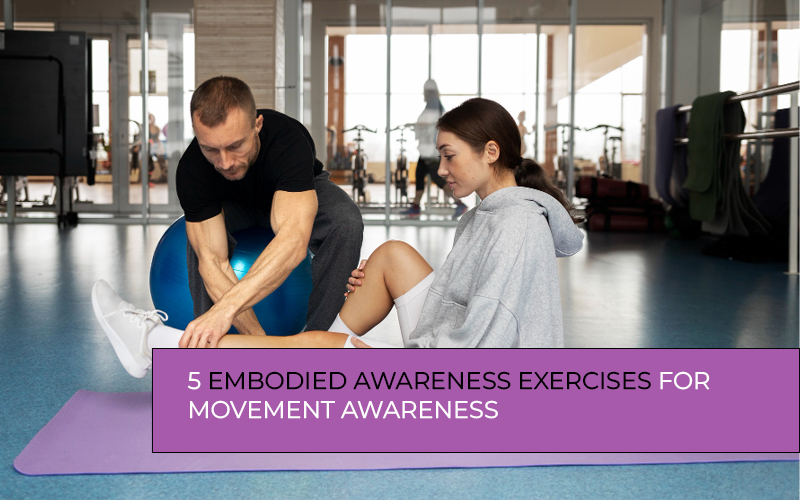
5 Embodied Awareness Exercises for Movement Awareness
Embodied awareness exercises help you notice how your body moves, breathes, and uses effort.
Each exercise focuses on movement observation, posture awareness, breath awareness, and body sensation through guided movement exploration.
SomaFlow™ Institute in Las Vegas offers these exercises as part of its somatic movement and experiential learning approach.
The five best exercises are slow weight-shift practice, seated pelvis and spine awareness, breath response during arm movement, mindful reaching, and touch and pressure awareness.
Each exercise helps you notice your movement patterns, postural habits, breath response, and physical sensation from the inside out.
What Does Embodied Awareness Mean in Movement Practice?
Embodied awareness means paying attention to lived body experience.
It includes sensation, movement, breath, posture, balance, pressure, weight, timing, and muscular effort.
Embodied movement exploration allows individuals to observe the body as a living system rather than a fixed structure.
Someone exploring movement may notice how the body gets up from a chair, not just whether it can stand.
They may notice if they hold their breath, put more weight on one foot, tighten their shoulders, or avoid one side.
In guided somatic exploration, a person may notice how the body responds to touch, such as shifts in breathing, muscle tension, pressure sensations, warmth, or small body movements.
Embodied awareness helps individuals notice how they move, not just what movement they do.
Those who want to understand the wider field can also explore somatic movement and how different body-based approaches support movement awareness, touch, and embodied exploration.
5 Embodied Awareness Exercises for Movement Awareness
Embodied awareness exploration goes beyond observing movement from the outside. It involves noticing how the body moves, breathes, and responds from the inside.
It also helps the individual stay aware of their own body during exploration.
A tense or rushed state may affect how movement feels and how much can be noticed.
A calm, aware, and grounded state creates a clearer space for embodied observation.
Embodied awareness supports deeper observation during movement exploration by helping individuals notice their bodies with greater care and attention.
1. Slow Weight Shift Practice
Slow weight shifting is a simple embodied awareness exercise for individuals exploring somatic movement and body awareness.
It helps develop a sense of balance, posture, standing habits, and how the body carries weight.
Stand with both feet on the floor. Keep your knees soft.
First, notice where your weight is. Is it more on the heels, toes, left foot, or right foot? Do not try to fix it at once. Just notice it.
Now move your weight slowly forward and backward. Then move it slowly from side to side. Keep the movement small and easy. Notice how your feet, ankles, knees, hips, spine, and head respond.
This exercise is useful for exploring embodied awareness because it highlights how the body organizes weight and balance in everyday standing.
For a deeper look at posture work, individuals can explore somatic awareness for posture in a body-centered way.
The body may lean more to one side, shift weight forward, or hold tension in one area without awareness.
Slow weight shifting helps bring these patterns into conscious observation before they become habitual.
It also deepens movement observation. When noticing a weight shift, the individual can explore whether the movement feels smooth, stiff, uneven, rushed, or guarded.
Balance exercises are also commonly used to support safer movement and stability, Mayo Clinic explains.
2. Seated Pelvis and Spine Awareness
Seated pelvic and spinal awareness helps individuals explore sitting posture through direct body experience.
The goal is not to force a “perfect posture.”
It is worth noticing how the pelvis, spine, ribs, neck, and head work together while sitting.
Sit on a chair with both feet on the floor. Notice where your body touches the chair.
Are you sitting more on one side?
Is your weight forward or backward?
Does your spine feel stiff, heavy, lifted, or relaxed?
Now slowly rock your pelvis forward and backward. Keep the movement small. Notice how your lower back, ribs, shoulders, neck, and head respond.
Then shift gently from side to side and notice if one side feels easier than the other.
This exercise supports embodied awareness by bringing attention to sitting habits that often go unnoticed.
A person may sit with more weight on one side, hold the lower back, or keep the spine stiff without realizing it.
3. Breath Response During Arm Movement
Breath and movement are closely connected.
The body may hold the breath when feeling effort, tension, or unfamiliar movement during exploration.
Sit or stand in a comfortable position. Let your breath stay natural. Do not force deep breathing. Just notice where you feel the breath. It may be in the chest, ribs, belly, back, shoulders, or throat.
Now slowly raise one arm and lower it again. Repeat this a few times. Notice what happens to your breath.
Try to understand if your breath stops or becomes shallow. Check whether your shoulder lifts or your jaw tightens. Ask yourself if the movement feels easy or heavy.
This embodied awareness exercise helps individuals notice how breathing responds during movement exploration.
Breath awareness can reveal effort, guarding, or tension even when movement feels fine on the surface.
Cleveland Clinic explains diaphragmatic breathing as a way to notice and use the diaphragm during breathing practice more clearly.
It underscores the importance of breath awareness in body-based work.
4. Mindful Reaching for Movement Awareness
Mindful reaching is a practical, embodied awareness exercise because it occurs constantly throughout daily movement.
Stand or sit near an object. Before you reach, pause for a moment. Notice your feet, spine, shoulders, neck, and breath. Then reach slowly toward the object.
Notice what moves first. Your hand, shoulder, or neck?
Pay attention to whether your lower back works too hard. Observe if you hold your breath.
Now reach again with less effort. Let your body support the movement.
Allow the ribs, spine, and weight to shift to help, rather than relying only on the shoulder and arm.
The American Massage Therapy Association highlights body mechanics because it can help protect joints, reduce strain, and support career longevity.
Mindful reaching also helps with noticing how the whole body participates in movement, not just the arm or shoulder.
If reaching feels effortful or stiff, the exploration may reveal breath holding, limited rib movement, poor weight shift, or tension elsewhere in the body.
5. Touch and Pressure Awareness
Touch and pressure awareness is a valuable embodied awareness exercise for individuals exploring body sensation and somatic movement.
Touch can be explored as an awareness-based experience.
Place one hand on your opposite forearm. Apply light pressure. Notice your own hand, wrist, elbow, shoulder, and breath.
Also, notice if your fingers feel tight or your wrist feels stiff.
Check whether your shoulders are lifting. Observe if you press only with your hand or let your whole body support the touch.
Now reduce the pressure slightly.
Notice if the contact feels clearer. Then slowly add a little more pressure and notice what changes.
Keep your attention on both sides: the hand giving touch and the body receiving touch.
This exercise helps individuals explore how touch and pressure feel from both sides.
Why Does SomaFlow’s Approach Fit Embodied Awareness Exploration?
SomaFlow™ Institute is not just about relaxation or slow movement.
The SomaFlow approach is for individuals exploring embodied awareness, somatic movement, and experiential learning through direct body experience.
It helps people notice important things during guided movement exploration, such as:
- Forcing or bracing during movement
- Breath holding during touch or movement exploration
- Guarding, stiffness, or body tension
- One side of the body working harder
- Needing more time to feel a movement fully
- Using too much effort during exploration
- Postural habits during everyday movement
This kind of embodied awareness makes movement exploration more careful, clear, and awareness-centered.
It helps individuals notice movement patterns more clearly, deepen body awareness, and stay present during embodied exploration.
Those who want to grow further in this field can learn more about somatic movement and the experiential learning that supports body awareness.
How Can Individuals Use Embodied Awareness Exercises Daily?
These exercises can fit naturally into everyday life.
They do not need to be treated as a separate routine.
They can be used in small moments of awareness throughout the day.
Individuals can use embodied awareness by noticing:
- Standing posture during everyday activities
- Breathing during movement or moments of effort
- How much tension the body holds during simple tasks
- Body position during reaching, sitting, or walking
- Weight shift while standing or moving
- Shoulder, neck, or back sensation during the day
- Full movement patterns, not just one area of the body
- Small changes in breath, posture, or body response during movement
For example, someone may check their weight shift before standing from a chair.
Another person may notice their breath during a shoulder movement.
Seated pelvis awareness can be used at any moment of sitting throughout the day.
Deepen Your Embodied Awareness with SomaFlow!
If you are an individual exploring embodied awareness, somatic movement, or experiential learning, SomaFlow™ Institute in Las Vegas can help you deepen your understanding of how your body moves, breathes, and organizes effort.
You can learn to notice movement, breath, posture, touch, and body sensation in a simple, practical way.
Explore our workshops and SIGN UP for our learning programs in Las Vegas to bring more awareness and presence into your embodied exploration.