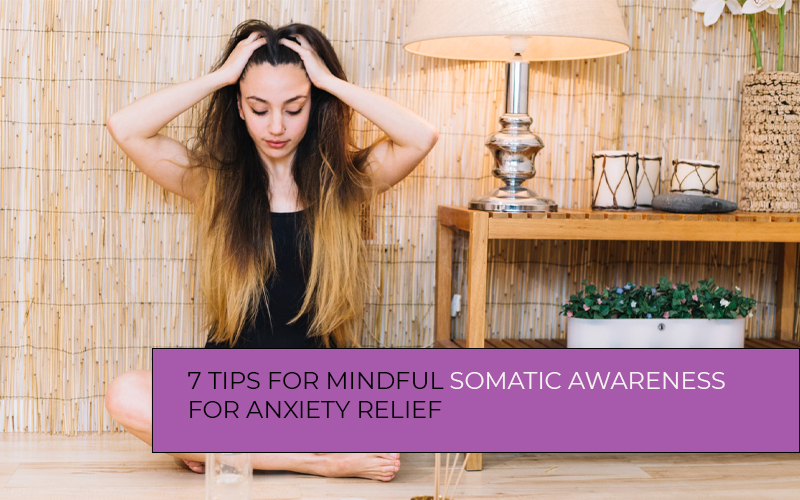
7 Tips for Mindful Somatic Awareness for Anxiety Relief

We hope you enjoyed reading and learning more about the body and mind. If you would like to connect with our experts, click here
Author: Glenn Hall | Co-Founder of SomaFlow™ Institute
Mindful somatic awareness relieves anxiety by teaching your body to calm itself from the inside out.
Anxiety does not live in your thoughts. It lives in your body. Your chest tightens, jaw clenches, and shoulders creep toward your ears. Your breath goes shallow before your mind even knows something is wrong.
That tightness is not a flaw in you. It is your nervous system carrying out the job it was designed for. The issue begins when it stays locked in that state. And no amount of overthinking is going to loosen it.
At SomaFlow™ Institute, we train therapists and bodywork professionals to bring somatic movement education into their client sessions.
Our practitioners learn to guide clients through body-awareness practices that calm the nervous system, release tension, and build resilience.
These seven tips reflect the same approach our trained facilitators use every day.
What Is Somatic Awareness, Really?
The term somatic is rooted in a Greek word that means body. At its core, somatic awareness is about tuning in to the physical sensations present within you in this moment.
Not the story in your mind. Not the interpretation. The direct experience in your body.
It could show up as pressure in your chest. A light trembling in your belly. A weight in your arms and legs. Or a quiet sense that your entire system is on alert for something that might never actually happen.
When you begin to observe these sensations without immediately trying to change or resist them, a shift occurs.
Your nervous system gradually eases. Your breathing becomes fuller. The intensity of anxious energy starts to soften.
This is not abstract theory. It is physiology. Your body has its own natural mechanism for calming down. Somatic awareness is one way to activate it.
A Different Way of Working With the Body
SomaFlow offers an approach centered on embodied practice and facilitation that many practitioners find more sustainable over time, prioritizing awareness, adaptability, and working with the body rather than against it.
Why Does Somatic Awareness Help with Anxiety?
Anxiety does not live only in your thoughts. It moves through your entire body.
Conversation-based therapy supports many people. Yet speaking about anxiety does not always dissolve it. The activation lingers in the body, and the body requires its own form of care.
Somatic awareness takes another route. It guides your focus inward, toward physical sensation. In doing so, it engages your parasympathetic nervous system, the branch responsible for rest, digestion, and a sense of ease.
Research on interoception (the awareness of internal body sensations) shows that people who sense their body accurately may regulate their emotions effectively.
Noticing your body is not a passive skill. It is a trainable one.
7 Tips for Practicing Mindful Somatic Awareness for Anxiety Relief
Each of these tips comes from the same somatic framework SomaFlow™ teaches to practitioners. Try one. Then try them all.
Tip 1: Start with One Breath, Not Ten
Most people hear “breathe” and immediately try to do box breathing or four-seven-eight breathing or some technique they half-remember.
Stop. Just take one breath.
Inhale slowly. Feel your ribs expand. Feel your belly rise. Exhale all the way. Feel your body soften.
That is it. One breath done with full attention is more powerful than ten breaths done on autopilot.
This is the foundation of somatic awareness. Presence over performance.
Tip 2: Feel Your Feet on the Floor
When anxiety spikes, your attention shoots upward, into your head, thoughts, everything that might go wrong.
This is a quick reset. Feel your feet.
Gently press your feet into the ground. Feel your weight settling downward. Pay attention to what is beneath you, the surface against your soles, the way it feels, whether it is cool or warm.
This practice is known as grounding. It is not symbolic. You are deliberately shifting your nervous system away from searching for danger and toward direct sensory input.
Sensation brings you into the here and now, and in the present moment anxiety has far less control.
Tip 3: Do a Slow Body Scan
This is one of the most effective somatic tools for anxiety. And it takes less than five minutes.
Start at the top of your head. Move your attention slowly downward. Forehead. Eyes. Jaw. Neck. Shoulders. Chest. Belly. Hips. Thighs. Calves. Feet.
Do not try to relax anything. Just notice.
Is there tightness somewhere? Heat? Numbness? A held breath? You are not fixing. You are observing. The act of noticing itself tells your nervous system that it is safe to let go.
Try this once a day. Even better, try it when you first notice anxiety building.
Tip 4: Let Your Exhale Be Longer Than Your Inhale
You do not need an elaborate method to calm your breath. Simply make your exhale longer than your inhale.
Try breathing in for a count of four. Then breathe out for six or even eight.
Lengthening the exhale stimulates the vagus nerve, a key pathway of your parasympathetic system. It cues your heart to slow down and lets your body know it can ease off.
The effect is often quick. After just a handful of breaths, you may notice your system beginning to soften.
Tip 5: Move Slowly and With Awareness
Anxiety often makes people want to move fast. Fidget. Pace. Shake their leg. This is your body trying to discharge energy.
Let it. But do it with intention.
Gently circle your shoulders at an unhurried pace. Not to force a stretch, but simply to sense them. Let your head tip from one side to the other, slowly. Notice the weight it carries. Allow your jaw to loosen.
Deliberate, steady movement communicates safety to your nervous system. Quick, tense motions tend to reinforce the feeling that something is wrong.
This is the core idea behind somatic movement education. Movement done with awareness is medicine.
Tip 6: Name What You Feel in Your Body, Not What You Think
This is a subtle but powerful shift.
When anxiety hits, most people say, “I feel like something bad is going to happen.” That is a thought dressed as a feeling.
Instead, try this. Say, “I feel tightness in my chest.” Or, “I feel a buzzing in my arms.” Or, “My stomach feels hollow.”
Naming body sensations activates the prefrontal cortex. That is the rational part of your brain. It creates a small but important distance between you and the sensation. Research calls this affect labeling. It reduces the intensity of the experience.
Words about the body calm the body.
Tip 7: Build a 5-Minute Daily Practice
You do not need a full hour, special equipment, or an app guiding you through it.
You need five minutes. And you need to return to it every day.
Here is a simple framework. Sit in a way that feels supportive. Take one slow, complete breath. Gently scan your body from the top of your head down to your feet. Notice a single sensation without labeling it as good or bad. Take one more full breath. That is it.
That is the whole practice.
Its strength does not come from duration. It comes from repetition. Each time you do this, you are strengthening your ability to sense what is happening inside you.
You are teaching your nervous system how to regulate itself. With time, your entire relationship with anxiety begins to shift.
A Note on Somatic Work and Anxiety!
Somatic awareness is not therapy. It is education. It is a practice.
If you are working with a clinical anxiety disorder, please continue working with your therapist or doctor. Somatic awareness techniques can strongly support professional treatment. They are meant to work alongside clinical care, not take its place.
But for the daily hum of anxiety, the low-grade tension that so many people carry, these practices are some of the most effective tools available. They are free. They are always with you. And your body already knows how to do them.
You just have to remember to listen.
Final Thought!
Your body is not the enemy.
It is attempting to keep you safe. It always has been. Somatic awareness simply gives you a way to relate to it differently. A conversation that unfolds at a gentler pace. One rooted in patience.
Begin modestly. One steady breath. One slow scan. Five minutes.
Your nervous system pays attention to that. And with time, you will begin to sense the difference as well.
If you feel drawn to exploring guided somatic movement with an experienced facilitator, the SomaFlow™ Institute offers in-person workshops and small group training programs in Las Vegas for practitioners interested in body-centered awareness.
DISCLAIMER: SomaFlow™ is an educational framework and not therapy or clinical training.
About the Author

Glenn Hall
Glenn Hall knows what it’s like to live with pain. Born with a serious back condition, he grew up dealing with stiffness, poor posture, and discomfort that never fully went away. Later in life, his challenges intensified: he suffered two complete biceps tears and two supraspinatus muscles retracted off the bone.