5 Somatic Exercises for Beginners to Improve Body Awareness
Somatic exercises are slow, simple movements that help you notice your body from the inside. These help you become aware of posture, tension, and how your body moves in daily life.
Many therapists, massage therapists, and physiotherapists face a common issue.
Clients often move without awareness, so tension patterns return even after treatment.
This makes progress slow and inconsistent, even when care is good.
SomaFlow™ Institute offers training in this area. Based in Las Vegas, our team teaches somatic movement through slow, guided exploration and focused attention.
You learn how the body holds tension and how awareness can gently shift movement habits over time.
What Are Somatic Exercises?
Somatic exercises are slow, simple movement practices performed with full attention.
The main goal is to build somatic awareness of the body from the inside.
In somatic movement exercises, a person slows down and notices what is happening in their body while they move. This includes:
- How the body feels during movement
- Where tension shows up
- How each movement begins and ends
- How posture changes with small shifts
Therapists use various somatic therapies to help clients reconnect with natural movement patterns in a safe, gentle way.
This makes it easier for the body to notice habits that often go unseen.
Harvard Health studies on body awareness show that mindful movement improves internal body perception and coordination over time.
Why Do Therapists Use Somatic Movement Exercises?
Therapists, massage therapists, and physiotherapists notice the same problem.
Clients feel better after treatment, but the same tension patterns return again and again.
Somatic movement exercises help slow this cycle down. They draw attention to how the body moves in real time, rather than treating symptoms only after they appear.
- They support:
- Better awareness of how the body moves
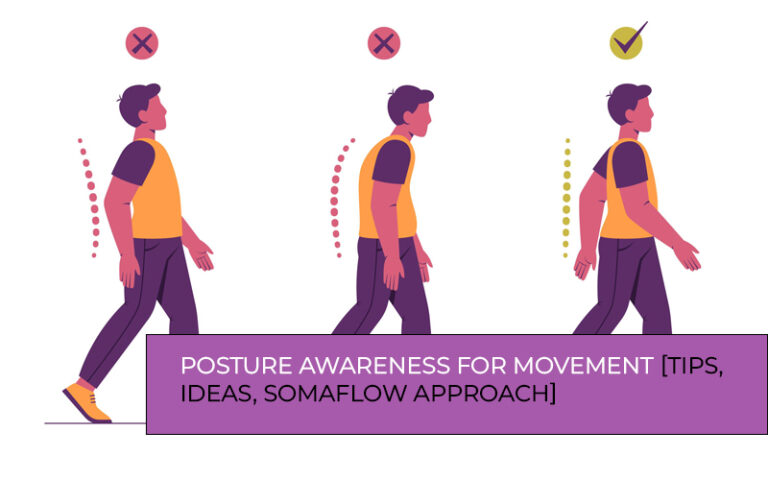
- More control over posture and alignment
- Smoother and more natural coordination
- Less unconscious muscle holding and stiffness
Instead of telling the body what to do, you guide the client to notice what is already happening.
This simple shift changes how the body learns.
Somatic work influences internal regulation and movement patterns, supporting nervous system regulation.
5 Beginner Somatic Exercises for Body Awareness
Below are simple somatic exercises you can use in sessions or teach to clients. Keep everything slow. Keep everything light.
1. Still Body Check
Ask the client to sit or lie down in a comfortable position. Let the body fully settle.
At first, there is no movement at all. Only stillness.
Guide their attention step by step:
- Ask them to feel where the body is touching the surface
- Help them notice if some areas feel heavy, light, tight, or relaxed
- Bring attention to the breath and how it moves in the body
- Ask them to notice if breathing feels easy in some areas and blocked in others
Stay here for a short moment without rushing.
This simple pause helps the nervous system slow down and brings attention back to basic body signals. It serves as the basis for all other somatic exercises.
2. Slow Head Turn
Ask the client to slowly turn the head to one side. The movement should be very small, almost like a half turn.
Tell them to move more slowly than they normally would.
During the movement, guide their attention. Ask them to:
- Notice where the movement begins: neck, shoulders, or chest
If one side of the neck feels tighter or shorter
Feel how the jaw, eyes, or breath change as the head moves
Pause in the middle and feel the position before going further
Then they return slowly to the center.
Repeat on the other side with the same slow attention.
This exercise helps clients notice small differences between the left and right sides and improves awareness of neck and upper spine habits.
3. Shoulder Lift and Drop
Ask the client to gently lift both shoulders upward, as if moving them toward the ears. The movement should stay light and controlled.
Then ask them to let the shoulders drop completely without forcing it.
Guide attention during the movement and ask them:
- If and where they feel effort in the starting, neck, upper back, or arms
- Notice if one shoulder lifts more easily than the other
- What happens in the breath when the shoulders rise and fall
- Pause at the bottom and feel the weight of the shoulders resting
Repeat slowly a few times, always with pauses in between.
This helps clients become aware of hidden tension that often remains in the upper body unnoticed.
4. Arm Reach with Awareness
Ask the client to slowly lift one arm forward at a comfortable speed. The movement should not be stretched or pushed.
Tell them to move as if they are discovering the movement for the first time.
Guide their attention and ask questions like:
- Notice how the shoulder supports the arm
- If the movement feels smooth, shaky, heavy, or light
- Feel what happens in the ribs and chest during the reach
- How does balance change in the body when they lift the arm
- Pause at the top and simply feel the position
Then they slowly lower the arm back down.
Repeat on the other side.
This exercise helps improve coordination and shows how different parts of the body work together, even in a simple movement.
5. Pelvic Rock (Seated or Lying)
Ask the client to sit or lie down comfortably. Then guide them to gently tilt the pelvis forward and backward in a very small range of motion.
Keep the movement soft and slow.
Guide their awareness again and ask them to:
- Notice how the lower back moves with the pelvis
- If the movement feels smooth or stuck in certain areas
- Feel how the weight shifts between the hips and the lower spine
- Notice if the movement affects breathing or posture
- Pause in the middle and feel the neutral position
This exercise helps clients understand how the pelvis influences posture and whole-body coordination.
How Therapists Can Guide Somatic Exercises
When you guide somatic work, the way you speak and pause is more important than the movement itself.
Keep everything simple and calm:
- Move slowly and demonstrate patience
- Pause often so the client can feel what is happening
- Ask short questions about sensation, not performance
- Allow silence so the client can observe their own body
Do not correct posture in a forceful way. Do not rush the process. The goal is awareness, not fixing or shaping the body into a “perfect” position.
Somatic movement works best when clients feel safe to explore without pressure. Over time, this builds stronger body awareness and more natural movement patterns in daily life.
SomaFlow™ Institute in the USA teaches this approach through structured somatic movement and embodied awareness training for therapists and practitioners.
Many practitioners delve deeper into this field to explore becoming somatic therapists.
Common Mistakes That Take Away the Purpose of Somatic Exercises
Many people new to somatic exercises tend to treat them like fitness training.
They begin moving too fast, pushing too hard, or trying to “do it right.”
This changes the whole purpose of somatic movement exercises.
The goal is not performance or stretching, but awareness.
When the body is rushed or forced, it stops noticing small internal signals, and the learning becomes shallow.
Another common mistake is overthinking the process.
Some people explain too much, correct too much, or chase perfect posture during the movement. This pulls attention away from direct experience. Somatic work is strongest when it stays simple, slow, and felt in the moment.
When the focus stays on natural breathing, a small range of motion, and quiet attention, the body begins to notice patterns on its own. This is where real awareness grows.
Simple Way to Start Using Somatic Movement Exercises
If you are a therapist, massage therapist, or physiotherapist, the best way to begin is to keep everything very small and simple.
Do not try to change your whole session at once. Pick just one somatic movement exercise and place it either at the start or at the end of your session. This keeps the practice light and easy to integrate without pressure.
At first, focus on timing more than technique. Even two to three minutes of slow movement with full attention can shift how a client experiences their body.
When you guide a client through slow head turns, gentle shoulder lifts, or simple stillness, you are helping them notice sensations they usually ignore.
Over time, you can build from this small start.
Add one more exercise when the first feels natural. Keep the structure loose, not rigid. Somatic movement works best when it feels like an exploration, not a routine.
This is how it slowly becomes part of your therapeutic style and supports everything else you already do in your practice.
Final Note!
Somatic exercises and somatic movement exercises offer therapists a simple, practical way to help clients build stronger body awareness through slow, guided movement.
It does not replace your existing therapy work. It adds depth and helps clients understand their bodies in a more direct and lasting way.
If you want to learn this approach in a structured, hands-on way, you can train with SomaFlow™ Institute and bring this method into your professional practice.
Explore SomaFlow™ workshops and start learning somatic movement training for therapists.