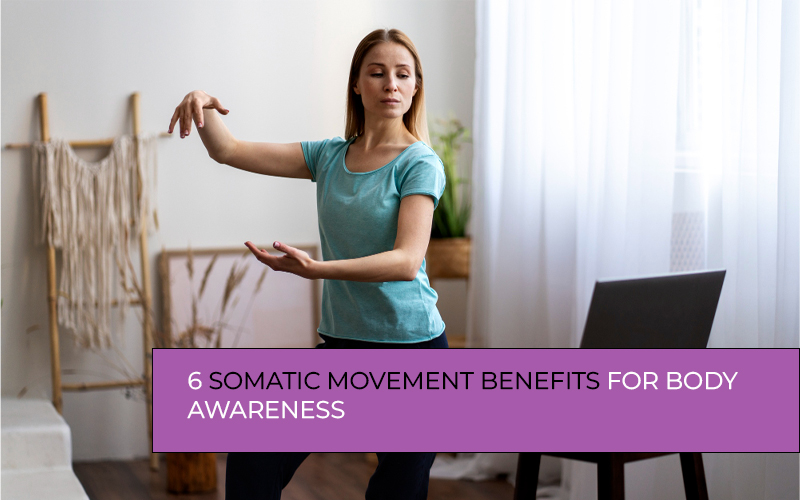
6 Somatic Movement Benefits for Body Awareness
We hope you enjoyed reading and learning more about the body and mind. If you would like to connect with our experts, click here
Author: Shoshi Hall | Co-Founder of SomaFlow™ Institute
Somatic movement helps you notice how your body moves, holds tension, and responds during everyday life.
Many people move through the day without paying attention to posture, breathing, or movement habits. Over time, this can make the body feel stiff, disconnected, or hard to understand.
Somatic movement offers a slower and more aware way to explore movement through focused attention and embodied practice.
At SomaFlow Institute, somatic movement and embodied practice help people build body awareness through guided movement exploration.
Your aim should not be to “fix” the body, but to notice, feel, and better understand how you move.
What Is Somatic Movement?
Somatic movement is a mindful movement practice that focuses on internal awareness.
Instead of copying exercise movements quickly, you move slowly and pay attention to sensation, coordination, posture, balance, breathing, and movement patterns.
The word “somatic” comes from the Greek word “soma,” which means “the living body.” Somatic practices are used in many movement education methods, including:
- Embodied movement
- Movement awareness training
- Functional movement exploration
- Mindful movement practices
- Body awareness education
The National Center for Complementary and Integrative Health explains that mind-body practices support brain-body interaction through methods such as meditation, relaxation, yoga, tai chi, and other awareness-based practices.
These practices include slow movement, breath awareness, sensory attention, and guided observation.

A Different Way of Working With the Body
SomaFlow offers an approach centered on embodied practice and facilitation that many practitioners find more sustainable over time, prioritizing awareness, adaptability, and working with the body rather than against it.
Why Do People Practice Somatic Movement?
People are drawn to somatic movement and different types of somatic therapy because they want to feel more connected to their body’s movement.
Some people notice they move through life on autopilot. Others want better posture awareness, smoother movement coordination, or more comfort during daily activities.
Somatic movement helps people slow down and pay attention to how their bodies move during everyday life.
Through gentle movement and focused awareness, people begin to notice their posture, breathing, shoulder tension, walking patterns, and coordination more mindfully.
This makes somatic movement simple, beginner-friendly, and easy to explore at any pace.
The World Health Organization notes that physical activity can be undertaken at any skill level and encompasses many forms, from walking and cycling to recreation and everyday movement.
Somatic Movement Benefits You Cannot Ignore
Somatic movement is helpful because it brings your attention back to how your body actually feels and moves in daily life.
Many people go through the day with tight shoulders, stiff backs, shallow breathing, or poor sitting habits without even noticing them.
Somatic movement slows things down so you can understand your body better, move with more ease, and become more aware of patterns that usually happen on autopilot.
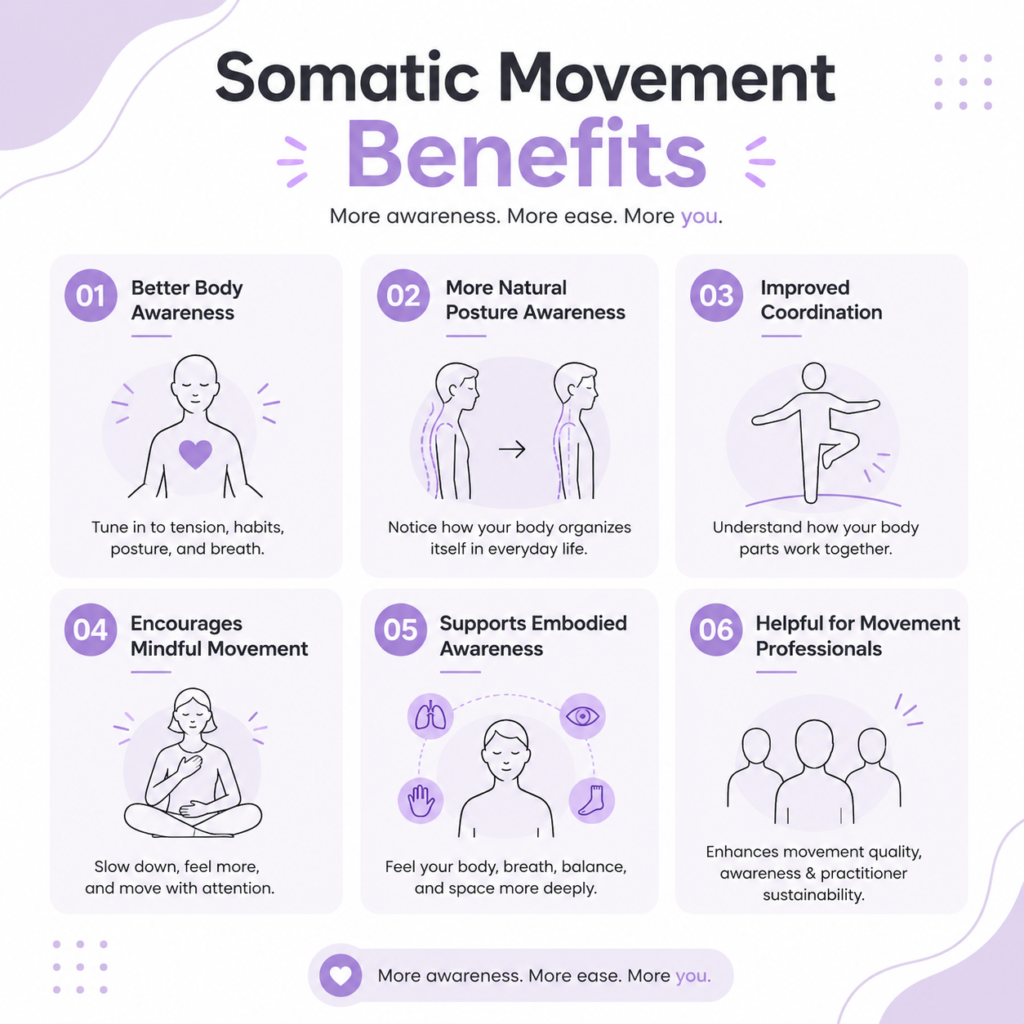
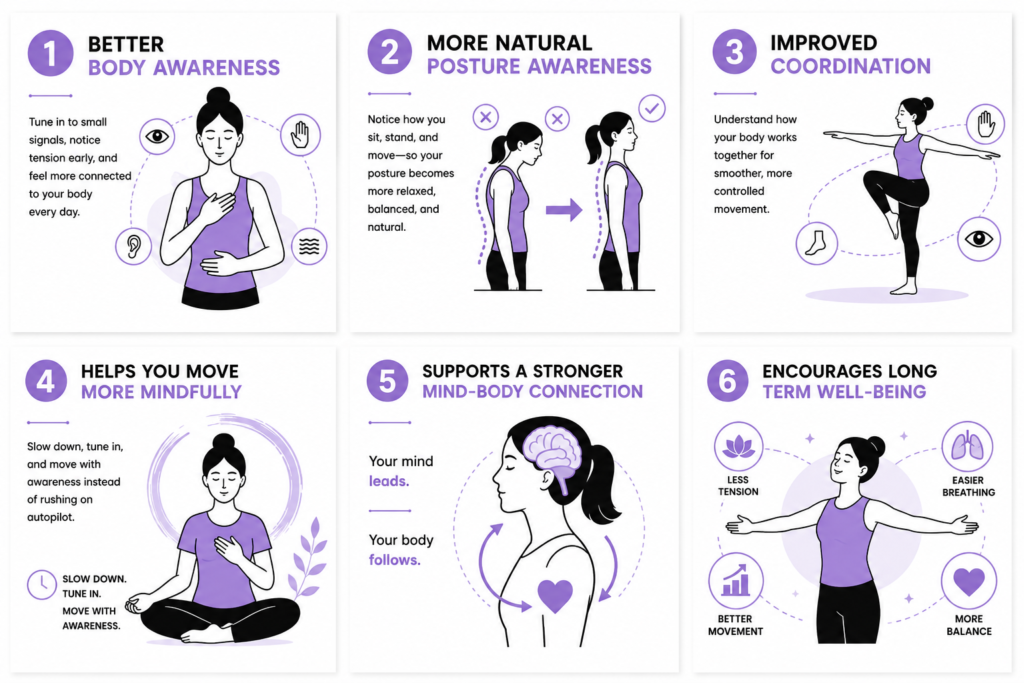
1- Better Body Awareness
One of the biggest benefits of somatic movement is that it helps you become more aware of your own body.
Most people only notice their body when something feels uncomfortable, painful, or tense. Somatic movement helps you notice smaller signals earlier.
For example, you may begin to realize that you hold tension in your neck while working, lock your knees while standing, or breathe shallowly when stressed.
These small discoveries matter because once you notice a habit, you can begin to change your relationship with it.
Instead of pushing the body harder, somatic movement teaches you to listen more closely.
Over time, this can help you feel more connected to your posture, breathing, balance, and everyday movement.
2- More Natural Posture Awareness
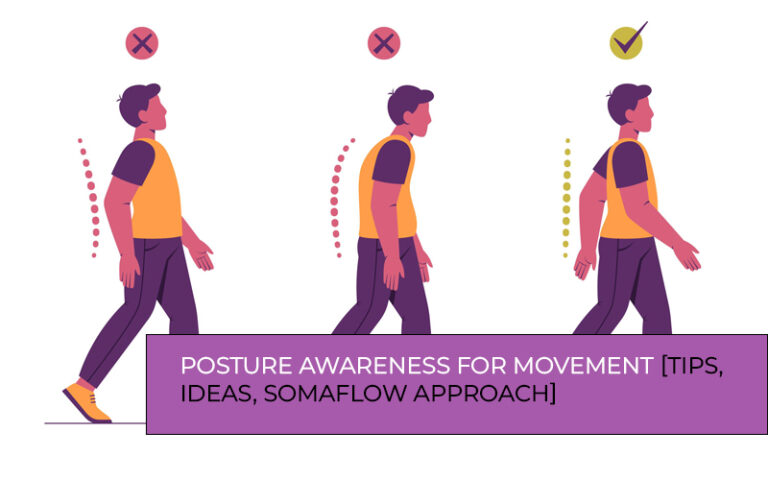
Somatic movement is not about forcing yourself to “stand up straight” all day. That usually creates more tension.
Instead, it helps you notice how your posture changes in different situations.
You may begin to notice how you sit at your desk, how your shoulders move when you walk, or how your head drops forward when you use your phone.
This awareness is more useful than trying to hold a perfect posture.
The goal is not to make your body look perfect.
The goal is to help your body feel more organized, relaxed, and natural during daily activities like sitting, standing, reaching, and walking.
3- Improved Coordination
Somatic movement can also help you understand how different parts of your body work together.
Simple actions like walking, bending, turning, or lifting something all require coordination, but most people do these movements without thinking.
When you practice somatic movement slowly, you start noticing connections.
You may feel how your feet affect your balance, how your spine responds when you turn, or how your breathing changes when you lift your arms.
These moves feel clearer and more controlled. You are not just moving randomly. You are learning how your body works as a complete system.
4- Helps You Move More Mindfully
Modern life keeps people rushing. Many people move from task to task without paying attention to how their bodies feel.
Somatic movement creates a quiet space to slow down and move with attention.
Instead of focusing on speed, effort, or performance, the focus is on sensation.
You notice whether a movement feels easy, tight, smooth, restricted, heavy, or light.
These moves feel less like exercise pressure and more like self-awareness.
It can be helpful for people who want a gentler way to reconnect with their body without forcing intense workouts.
5- Supports a Stronger Mind-Body Connection
Somatic movement helps you feel more present in your body. This is called embodied awareness, but in simple words, it means you are not just thinking about your body from the outside.
You are feeling it from the inside.
You become more aware of breathing, balance, tension, space, and movement habits.
This can be useful for people who spend long hours in front of screens, sit for most of the day, or feel physically disconnected due to stress or busy schedules.
Even small movements can become meaningful when done with attention. A simple shoulder roll, slow turn, or gentle stretch can help you notice what your body needs in that moment.
6- Useful for Movement Professionals
Somatic movement is also valuable for people who work with movement, such as yoga teachers, dancers, Pilates instructors, fitness coaches, massage therapists, and bodywork professionals.
For these professionals, somatic practice can improve their understanding of movement quality, body mechanics, postural habits, and coordination.
It can also help them teach or guide others with more sensitivity.
Because somatic movement is not based on intensity or competition, it fits well with many practices. People explore it alongside traditional exercise approaches to create more mindful movement habits.
It can support yoga, dance, fitness, rehabilitation-style movement, and general wellness routines.
How Can You Start Somatic Movement?
You do not need any special experience to begin somatic movement. The best way to start is slowly, gently, and with full attention to how your body feels.
Start by choosing a quiet space where you can move without distraction. Wear comfortable clothes and give yourself a few minutes to settle before starting.
Take a few slow breaths and notice how your body feels while standing, sitting, or lying down.
Start with small movements instead of big stretches.
You can gently roll your shoulders, turn your head from side to side, move your spine slowly, or notice how your feet connect with the floor.
Move at a pace that feels calm and natural.
Pay attention to your breathing, posture, and body sensations as you move. Notice where you feel tension, ease, tightness, warmth, or relaxation.
There is no need to force your body into a perfect position.
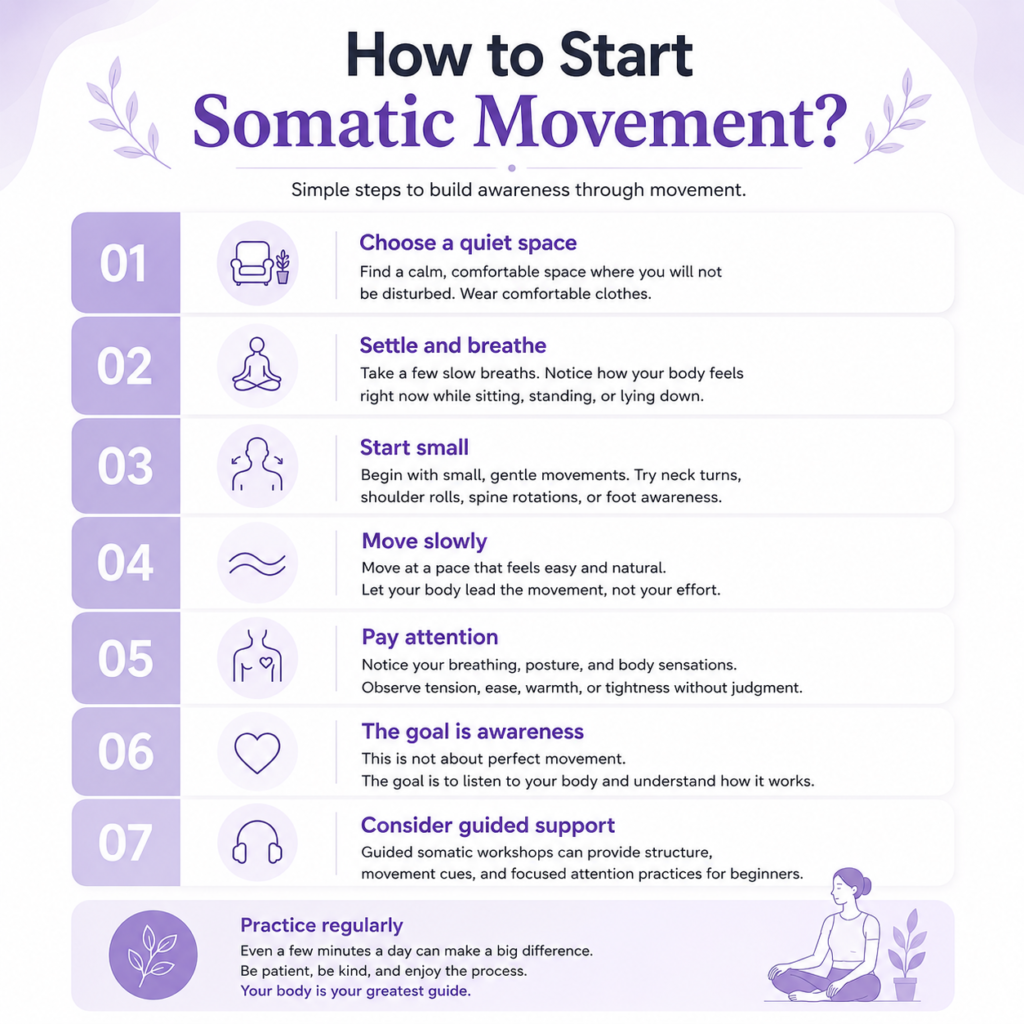
You are learning to listen to your body and understand how its different parts work together.
For beginners, guided somatic workshops can be helpful because they provide simple movement cues, structure, and a safe space to explore body awareness.
With regular practice, somatic movement can become an easy and mindful part of your daily routine.
Final Note!
Somatic movement helps people build awareness of posture, coordination, movement habits, and physical sensations through slow, mindful exploration.
It is not about forcing the body to move a certain way. It is about learning how your body already moves and becoming more aware of that experience.
If you want to explore embodied practice in a simple, supportive environment, book a workshop with SomaFlow Institute to start building deeper body awareness through guided somatic movement.
Full-Body SomaFlow Course
An immersive introduction to embodied awareness, self-practice, and whole-body integration through the SomaFlow method.
People Also Ask
How does somatic movement improve body awareness?
Somatic movement uses slow, guided movement and focused attention. This helps people notice sensation, posture, breathing, and movement habits more clearly.
Why do people do somatic movement?
People practice somatic movement to feel more connected to their body and movement experience. Many enjoy the slower pace and awareness-based approach to movement exploration.
What is embodied practice?
Embodied practice is the process of paying attention to physical experience through movement, sensation, posture, and awareness. It encourages a deeper connection between movement and attention.
How do beginners start somatic movement?
Beginners can start with slow and simple guided movements in a calm environment. Workshops and somatic movement classes can also help people learn awareness-based movement practices safely and comfortably.
About the Author
Shoshi Hall
Shoshi Hall’s journey into healing began on the stage. As a professional dancer, she experienced both the beauty and the vulnerability of the human body. Years of rigorous training left her with persistent neck and lower back pain, discomfort that touched not only her body but her spirit as well.