5 Best Somatic Workouts for Movement Awareness

We hope you enjoyed reading and learning more about the body and mind. If you would like to connect with our experts, click here
Author: Shoshi Hall | Co-Founder of SomaFlow™ Institute
The best somatic workouts for movement awareness are mindful movements that help you notice posture, breathing, coordination, balance, and tension patterns more clearly.
Somatic workouts help you move with greater awareness by slowing your movements and paying attention to how your body feels.
Many people exercise without noticing posture, breathing, balance, or tension patterns. Over time, movement can start to feel rushed, stiff, or disconnected.
Somatic workouts offer a mindful way to explore movement through attention and body awareness.
At SomaFlow™ Institute in Las Vegas, somatic movement helps people become more aware of how their bodies move during everyday life.
The aim is to help you notice movement patterns, physical sensations, posture habits, and coordination.
What Is a Somatic Workout?
A somatic workout is a slow, awareness-based movement session that focuses on how movement feels in the body.
Unlike traditional workouts that focus on speed, repetitions, or calorie burn, somatic workouts focus on sensation, breathing, posture, coordination, and mindful attention.
The word “somatic” comes from the Greek word “soma,” meaning “the living body.” Somatic movement practices encourage people to pay attention to their internal movement experience rather than focusing solely on external performance.
A somatic workout may include:
- Gentle stretching
- Slow floor movements
- Breathing awareness
- Posture exploration
- Mindful walking
- Simple coordination exercises
You usually do these movements slowly so you can notice how different parts of the body move together.
The National Center for Complementary and Integrative Health explains that mind-body practices like yoga, tai chi, and other awareness-based movement approaches support attention, relaxation, and body awareness.
What Makes a Workout “Somatic”?
A workout becomes somatic when awareness becomes the main focus of the movement.
In many traditional fitness routines, people move quickly while thinking about sets, repetitions, or physical goals.
In somatic workouts, the attention shifts toward noticing physical sensations and movement habits.
Instead of rushing through a shoulder movement, you may pause and notice:
- Are the shoulders tight or relaxed?
- Does one side move differently?
- Are you holding your breath?
- Does the neck feel tense during movement?
These small observations help you understand your movement patterns more clearly.

A Different Way of Working With the Body
SomaFlow offers an approach centered on embodied practice and facilitation that many practitioners find more sustainable over time, prioritizing awareness, adaptability, and working with the body rather than against it.
How Do Somatic Workouts Differ From Traditional Fitness?
Traditional workouts focus on intensity, strength, endurance, or appearance.
Somatic workouts focus more on movement quality and body awareness.
That does not mean somatic movement is “better” than fitness training. It simply has a different purpose.
In a traditional gym workout, people often move quickly and follow structured exercises.
In somatic movement, slower movement allows you to notice posture, breathing, balance, coordination, and tension more carefully.
For example, during a squat in a traditional workout, the focus may be on repetitions and muscle effort.
In a somatic workout, the focus may be on how the feet connect to the floor, how the spine responds, or whether the breathing stays relaxed during movement.
This slower pace can feel calming and beginner-friendly for people who want a more mindful movement experience.
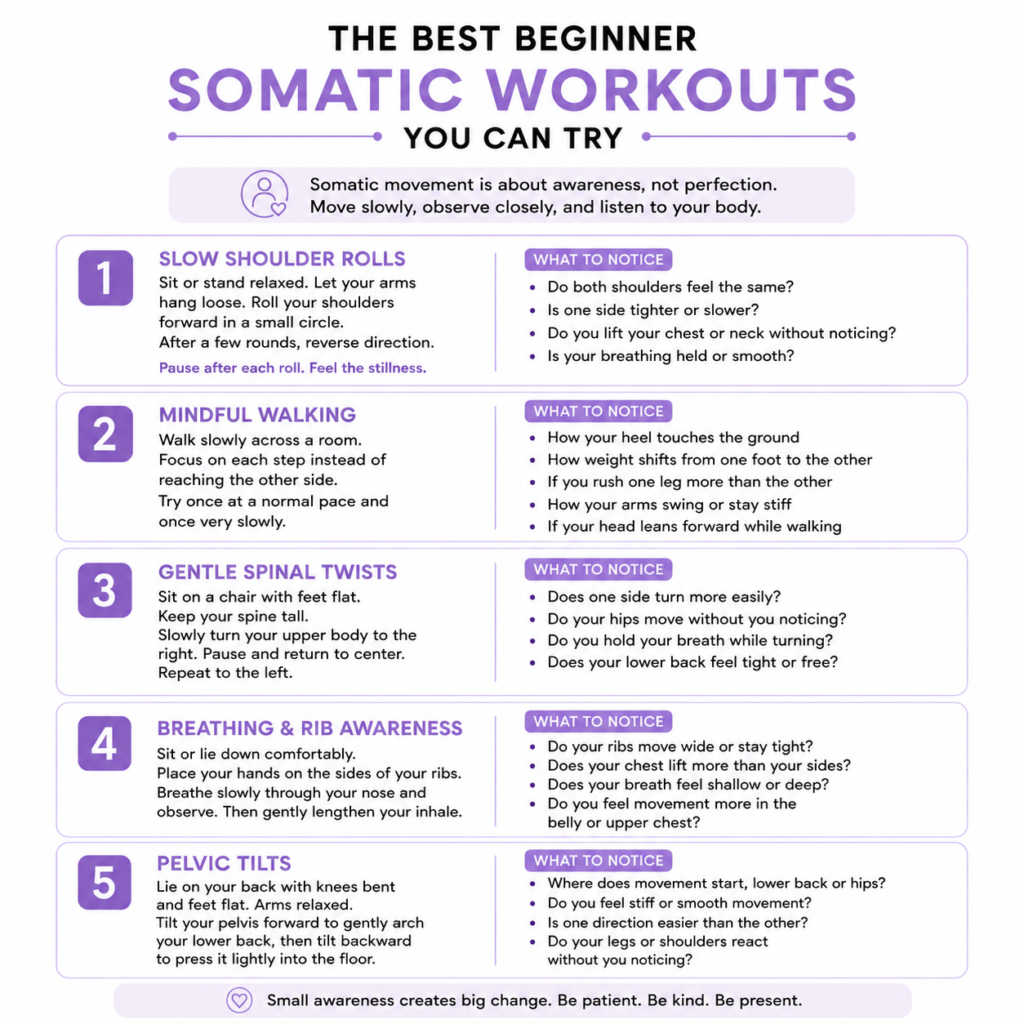
The Best Beginner Somatic Workouts You Can Try
You do not need experience to begin somatic workouts. Most movements are simple, gentle, and easy to follow.
The main idea is not to perform the movement perfectly, but to notice what changes occur in your body as you move.
Go slow enough that you can actually feel small details. If you rush, you miss the whole point of somatic movement.
More structured forms of this practice are grouped under different types of somatic therapy.
These are a few beginner-friendly examples to help you practice.
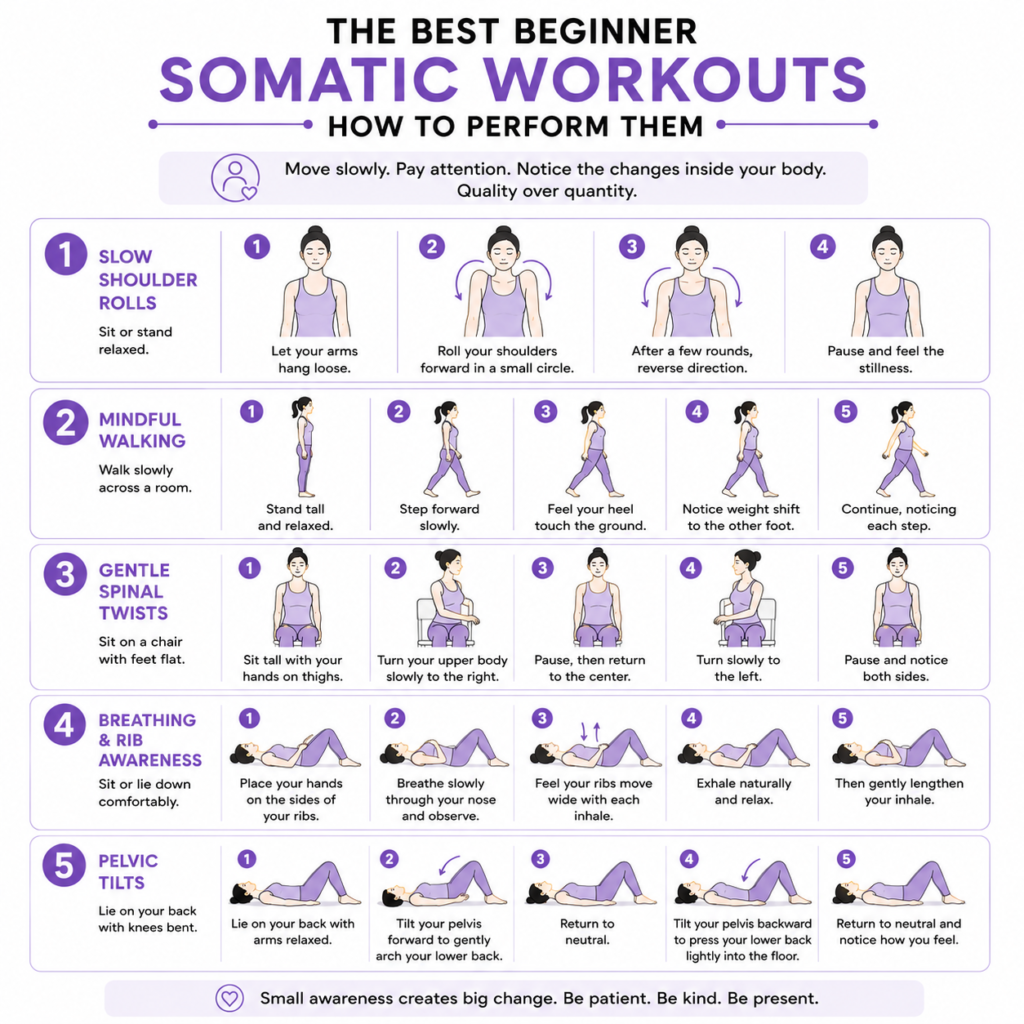
1- Slow Shoulder Rolls
Sit or stand in a relaxed way. Let your arms hang loose. Now slowly roll your shoulders forward in a small circle. Do not force a big movement.
After a few rounds, change direction and roll them backward. While you move, pay attention to simple things:
- Do both shoulders feel the same?
- Is one side tighter or slower?
- Do you lift your chest or neck without noticing?
- Is your breathing held or smooth?
Most people discover they carry tension in their shoulders without realizing it. This movement helps you notice that habit.
Try pausing after each roll. Feel what your body feels like in stillness before moving again.
2- Mindful Walking
Stand tall but relaxed. Start walking very slowly across a room. Instead of focusing on reaching the other side, focus on each step. Notice:
- How your heel touches the ground
- How weight shift from one foot to the other
- If you rush one leg more than the other
- How do your arms swing naturally, or stay stiff
- If your head leans forward while walking
Try walking once normally and once very slowly. The difference in awareness will be clear.
This is one of the simplest ways to understand how you move in daily life.
3- Gentle Spinal Twists
Sit on a chair with your feet flat on the ground. Keep your spine tall but not stiff.
Slowly turn your upper body to the right. Do not force the twist. Let it be small and easy.
Pause. Then slowly return to the center. Now move to the left side. While doing this, notice:
- Does one side turn more easily?
- Do your hips move without you noticing?
- Do you hold your breath while turning?
- Does your lower back feel tight or free?
Many people realize they twist unevenly from side to side. This simple awareness is important for daily movement habits like driving, reaching, or looking behind.
4- Breathing and Rib Awareness
Sit or lie down in a comfortable position. Place your hands gently on the sides of your ribs.
Now breathe slowly through your nose. Do not try to change your breathing at first. Just observe. Notice:
- Do your ribs move wide or stay tight?
- Does your chest lift more than your sides?
- Does your breath feel shallow or deep?
- Do you feel movement more in the belly or upper chest?
After a few breaths, try making the inhale slightly longer. Do not force it. Just allow a little more space.
It helps you connect breathing to body awareness rather than doing it automatically.
5- Pelvic Tilts
Lie on your back with your knees bent and feet flat on the floor. Keep your arms relaxed beside you.
Slowly tilt your pelvis forward so your lower back gently arches. Then slowly tilt it backward so your lower back presses lightly into the floor.
Move very slowly. While you do this, notice:
- Where does movement start, lower back or hips?
- Do you feel stiff or smooth movement?
- Is one direction easier than the other?
- Do your legs or shoulders react without you noticing?
This movement helps you understand your lower body connection and how your spine responds to small changes.
3 Common Misconceptions About Somatic Workouts
Many people misunderstand what somatic workouts actually are.
1- “Somatic movement is only for flexible people.”
One common misconception is that somatic movement is only for flexible people or advanced movement practitioners.
In reality, beginners can start with very small and gentle movements. You do not need flexibility, strength, or training to begin.
2- “Somatic workouts are the same as fitness workouts.”
Another misconception is that somatic workouts are traditional fitness workouts.
They don’t revolve around calorie burn, competition, or intense exercise performance. It is very different from traditional exercise approaches.
3- “It is about perfect posture.”
Some people also assume somatic movement is about forcing “perfect posture.” That is not the goal either.
Somatic movement focuses more on awareness and movement exploration than rigid body positions.
Research from Harvard Health Publishing also notes that mindful movement practices can help people become more aware of stress patterns in the body and improve attention to physical sensations.
SomaFlow’s Awareness-Based Approach
At SomaFlow™ Institute, somatic workouts focus on movement awareness, embodied practice, and mindful exploration.
Our team guides people through slow and attentive movement sessions that encourage awareness of posture, breathing, coordination, and movement habits.
The SomaFlow™ approach is gentle, beginner-friendly, and accessible for people who want to feel more connected to their movement experience.
Instead of focusing on performance or intensity, SomaFlow encourages people to slow down, observe movement patterns, and build stronger body awareness through guided practice.
Final Note!
Somatic workouts help people become more aware of their posture, breathing, coordination, movement habits, and physical sensations through slow, mindful movement.
They are not about pushing the body harder or chasing fitness goals. They are about learning how your body moves and paying closer attention to that experience.
If you want to explore awareness-based movement in a supportive environment, SomaFlow™ Institute offers guided somatic movement workshops to help people build deeper body awareness through embodied practice.
Full-Body SomaFlow Course
An immersive introduction to embodied awareness, self-practice, and whole-body integration through the SomaFlow method.
People Also Ask
What is a somatic workout?
A somatic workout is a slow, mindful movement practice that focuses on body awareness, breathing, posture, and attention to movement. The goal is to notice how movement feels inside the body.
Are somatic workouts good for beginners?
Yes. Somatic workouts are usually gentle, slow, and beginner-friendly. Many movements are simple and can be practiced at a comfortable pace.
How are somatic workouts different from regular workouts?
Traditional workouts often focus on intensity, strength, or endurance. Somatic workouts focus more on awareness, posture, breathing, coordination, and mindful movement.
Why do people practice somatic movement?
People practice somatic movement to feel more connected to their body and movement habits. Many people enjoy the slower pace and awareness-based approach to movement exploration.
Can somatic workouts be part of a wellness routine?
Yes. Many people include somatic workouts alongside walking, yoga, stretching, or general fitness routines as part of a mindful movement practice.
About the Author
Shoshi Hall
Shoshi Hall’s journey into healing began on the stage. As a professional dancer, she experienced both the beauty and the vulnerability of the human body. Years of rigorous training left her with persistent neck and lower back pain, discomfort that touched not only her body but her spirit as well.