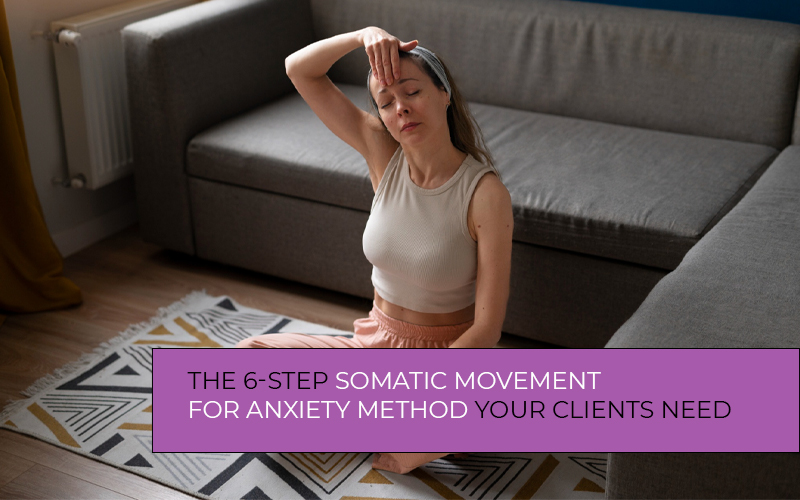
The 6-Step Somatic Movement for Anxiety Method Your Clients Need

We hope you enjoyed reading and learning more about the body and mind. If you would like to connect with our experts, click here
Author: Glenn Hall | Co-Founder of SomaFlow™ Institute
Somatic movement for anxiety is a simple body-based practice. It helps people notice how anxiety shows up in the body. Anxiety is not only in the mind. It also affects breath, posture, and muscle tension. The body may feel tight, the breath may feel short, and the jaw may feel hard.
These are body responses. The body is reacting. So the work must also include the body.
At the SomaFlow™ Institute in Las Vegas, we teach a structured somatic method.
SomaFlow™ focuses on awareness, presence and learning through direct experience.
It is not therapy or treatment. It is an educational and experiential practice centered on movement and perception.
Why Does the Body Hold Anxiety in the First Place?
Most therapists are trained to work with the mind. But Bessel van der Kolk’s foundational work, The Body Keeps the Score showed us clearly that stress and trauma do not live only in memory. They live in muscle tissue, fascia, and the nervous system itself.
Stress affects the nervous system. When a person feels unsafe or overwhelmed, the body prepares to protect itself. Muscles tighten. Breathing changes. Posture shifts.
If this happens often, the body may stay in that pattern. The person may not even notice it anymore. Tight shoulders may feel normal. Shallow breathing may feel normal.
Over time, these patterns become habits.
Talking about stress can help. But awareness of the body adds another layer. When people learn to notice tension and effort as they happen, they begin to understand how their body organizes itself.
This is where somatic movement becomes useful. It brings attention back to direct experience.

A Different Way of Working With the Body
SomaFlow offers an approach centered on embodied practice and facilitation that many practitioners find more sustainable over time, prioritizing awareness, adaptability, and working with the body rather than against it.
What Somatic Movement Actually Is?
The word somatic means related to the body.
Somatic movement is slow, intentional movement with awareness. The focus is on how the body feels from the inside. Not how it looks. Not how well it performs.
It may include slow guided movement, gentle breath awareness, body scanning, simple grounding practices and light touch awareness in an educational setting.
At the SomaFlow™ Institute, this is the foundation of the SomaFlow™ method. It blends movement, observation, and touch awareness in a clear structure. It is taught as a non-clinical and non-therapeutic approach. The goal is embodied learning, not correction or fixing.
6 Steps to Bring Somatic Movement Into Your Sessions
These six steps help you guide somatic awareness in a clear and meaningful way. Move slowly. Keep your language simple.
The goal is to help the client notice their body, not to fix or change it.
1. Start With Safety, Not Technique
Safety is the foundation of body awareness. If a person does not feel safe, their body will stay tight and alert. Muscles brace. Breath becomes shallow. Attention moves outward instead of inward.
Create a calm space before doing anything else. Speak gently. Slow your pace. Let there be quiet moments.
Ask simple questions such as, “What do you notice in your body right now?” This helps shift attention inside. That shift is where somatic learning begins.
2. Ground the Body First
Grounding helps the nervous system settle. It gives the body a sense of support.
Ask your client to place both feet flat on the floor. Invite them to notice the pressure under their feet.
Ask if the weight feels even or uneven. You can also guide them to feel the chair under their legs or their back against support.
When a person feels physical support, the body often begins to soften naturally. Grounding is simple, but it is powerful.
3. Use Breath as Your First Tool
Breath connects directly to the nervous system. Before changing it, ask the client to notice how they are already breathing.
Then invite a slow inhale followed by a slightly longer exhale. Keep it gentle. Do not force depth. The longer exhale often brings a small release. Shoulders may drop. The jaw may soften. The body may feel heavier in a good way.
Breath awareness is not about control. It is about noticing rhythm and allowing space.
4. Introduce Slow, Mindful Movement
Add very small movements. Keep them slow and simple. A gentle head turn. A small shoulder roll. A soft side bend.
Ask the client to move at half their normal speed. Slower movement increases awareness.
Encourage them to notice where movement feels easy and where it feels restricted. If something feels strained, make the movement smaller.
The goal is sensing, not stretching. When awareness increases, the body often reorganizes on its own.
5. Apply Hands-On Awareness
If you include touch, keep it steady and unhurried. Place your hands gently and allow time.
Invite the client to notice what they feel under your hands. They may notice warmth, firmness, subtle movement with the breath, or areas that feel less responsive. This attention deepens their internal awareness.
In SomaFlow™, touch supports learning. It is not used to correct or treat. It creates a space for perception and presence.
6. Always Close With Integration Time
Do not end the session abruptly. After movement and touch, allow a few minutes of quiet rest.
Stillness gives the nervous system time to settle. This is often when changes become clear.
After the pause, ask what feels different. The client may notice slower breathing, less tension, or a greater sense of calm.
Integration helps the experience stay with them. Small shifts, noticed clearly, can lead to meaningful change over time.
What This Looks Like in Real Practice?
Imagine a client in her late thirties. She feels anxious often. She has tight shoulders and frequent headaches.
Instead of beginning with strong techniques, you begin with awareness.
You ask where she feels tension. She places her hand on her chest.
You guide slow breathing.
After a few minutes, her shoulders soften. Her breath becomes deeper. She says she did not realize how tense she felt.
That moment is important. She is learning about her own patterns.
From there, you include slow movement and gentle touch awareness. She begins to recognize when she holds her breath during the day.
Over time, she feels more ease. Not because something was fixed. But because she learned to notice and respond differently.
This is the value of a body-first awareness approach.
Take Your Practice Further With SomaFlow™
If you want a clear structure for teaching and guiding somatic awareness, the SomaFlow™ Institute offers in-person workshops and small group learning experiences in Las Vegas.
SomaFlow™ is an educational framework. It supports personal practice and facilitation skills. It does not provide therapy, medical care, or professional licensure.
You will learn how to guide movement, observation, and touch awareness in a simple and grounded way.
Explore upcoming SomaFlow™ courses and workshops to deepen your understanding of embodied practice.
People Also Ask
What is somatic movement for anxiety?
Somatic movement for anxiety is a body-based awareness practice. It uses slow movement and breath to help people notice how anxiety shows up in the body. It focuses on perception and learning, not treatment.
How does somatic movement support anxiety awareness?
It helps people notice tension, breath patterns, and posture. With awareness, they may begin to experience more ease and adaptability in daily life.
Why do therapists use somatic techniques with anxious clients?
Because anxiety affects the body. Muscles tighten. Breathing changes. Somatic methods help clients observe these patterns directly.
How long does somatic movement practice take to show changes?
Some people notice small shifts in one session. Deeper changes usually come with steady practice over time. SomaFlow™ is taught as an ongoing educational process, not a quick fix.