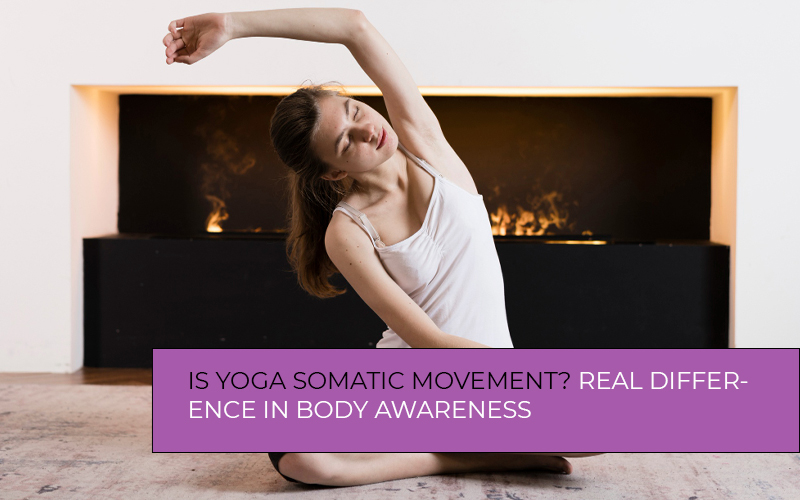
Is Yoga Somatic Movement? Real Difference in Body Awareness
Yoga focuses on postures, breath, and flexibility. Somatic movement focuses on what you feel inside your body as you move.
Many people practice yoga for years and still carry the same tension, the same stress, the same tight spots that never fully release. That is because yoga was not to retrain the nervous system from the inside.
Somatic movement was. At SomaFlow Institute in Las Vegas, we teach therapists and movement professionals how to use body awareness and somatic techniques to create real change. In their own bodies first, then in their clients.
What Is Somatic Movement?
Somatic movement is movement practiced with direct attention to internal body sensations.
The word “somatic” comes from the Greek word soma, meaning the living body as experienced from within. That is the key.
Somatic movement is not about how your body looks from the outside. It is about what you feel from the inside.
Instead of focusing on performance, posture goals, or hitting a range of motion, somatic practices ask a different question: what do you actually notice as you move?
Common characteristics of somatic movement include:
- Slow and intentional movement that gives the nervous system time to register what is happening
- Attention to sensation and perception rather than appearance or outcome
- Exploration rather than repetition, meaning each movement is an opportunity to notice something new
- Learning through direct experience, letting the body teach you rather than following a fixed instruction
The goal is to deepen your awareness of how the body organizes itself during movement.
What Is Yoga?
Yoga is an ancient practice with roots in Indian philosophy.
At its core, it combines physical postures (asanas), breathing techniques, and meditation or mindfulness.
Yoga has been practiced for thousands of years and has taken on many forms across different traditions and cultures.
Today, most people in the West encounter yoga through studio classes that focus on posture alignment, flexibility, strength, and relaxation.
Traditional yoga systems often include structured sequences and specific poses designed to support physical and mental well-being.
Depending on the style, a yoga class might be vigorous and heat-building (like Vinyasa or Ashtanga) or slow and restorative (like Yin or Restorative Yoga).
What most yoga styles share is a structured framework. This framework includes specific poses and planned sequences, along with alignment cues to support safe movement. A teacher guides you through a practice that follows a clear shape and direction.
Is Yoga a Somatic Practice?
This is where it gets interesting.
Yoga can include somatic elements, but it is not always a somatic practice.
Most yoga classes focus on external alignment. Your teacher tells you to straighten your leg, square your hips, or press your foot down in a specific way. The guidance comes from outside your body. You are trying to match a shape or form.
Somatic movement works differently. The feedback comes from inside. You are not trying to reach a perfect pose.
You are noticing what your body already feels, and letting those internal sensations guide your movement.
This is the core difference between yoga and somatic movement. One focuses on body positioning. The other focuses on body awareness and internal perception.
Both approaches have real value. But for nervous system regulation, stress relief, and building a deeper mind-body connection, somatic movement goes further.
Yoga can be practiced with somatic awareness. But not all yoga is somatic.
What Is Somatic Yoga?
Somatic yoga is a hybrid approach that bridges these two worlds.
In somatic yoga, practitioners use yoga postures as a starting point, but the emphasis shifts dramatically.
Instead of focusing on achieving a perfect pose, the focus is on sensing how the movement feels from inside the body.
This approach has:
- Slower pacing that allows internal observation
- Exploration of sensation rather than achievement of form
- Gentle variations in movement to notice how the body responds
- Awareness of breath and posture as a continuous, evolving experience
Somatic yoga encourages practitioners to move in ways that feel natural and informative rather than strictly following external alignment rules.
For many people, mostly those recovering from chronic pain, stress, or past injuries, somatic yoga offers a gentler path than traditional yoga classes.
Studies show that people with higher body awareness recover from stress faster and report lower levels of chronic pain.
Key Differences Between Yoga and Somatic Movement
Both practices work with the body and breath. But they approach movement in very different ways.
| Yoga | Somatic Movement | |
| Focus | Posture alignment and breath coordination | Internal sensation and body awareness |
| Structure | Follows set sequences and poses | Explores freely based on what the body reveals |
| Learning Style | Guided by teacher instruction and demonstration | Guided by your own internal observations |
| Purpose | Strength, flexibility, and relaxation | Understanding and shifting movement patterns through awareness |
| Feedback Source | External cues from teacher or mirror | Internal sensations from inside the body |
| Nervous System Focus | Varies by style | Central to the practice |
Neither approach is better than the other. They simply serve different purposes.
But if your goal is nervous system regulation, releasing chronic tension, or building a deeper mind-body connection, somatic movement offers something yoga alone cannot.
How Yoga Can Become More Somatic?
If you already have a yoga practice and want to bring a somatic quality to it, the good news is that the shift is more about attention than technique.
You do not need to change what you are doing. You need to change where you focus.
Practical ways to bring somatic awareness into yoga include:
- Slowing down your movements more than you think you need to
- Paying attention to sensation instead of whether your pose looks right
- Exploring small variations in a posture to see how different adjustments feel
- Observing your breathing and tension patterns as they change through the practice
These small shifts move the practice from performance toward embodied awareness. The pose stops being the point. What you learn through the pose becomes the point.
Why Body Awareness is Important in Movement?
Whether you practice yoga or somatic movement, body awareness is the essential skill that turns movement into something practical and beneficial.
Without it, movement can become mechanical. Instead of learning deeply, the motions are repeated without real understanding. The same tight areas are stretched again and again, without understanding why they remain tight. Instructions are followed, but there is little connection to what the body is actually saying.
Body awareness helps you notice patterns that would otherwise stay invisible. Things like:
- How does the posture shift when you are under stress
- How breathing affects the quality of your movement and the tension you carry
- And how small adjustments in how you hold your weight or position your head can change how your whole body feels
Somatic learning places curiosity at the center of all of this. Instead of pushing toward a goal, you become genuinely interested in what is happening in your body right now.
That curiosity is where real change begins.
Exploring Somatic Movement Through Structured Practice at SomaFlow!
For those who want to explore somatic movement more deeply, structured programs provide guided environments to develop these skills over time.
Good somatic programs include:
- Guided movement explorations that develop sensory attention
- Attention-based learning that builds the body-mind connection
- Observation of movement patterns with skilled facilitation
- Group learning experiences that support sustained practice
At SomaFlow Institute, our somatic movement workshops are for therapists and movement professionals who want to understand this work in depth.
Our somatic learning programs give you hands-on experience you can bring directly into your work with clients.
Final Note!
Yoga and somatic movement share many commonalities. Each practice encourages you to slow down and pay attention to how you feel. This awareness helps you recognize the important signals your body sends about comfort, safety, tension, and recovery.
But somatic movement goes a step further. It makes internal perception the entire point of the practice.
This distinction opens doors. It helps practitioners and therapists choose the right tool for the right situation. And it invites a deeper, more honest relationship with the body.
If you are curious about what somatic movement can offer beyond yoga, SomaFlow Institute in Las Vegas is a good place to start.
Join one of our full-body course workshops and feel the difference in your body first.