Experiential Somatic Learning 101: Learn Through Movement & Awareness

We hope you enjoyed reading and learning more about the body and mind. If you would like to connect with our experts, click here
Author: Glenn Hall | Co-Founder of SomaFlow™ Institute
Somatic learning means learning through your body instead of only your mind. You move, you pay attention, and you notice what you feel.
Most of us learned everything from books, screens, and lectures. We sat still while information was being fed into our heads. But the body learns differently. It learns by moving, sensing, and noticing.
This is where experiential somatic learning comes in. “Experiential” means learning by doing. You do not read about a movement. You move, slowly and with attention, and you learn from what you feel.
The SomaFlow™ Institute uses this movement-based experiential learning approach.
Instead of asking you to perform perfectly, it invites you to slow down, explore, and notice how your body naturally moves.
What Is Somatic Learning?
Somatic learning is the process of gaining knowledge through body awareness and felt experience.
Think about riding a bicycle.
Nobody learns to ride a bike by reading a manual.
You learn by sitting on the seat, wobbling, balancing, falling, and trying again. Your body figures it out. Your muscles, your balance, and your senses do the learning.
That is somatic learning in action. The knowledge lives in your body, not just in your thoughts.
Somatic education builds on this natural ability. It uses slow movement, posture observation, and breath awareness to help you notice things about your body that you normally miss.
The field of somatics was shaped by thinkers like Thomas Hanna, who described the soma as the body experienced from within. In simple words, it is the difference between looking at a body and living inside one.

A Different Way of Working With the Body
SomaFlow offers an approach centered on embodied practice and facilitation that many practitioners find more sustainable over time, prioritizing awareness, adaptability, and working with the body rather than against it.
What Does “Experiential” Mean in Somatic Learning?
Experiential learning means learning by doing, not by memorizing.
When you put “experiential” and “somatic” together, you get a very simple idea. Experiential somatic learning is learning about your body through your body as you move it.
Reading about walking is mental learning. You collect information. You might learn that walking involves weight shifts, foot contact, and balance.
Walking slowly across a room while feeling your foot press into the floor is an example of somatic learning. As you move, each step provides new sensory feedback. Feel the weight shift from one foot to the other and notice your heel touching the floor first. Pay attention to the natural swing of your arms.
Both types of learning are useful. But information alone often stays in the head. Experience goes deeper. It changes how you sense yourself, and that understanding tends to stay with you.
7 Simple Ways to Practice Experiential Somatic Learning
You do not need a studio, special clothes, or any equipment. These simple somatic practices function like everyday embodied practices, and you can try them at home, at work, or anywhere in daily life.
1. Slow Walking with Attention
Walk slowly across a room. Feel which part of your foot touches the ground first. Notice how your weight moves from one leg to the other, and how your arms swing on their own.
Walking is something you already do every day.
Slowing it down turns it into one of the easiest somatic learning practices there is.
2. Breath Observation
Sit or stand comfortably and simply watch your breathing.
Does your chest move more, or your ribs? Do your shoulders lift when you breathe in?
Do not try to fix or control anything. Your only job is to notice. This builds interoception, your sense of what is happening inside your body.
3. A Simple Body Scan
Sit quietly and move your attention slowly through your body, from your feet to your head. Notice warmth, pressure, tension, or ease in each area.
A body scan is like taking a gentle tour of your own body. Over time, it sharpens your felt sense and makes hidden tension easier to catch.
4. Slow Movement Exploration
Raise one arm slowly, then lower it. Turn your head gently from side to side. Stand up from a chair without rushing.
Slow movement gives your senses time to notice details that normal speed hides, like where a movement starts and how the rest of your body responds.
This kind of gentle exploration is also where many of the benefits of somatic workouts come from.
5. Grounding Through Your Feet
Stand comfortably and feel how your feet meet the floor.
Is more weight on your heels or your toes? Does one foot carry more than the other?
Gently shift your weight forward, backward, and side to side. This simple practice builds proprioception, your sense of where your body is in space.
6. Everyday Moments of Noticing
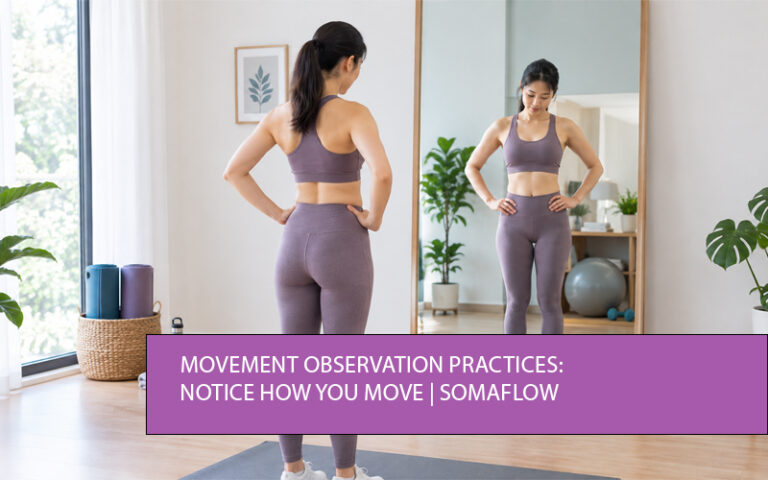
Daily life is full of chances to learn. While cooking, brushing your teeth, standing in line, or sitting at your desk, pause and ask: How am I standing? Where is my weight? Am I rushing?
Each small moment of noticing is a small moment of somatic learning. They add up faster than you would expect.
7. Reflect After You Move
Learning continues even after the movement stops. After practicing, take a minute to notice or write down what you observed.
Which movement felt easy? Which one needed more attention? What surprised you?
Reflection turns a single experience into lasting understanding, which is the whole point of experiential learning.
How Is Somatic Learning Different From Regular Learning?
Regular learning is mostly top-down. Information enters through your eyes and ears, and your brain stores it. Somatic learning is bottom-up. It starts with sensation, and awareness grows from there.
| Regular Learning | Somatic Learning | |
| Direction | Top-down: information goes into the brain | Bottom-up: starts with body sensation |
| How you learn | Reading, listening, memorizing | Moving, feeling, noticing |
| Where knowledge lives | In your thoughts | In your lived experience |
| Main focus | Right and wrong answers | Noticing, not correcting |
| Typical question | “Am I doing this correctly?” | “What do I notice while I move?” |
| Result | You can pass a test, but your body may feel no different | Awareness becomes part of how you sense yourself |
Regular learning judges. Somatic learning observes. In a somatic movement session, nobody checks whether you are “doing it right.”
Instead, you are invited to notice your weight, your breath, and how a movement feels today.
How Does SomaFlow™ Approach Somatic Learning?
SomaFlow™ Institute teaches somatic learning through guided, experiential practice.
Instead of lectures full of theory, sessions are built around movement, observation, and direct experience.
During a session, participants move slowly and pay attention to posture, coordination, pacing, and breath.
There is no pressure to perform. The focus is always on awareness, not correction.
The SomaFlow™ approach includes guided somatic movement, body awareness practice, posture observation, hands-on exploration, and small-group learning. Learning with others adds another layer, because one person’s observation often helps someone else notice something new in their own body.
Rather than asking, “How do I fix this?” SomaFlow™ invites a simpler and more useful question: “What do I notice while I move?”
5 Easy Tips to Start Somatic Learning
You do not need special training, equipment, or extra time to begin. Your body is already with you all day.
These five tips make the start simple.
1. Slow everything down.
Speed hides details.
When you move slowly, your senses finally have time to catch what is really happening, where a movement begins, how your weight shifts, and when your breath changes.
Slow is not lazy. Slow is how the body learns.
2. Notice instead of judging.
There is no perfect way to sit, stand, or walk, so stop grading yourself.
If you catch yourself thinking “this is wrong,” gently switch the thought to “this is interesting.” That one swap turns correction into learning.
3. Start with one minute.
You do not need an hour-long practice.
Sixty seconds of feeling your feet on the floor or watching your breath is real somatic learning. Small moments done often beat long sessions done rarely.
4. Turn daily life into practice.
Waiting for the kettle, brushing your teeth, sitting at your desk, walking to the car, each one is a free practice session.
Ask a simple question: Where is my weight right now? That is all it takes.
5. Stay curious, not critical.
Every observation is information, not a problem to solve. Noticing that you lean to one side or hold your breath is a discovery, not a failure.
Curiosity keeps the practice light, and light practices are the ones people actually continue.
Final Note!
Somatic learning is simply your body’s natural way of learning, brought back to life through attention and movement.
You move slowly, notice what you feel, and understanding grows from experience rather than memorization.
If you want to explore experiential somatic learning in a supportive, guided environment, book a SomaFlow™ Full-body Course and experience what it feels like to learn through your own body.
Full-Body SomaFlow Course
An immersive introduction to embodied awareness, self-practice, and whole-body integration through the SomaFlow method.
People Also Ask
What is an example of somatic learning?
Learning to ride a bicycle is a classic example. You cannot learn it from a book. Your body learns through balance, movement, and repeated experience. Slow walking while noticing your foot contact is another simple example.
What is the difference between somatic learning and experiential learning?
Experiential learning means learning by doing, such as through experiments or projects. Somatic learning is a type of experiential learning that focuses specifically on the body, using movement, sensation, and body awareness as the source of learning.
Is somatic learning the same as exercise?
No. Exercise usually focuses on fitness, strength, or performance. Somatic learning focuses on awareness. Movements are often slow and gentle, and the goal is to notice how your body moves rather than to work out.
Who can benefit from somatic learning?
Anyone can. It is especially useful for therapists, body workers, movement teachers, and students who want stronger observation skills, as well as everyday people who want to feel more connected to their own bodies.
About the Author
Glenn Hall
Glenn Hall knows what it’s like to live with pain. Born with a serious back condition, he grew up dealing with stiffness, poor posture, and discomfort that never fully went away. Later in life, his challenges intensified: he suffered two complete biceps tears and two supraspinatus muscles retracted off the bone.