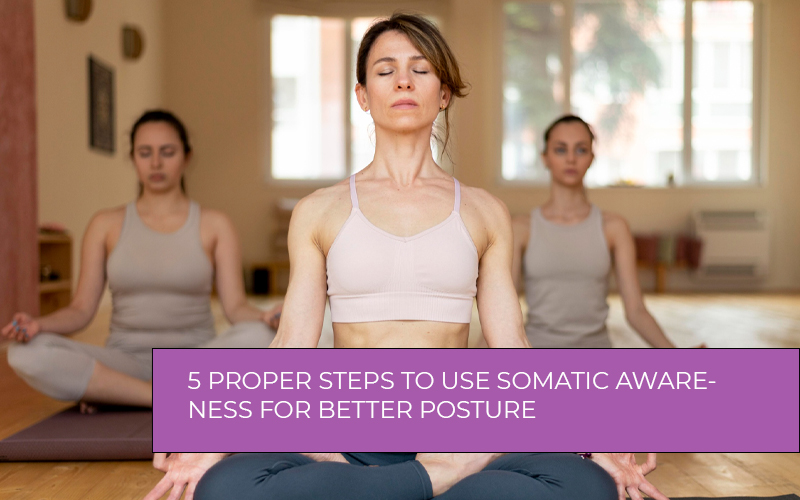
5 Proper Steps to Use Somatic Awareness for Better Posture

We hope you enjoyed reading and learning more about the body and mind. If you would like to connect with our experts, click here
Author: Glenn Hall | Co-Founder of SomaFlow™ Institute
Most posture advice is wrong because it treats the body like a machine that just needs adjustment. But your body is not a machine. It is a living, feeling system that holds patterns for a reason.
At SomaFlow™ Institute, we teach massage therapists and movement practitioners how to work with the body, not against it.
Through somatic movement education, we help you guide clients to feel clearly and release the tension patterns behind poor posture.
What Is Somatic Awareness, Exactly?
Somatic awareness simply means paying attention to what is happening inside your body, sensations, tension, breath, weight, and movement, from the inside out.
It is the practice of slowing down, getting quiet, and noticing what your body is actually doing right now.
When it comes to posture, somatic awareness helps you understand the why behind your habitual positions. Most postural patterns are tied to the autonomic nervous system.
Slouching, bracing, and collapsing are often protective responses. Your body learned them in response to stress, fatigue, or emotional experience.
Somatic body awareness education gives you a way to unwind those patterns.

A Different Way of Working With the Body
SomaFlow offers an approach centered on embodied practice and facilitation that many practitioners find more sustainable over time, prioritizing awareness, adaptability, and working with the body rather than against it.
How Somatic Awareness Actually Improves Posture?
Somatic awareness does not correct your posture; it teaches your body to find it on its own.
Step 1: Start With Sensing, Not Correcting
Before you change anything, just notice.
Sit or stand in whatever position feels natural. Do not adjust. Do not judge. Just take thirty seconds and ask yourself:
- Where is the weight in my feet or seat?
- Is my jaw tight?
- Where is my breath going: chest or belly?
- Which parts of me feel held or braced?
This is interoceptive awareness, tuning in to the signals your body is already sending. Most people move through the entire day without doing this once.
This simple act of noticing is where somatic movement work begins.
Step 2: Follow the Breath
Breath and posture are deeply connected. When the chest is collapsed, breathing becomes shallow. When the back is braced, the diaphragm cannot move freely.
Try this: place one hand on your belly. Take a slow breath in. Does your belly move? Or does your chest rise and your shoulders lift?
Shallow chest breathing is both a symptom and a cause of poor posture. It keeps the nervous system in a low level of activation, which feeds tension patterns throughout the body.
Diaphragmatic breathing, slow, full, belly-first, is one of the most powerful somatic tools for releasing postural holding. It is free. It works immediately. And it resets the nervous system at the same time.
Practice five slow breaths several times a day. That is it.
Step 3: Find Your Ground
Grounding is a core concept in somatic education. It means feeling your actual contact with the floor or the chair beneath you.
Stand barefoot if you can. Feel where your weight falls. Is it forward on your toes? Shifted to one side? Do your heels feel light or heavy?
When you feel the ground beneath you, the body naturally organizes upward from that base.
The spine lengthens without effort. The head floats up.
Somatic grounding exercises are powerful for people who hold tension in their upper body. That tension often comes from a lack of felt safety in the lower body.
Step 4: Notice Habitual Tension Patterns
Every person has their own postural signature. Some people pull up through the shoulders. Others collapse through the chest. Some clench their jaw. Others grip through the hips.
These patterns are not random. They are stored in the body’s neuromuscular memory. The technical term is sensory motor amnesia. The idea that chronic tension patterns become so familiar that we stop feeling them.
Somatic movement practices, including slow, guided movement explorations, help bring these patterns back into awareness.
Step 5: Move Slowly and With Attention
One of the simplest somatic practices for posture is slow, conscious movement. This is different from exercise. The goal is not to strengthen or stretch. The goal is to feel.
Try slowly rolling your head from side to side. Not to release tension, just to notice what you feel. Where does movement feel easy? Where does it stop? And where does your breath change?
That quality of attention is what makes movement somatic. And it is that attention, repeated over time, that begins to shift posture from the inside out.
Why Forcing Better Posture Does Not Work?
When you force your body into “correct” posture, a few things happen.
First, you engage muscles that are not meant to hold you up all day.
Second, you create tension in the very areas you are trying to open.
Third, your nervous system, which monitors your internal state, reads forced position as effort, not ease.
The moment your attention moves elsewhere, your body collapses back into its familiar shape.
Proprioception, your body’s internal sense of position and movement, is what actually guides posture over time. You cannot override proprioception with willpower.
But you can train it.
A published study in Frontiers in Psychology found that directing conscious attention to interoceptive and proprioceptive sensations has a strong and direct influence on the nervous system.
Far stronger than conscious thought alone. In other words, feeling your body works better than thinking about it.
That is exactly what somatic awareness does.
How Does Somatic Awareness Fit Into a Somatic Movement Practice?
If you are a massage therapist or bodywork professional, you probably already see postural patterns in your clients every day.
Rounded upper backs. Tight hip flexors. Necks that carry the weight of every stressful week.
Adding somatic awareness to your work or offer somatic movement education with your bodywork. It gives clients something they can use between sessions.
Instead of leaving the table and returning to the same tension patterns, they start to feel differently. They start to notice. And noticing, as any somatic practitioner will tell you, is where everything begins to shift.
A Simple Daily Somatic Posture Practice!
You do not need an hour. You need five minutes and honest attention.
Sit comfortably. Feel your seat in the chair. Take three slow belly breaths. Bring your attention to your shoulders. Let them be exactly as they are. Notice your jaw and see if there is any tension. Now become aware of your feet, feeling their contact with the ground.
Then slowly, gently, let your spine lengthen upward as if something is lifting the top of your head. Stay there for one full minute. Breathe.
That is somatic posture work.
Your Clients Are Carrying Tension You Can Actually Help Them Release!
At SomaFlow™ Institute, we offer in-person workshops and small group training experiences in Las Vegas for practitioners who want to bring somatic awareness education into their work.
If posture, nervous system regulation, and body-centered facilitation feel like the next step for you, explore Somaflow courses and see what fits where you are right now.
DISCLAIMER: SomaFlow™ is an educational framework, not therapy or clinical training.
People Also Ask
Can somatic awareness actually fix chronic posture problems?
Somatic awareness does not correct posture from the outside. It helps your nervous system release the patterns that created poor posture in the first place. For chronic holding patterns, that is more effective than any correction-based approach.
How is somatic posture work different from yoga or Pilates?
Yoga and Pilates work with form, strength, and alignment. Somatic work is purely about internal sensation. You are not trying to achieve a shape. You are learning to feel what your body is doing and letting awareness create the change.
How long does it take to see results with somatic posture practice?
Most people notice something within the first session, not a dramatic change, but a felt shift. A little more ease. A little more length. Lasting change in deep postural patterns takes consistent practice over weeks or months. Five minutes daily beats one hour once a week every time.
Why does my posture keep reverting even when I try to fix it?
Because your nervous system is running an old program. Posture is not just muscular; it is neurological. Until your body’s internal map changes, external corrections will not hold. Somatic awareness works at the level of that internal map.
About the Author

Glenn Hall
Glenn Hall knows what it’s like to live with pain. Born with a serious back condition, he grew up dealing with stiffness, poor posture, and discomfort that never fully went away. Later in life, his challenges intensified: he suffered two complete biceps tears and two supraspinatus muscles retracted off the bone.