8 Best Alternative Careers for Massage Therapists (+SOMA FLOW)
We hope you enjoyed reading and learning more about the body and mind. If you would like to connect with our experts, click here
Author: Shoshi Hall | Co-Founder of SomaFlow™ Institute
The best alternative careers for massage therapists are paths that use the same hands-on skills, body knowledge, and client care abilities in new and sometimes unexpected ways.
Many therapists reach a point where their bodies feel tired, income levels stay flat, or they want work that challenges them. It’s normal to look around and ask yourself what else you can do with all the experience you have built through touch, observation, and human care.
And you do have a lot of experience.
A Different Way of Working With the Body
SomaFlow offers an approach centered on embodied practice and facilitation that many practitioners find more sustainable over time, prioritizing awareness, adaptability, and working with the body rather than against it.
What are the Best Alternatives to Massage Therapy?
Massage therapists understand anatomy in a way many medical workers don’t. You know how tissue behaves under pressure. You can see posture issues before the client even lies on the table. You know how stress feels in muscles. This set of skills transfers into many fields.
We have seen this firsthand while teaching at SomaFlow in Las Vegas. Over the years, we have met therapists who reached a crossroads. Some were burnt out. Some wanted to earn more. Some wanted more meaning.
And many of them discover that their massage background actually gives them a major advantage in new careers.
1. Bodywork Specialist Using Advanced Hands-on Methods (Like SomaFlow)
Some therapists don’t want to leave the hands-on field but want something more advanced, more interesting, and less draining.
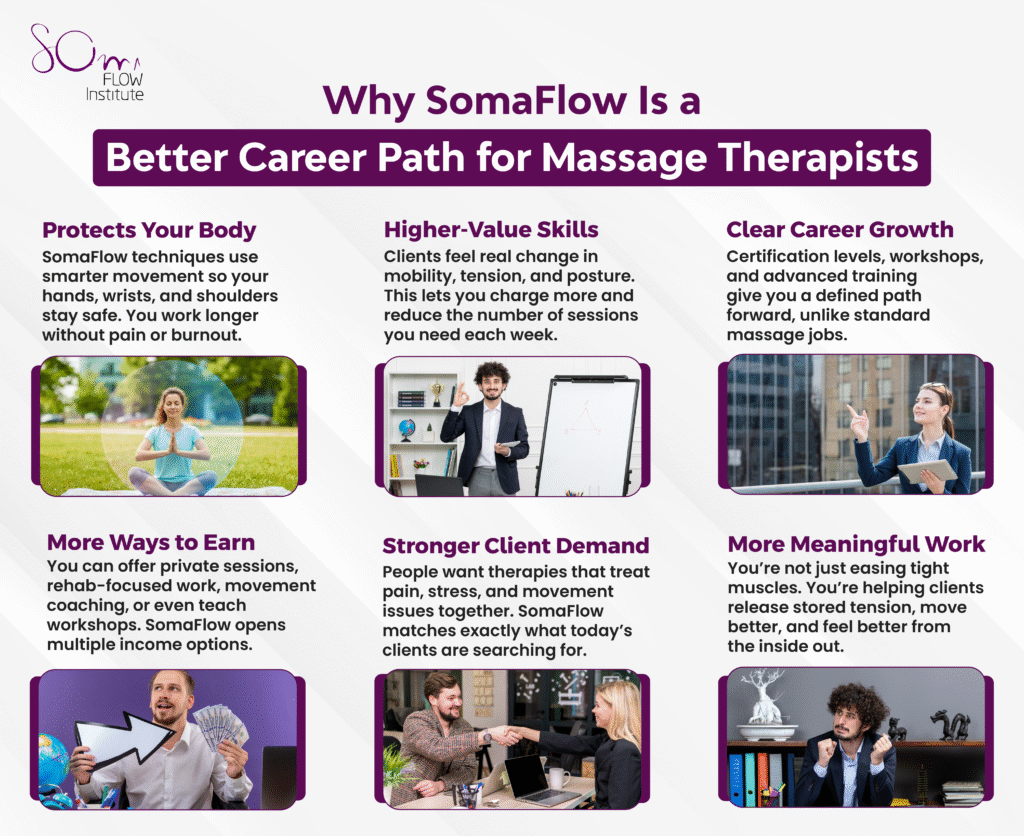
SomaFlow approach combines science-based techniques with Eastern healing methods. Therapists who learn it often say it feels “smarter on the body” because it uses leverage, breath, and intention instead of force.
A therapist from Arizona trained with us and said she reduced wrist strain by more than half after learning SomaFlow techniques. She now earns more because she offers a unique method that clients want.
If you feel stuck but still love hands-on work, training in a specialized system can give you a new direction without leaving bodywork altogether.
2. Corrective Movement Specialist
A corrective movement specialist helps clients improve their movement, walking, sitting, and exercise. This is a strong path because massage therapists already understand the body’s imbalances.
The International Sports Sciences Association (ISSA) says corrective exercise is booming, and the right skills can make you a highly in-demand professional.
Many therapists we train in SomaFlow enter this field naturally. They start noticing patterns. A client comes in with hip pain. You release tension, but the pain comes back because the client is moving incorrectly. Corrective work lets you solve that deeper issue.
The U.S. Bureau of Labor Statistics predicts that jobs for fitness trainers and instructors will grow by 12% between 2024 and 2034, which is much faster than the average for all occupations.
Therapists who add movement-based tools usually earn more per session because they solve long-term problems, not just ease short-term tension.
3. Medical Massage Technician or Clinical Assistant
Some therapists move toward clinical settings. Pain clinics, chiropractic offices, rehab centers, and physical therapy clinics hire massage therapists for supportive roles.
You already know how tissue responds during healing after surgery, injury, or chronic pain. Working in a clinical environment may mean more predictable hours and sometimes better pay.
One of our SomaFlow students took this path after years of private practice. She now works with a chiropractor who trusts her completely with soft tissue work. She says the job feels lighter because she shares the client load with a whole clinical team.
4. Sports Recovery Practitioner
Athletes need recovery work more than ever. Sports massage is only one part.
Teams and gyms look for specialists who understand mobility, stretching, soft-tissue recovery, cupping, and pressure-based therapy.
If you already do deep tissue work, this path is a natural fit. You can work with local gyms, fitness studios, athletic teams, or private clients.
The sports recovery market is rising. Reports from health and fitness associations show steady growth because more everyday people now follow athlete-style routines. They want better performance and less pain.
Therapists who understand body mechanics can do very well in this field.
5. Somatic Practitioner or Bodywork Educator
Somatic work focuses on how emotions, tension, and physical patterns connect. Many therapists feel drawn to this work when they notice clients holding stress in deeper ways.
At SomaFlow, we see this often.
A therapist starts learning hands-on techniques that bring up old tension, then begins exploring somatic responses in their clients. Some eventually shift into teaching or emotional-body integration.
This career allows you to work more slowly, with deeper intention, and often with higher-priced private sessions.
6. Wellness Coach or Stress-Reduction Guide
Clients trust massage therapists. They talk to you about stress, sleep, diet, and emotional struggles. This trust makes you a strong candidate for wellness coaching.
A wellness coach guides clients through healthier habits, stress reduction, and simple planning. It’s not medical advice. It’s supportive and practical.
For example, one of our graduates now offers a “Body Reset Coaching Program” where she blends basic SomaFlow techniques with breathing sessions and lifestyle guidance. She earns more with less physical strain.
7. Yoga Instructor or Stretch Therapist
These two paths work well for therapists who want fewer physical demands than a full-body massage.
Yoga instruction helps clients build strength and flexibility. Stretch therapy focuses solely on targeted stretching routines, often in 30–45-minute sessions.
Therapists make strong instructors because they already know where the body tends to compensate. You can feel when a muscle is guarding or when a stretch is too much. This intuition helps clients train safely.
8. Spa Consultant or Treatment Designer
If you enjoy creating experiences, spa consulting can be a great fit. Many spas lack professionals who understand real bodywork. They need people who can design treatments, train staff, and create consistent client experiences.
Your massage background gives you insight into what clients like, what therapists need, and how a treatment should feel from beginning to end.
9. Teaching and Continuing Education (CE)
Many therapists reach a high level of skill and want to share what they know. Teaching allows you to work with groups, create workshops, or develop certification programs.
At SomaFlow, we train therapists who later become assistants or instructors. They enjoy helping new therapists grow, and the work is less physically demanding than table work.
Teaching also builds authority and opens more doors in the wellness industry.
How to Know Which Massage Therapy Path Is Right for You?
Most therapists already know the answer once they listen to what their body and clients have been telling them. Here are a few signs that can help you figure out where you belong:
i. If your body feels worn out most days:
You may be ready for work that uses less physical effort, like movement correction, coaching, or teaching. These paths let you stay in the field without pushing your body past its limits.
iI. If you naturally look for the “why” behind a client’s pain:
Clinical roles, corrective exercise, or assessments might be a good match. Therapists who like solving patterns often thrive in these settings.
III. If emotional patterns and tension layers interest you:
Somatic work or deeper body-mind practices may be the right direction. Some therapists feel called to this once they notice how stress shows up in the body.
IV. If you want a predictable schedule and a steady workflow:
Clinics, rehab centers, and chiropractic offices provide more structure and usually lighter mental load.
V. If you want to earn more without burning yourself out:
Many therapists reach a point where they want steadier income without adding more hours on the table, and small adjustments in the way they structure their work often make a big difference for anyone thinking about making more money as a massage therapist.
Full-Body SomaFlow Course
An immersive introduction to embodied awareness, self-practice, and whole-body integration through the SomaFlow method.
Conclusion!
Massage therapists have more career options than people realize. Your body awareness and hands-on skills transfer into many fields. And if you want to stay in bodywork but feel stuck, you don’t have to start over. You may just need better tools and a method that’s easier on your body.
SomaFlow teaches techniques that help you work with less strain while offering clients deeper results. If you want to grow, earn more, and feel better in your work, explore SomaFlow’s courses and workshops.
People Also Ask
How can a massage therapist make more money without doing more hands-on sessions?
Some therapists add advanced training, teach small workshops, or offer focused services like stretching or recovery sessions. These things take less physical effort but often bring in higher rates because clients see quicker results.
Why do massage therapists think about changing careers?
Most therapists hit a point where their body feels tired or their income levels off. Some simply want work that feels deeper or less repetitive. Changing paths doesn’t mean leaving the field; it just means using your skills in a way that fits your life better.
What’s the simplest career shift for a massage therapist?
Usually the easiest step is something close to what you already do, like stretch therapy, yoga instruction, or corrective movement. You already understand how people hold tension, so the learning curve is smaller.
Can massage therapists switch into teaching or coaching?
Yes, and many do. Once you’ve worked with enough clients, you naturally build experience that newer therapists want to learn from. Some therapists start with small classes or CE hours, and others move into wellness coaching because clients already trust their guidance.
About the Author
Shoshi Hall
Shoshi Hall’s journey into healing began on the stage. As a professional dancer, she experienced both the beauty and the vulnerability of the human body. Years of rigorous training left her with persistent neck and lower back pain, discomfort that touched not only her body but her spirit as well.