

How Does Hands-Free Massage Work? 5 Tips Explained
We hope you enjoyed reading and learning more about the body and mind. If you would like to connect with our experts, click here
Author: Shoshi Hall | Co-Founder of SomaFlow™ Institute
Hands-free massage is a professional massage technique where the therapist uses body parts like elbows, forearms, feet, knees, or massage tools instead of hands. Unlike traditional massage, which relies on fingers, hands-free techniques provide deeper pressure, even distribution, and less strain on the therapist’s hands and wrists.
Hands-free massage is used in deep tissue therapy, sports massage, Thai massage, Ashiatsu (barefoot massage), and tool-assisted techniques like Gua Sha or massage rollers.
A Different Way of Working With the Body
SomaFlow offers an approach centered on embodied practice and facilitation that many practitioners find more sustainable over time, prioritizing awareness, adaptability, and working with the body rather than against it.
Why Massage Therapists Use Hands-Free Techniques?
Therapists often face hand and wrist fatigue due to repetitive movements. According to a study in the Journal of Occupational Rehabilitation, nearly 71% of massage therapists reported work-related musculoskeletal disorders (WMSDs) in the previous year.
Hands-free massage helps by:
- Reducing hand strain: Spreads pressure across larger body parts like forearms, elbows, or feet.
- Reaching deeper muscle layers: Broad surfaces penetrate tight muscles without sharp pain.
- Improving effectiveness: Deep tissue or sports massage is more efficient using elbows, forearms, or feet.
Therapists who master these techniques often find they can expand their services and improve client satisfaction, protect their hands, and even stand out as massage therapists.
5 Popular Hands-Free Massage Techniques
Let’s look at some ways therapists perform massage without their hands:
1. Forearm Rolling
Used in deep tissue massage, the forearm glides over large muscles like the back, thighs, or quadriceps. It provides broad, steady pressure that relaxes tight muscles without sharp discomfort.
2. Elbow Compression
Elbows allow therapists to apply deep, focused pressure. Leaning body weight into the elbow targets knots effectively. Ideal for shoulders, neck, and upper back tension.
3. Foot Pressure (Ashiatsu Massage)
In Ashiatsu, therapists use their bare feet to massage, holding overhead bars for balance. Foot massage covers a larger surface, making it perfect for deep, even pressure.
- “Ashiatsu” comes from Japanese: ashi = foot, atsu = pressure.
4. Knee and Shin Techniques
Used in Thai massage and other Eastern therapies. Knees and shins apply deep pressure during stretches, helping release muscle tension and improve flexibility.
5. Massage Tools
Tools like massage sticks, foam rollers, hot stones, and Gua Sha tools allow therapists to deliver consistent pressure without straining their hands.
Therapists who integrate hands-free methods often see increased efficiency and make more money as massage therapists by offering advanced techniques.
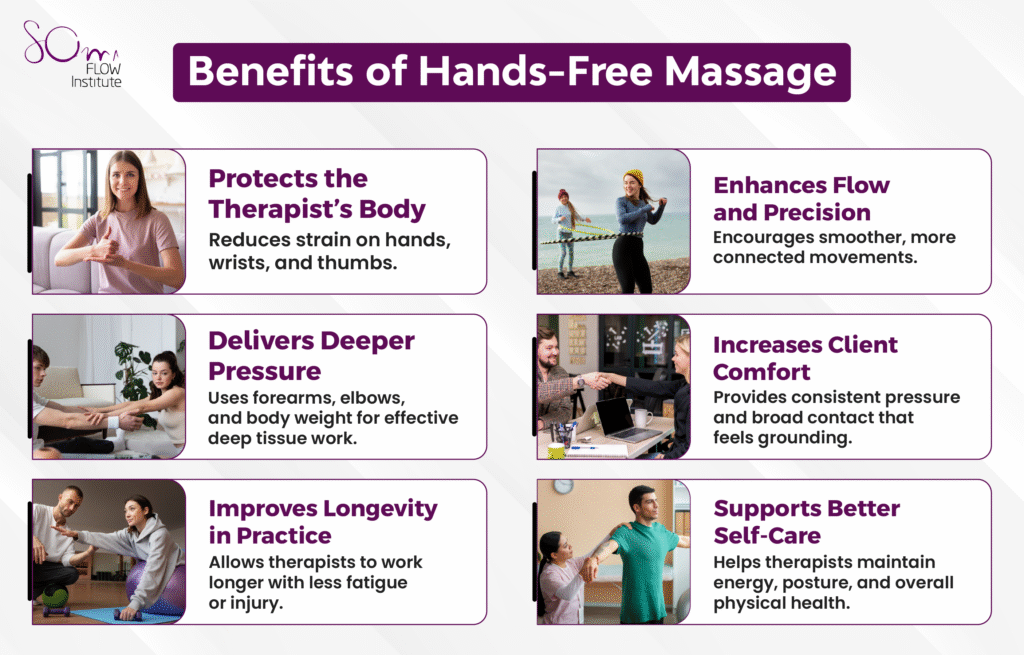
Benefits of Hands-Free Massage
Hands-free massage isn’t just for therapists; it’s better for clients in many ways:
1- Deeper Muscle Relief
Broad surfaces like forearms, elbows, and feet allow therapists to reach deeper muscle layers that fingers alone may not access.
This makes hands-free massage particularly effective for tight back muscles, shoulder knots, and stiff quadriceps.
2- Even, Comfortable Pressure
Unlike finger pressure, which can sometimes feel sharp or pokey, hands-free techniques distribute force smoothly and evenly across the muscle.
Clients experience firm and penetrating pressure without discomfort, which makes deep tissue work more enjoyable.
3- Versatile Techniques for Every Need
Hands-free massage allows therapists to blend different styles, including sports massage, deep tissue, Thai massage, Ashiatsu (barefoot massage), and tool-assisted techniques.
This versatility helps address specific muscle tension and individual client preferences, creating a truly personalized session.
4- Enhanced Relaxation and Comfort
Slow, broad strokes with forearms or gentle pressure from elbows feel soothing and wave-like, promoting full-body relaxation.
Even when delivering deep pressure, hands-free massage can calm the nervous system and reduce stress..
5 Step in a Hands-Free Massage Session
Let us tell you how a typical hands-free massage session might go. It uses forearms, elbows, feet, knees, and tools to give deep, effective relief.
1. Warm-Up with Forearms
The therapist rolls forearms over large muscles like the back, shoulders, and legs.
This gives even pressure, loosens tight muscles, and warms up tissues for deeper work.
2. Deep Pressure with Elbows
Elbows are used on knots and tight spots in the shoulders, neck, and upper back.
This lets the therapist apply strong but safe pressure without straining their hands.
3. Broad Coverage with Feet (Ashiatsu Massage)
Feet are used to massage large areas like the back and legs, supported by overhead bars.
This gives deep, smooth pressure that covers more area than hands alone.
4. Knees and Shins for Stretching
Knees and shins are used during Thai-style stretches to release tension and improve flexibility.
5. Tool-Assisted Finishing
Tools like foam rollers, massage sticks, Gua Sha, or hot stones are used to target small or hard-to-reach muscles.
This finishes the session by relieving remaining tension and leaving muscles relaxed.
Hands-Free Massage vs. No-Hand Massage
It’s important to differentiate:

- Hands-Free Massage: Uses elbows, forearms, feet, knees, or tools to massage muscles physically.
- No-Hand or Energy Work: Techniques like Reiki work without touching the body and focus on energy flow.
Hands-free massage physically releases muscle tension, while no-hand massage focuses on energetic balance.
Hands-Free Massage Safety: Tips for Therapists and Clients
Hands-free massage requires proper technique and training:
- Too much elbow pressure can bruise muscles.
- Incorrect foot balance can strain the ribs or the spine.
- Certified courses by SomaFlow Institute teach body mechanics, posture, and pressure control to prevent injuries for both therapist and client.
Who Should Try Hands-Free Massage?
- People with stubborn muscle tension
- Those who enjoy deep, effective massage
- Massage therapists looking to save their hands and work efficiently
Full-Body SomaFlow Course
An immersive introduction to embodied awareness, self-practice, and whole-body integration through the SomaFlow method.
Optimize Your Massage Practice
For therapists, hands-free massage is a game-changer:
- Reduces repetitive strain injuries
- Improves client satisfaction
- Expands your skillset and service menu
SomaFlow Institute in Las Vegas teaches hands-free techniques, including workshops and certifications for therapists. Learn to work smarter, not harder, while giving clients deeper, safer bodywork.
People Also Ask
How does hands-free massage differ from deep tissue massage?
Hands-free massage is a technique style that may include deep tissue methods, but it relies on body parts or tools instead of hands.
Is a hands-free massage relaxing?
Yes. Slow, broad pressure from forearms, feet, or elbows soothes muscles and promotes relaxation.
Can massage tools replace hands entirely?
Tools enhance massage and reduce hand strain, but skilled therapists combine tools and body parts for maximum effectiveness.
What is Ashiatsu massage?
A type of barefoot massage where therapists use feet for deep, even pressure, often guided by overhead support bars.
About the Author
Shoshi Hall
Shoshi Hall’s journey into healing began on the stage. As a professional dancer, she experienced both the beauty and the vulnerability of the human body. Years of rigorous training left her with persistent neck and lower back pain, discomfort that touched not only her body but her spirit as well.


